
|
|
|

Click here to ask Jackie a question! Jackie Clay answers questions for BHM Subscribers & Customers on any aspect of low-tech, self-reliant living.
Read the old Ask Jackie Online columns Read Ask Jackie print columns
|
Archive for the ‘Gardening’ Category
Jackie Clay
Monday, February 27th, 2012

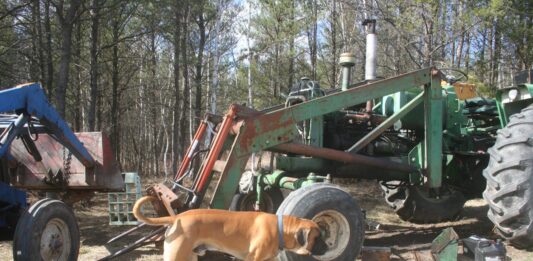
We listen to the weather radio every morning to check upcoming weather. We’d bought a used haybine at a farm 65 miles southwest of us, so now we can cut our own hay. We heard there was a major winter storm heading for us, so on Saturday, Will, David, and I drove down and picked it up before the snow hit. Saturday’s weather was a bit snowy, but mild, and the trip went uneventfully. We were a little nervous because the haybine takes up a whole lane, plus about four feet, so David, our driver, had to closely monitor mailboxes, signs, and oncoming traffic at all times. We all breathed a sigh of relief when we left the road and started down our driveway. Even our driveway presented a challenge, though, as the very wide haybine plowed about 18 inches of snowbank all the way to the house! I was worried that David would get “sucked” into the left-hand snowbank or a ditch. But he’s a good driver and is used to our driveway and we made it in. Now we have a baler, rake, and haybine, so we can do much more for ourselves. The farmer David works for in the summer is in his late eighties and sooner or later will have to slow down a bit and we want to ensure that our animals always have hay.

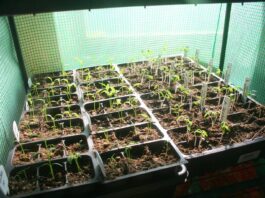
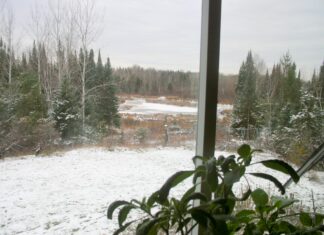
Sunday morning, the storm struck with heavy snow and 25 mile an hour winds. It was a good day to stay indoors. So I assembled the little (cheap) plastic greenhouse I’d bought to keep our monster kitten, Mittens, from playing in our newly-sprouted pepper plants. Seems to be working and the peppers look very nice. It’s odd to see tiny green sprouts when there’s a blizzard roaring outside!

Today, the storm’s over and Will’s out plowing our mile and a half long driveway, then the trail to the horse pasture, calves, and pigs, as well as the yard. It’s so nice to see the bright sunlight again. The weather’s sort of like life: you get some pretty scary, cloudy days, then if you wait the sun comes out and makes everything alright. — Jackie
Posted in Gardening, Self-sufficiency, Winter | 5 Comments »
Jackie Clay
Sunday, February 26th, 2012
Cooking turkey in a pressure cooker
I recently got a lot of frozen turkeys for Christmas and in our family we only care for the white meat. Rather than waste the dark I wanted to can it with carrots and celery as a soup starter. I wanted to cook the whole thawed turkey in a pressure cooker but I am not sure if it would work. Would it make the bones soft and crumbly, or would it work fine? I figured if it was pressure cooked it would take less time then the oven and the breast meat wouldn’t be dry. Any help would be appreciated in this turkey troubles.
Lisa Kukla
Kingsley, Michigan
To tell the truth, I’ve never cooked in a pressure cooker. What I do is to only partially roast the turkey. Then cool it and remove the meat. Boil the carcass to get your broth and pack the meat in jars and pour the boiling broth over the turkey. If you wish to add seasonings or vegetables, do it before pouring in the boiling broth. Your meat won’t end up dry and you’ll love your canned turkey. We, too, prefer the white meat, but I sure do use a whole lot of the dark meat in soups, turkey and dumplings, and casseroles! Good canning! — Jackie
Planting fruit trees
We are planning a move to my parents’ land. They have 5 acres with a large pond. The ground has a lot of clay. We want to plant fruit trees (peach, apple, orange, etc.). Only issue, where should we plant them? Near the pond or far from it? How far apart should the trees be planted from each other? What do you think about the ground? Should better soil be brought in?
Leigh Ann Mitchell
Cypress, Texas
Whether or not you plant your trees, or some of them near the pond depends on how wet the soil is in that area. Some ponds are located in low areas that are prone to wet ground. Fruit trees do not like “wet feet.” Smaller fruit trees, such as plum, peach, apricot, semi-dwarf apples, and pie cherry can be planted 15 feet apart in all directions. Larger maturing trees, such as standard apples need more room; 25 to 30 feet is about right. Be sure that apples do well in your new area. Most have chilling requirements in order to produce fruit, and if you can grow oranges, that would be something I’d check on. Ask the neighbors and the County Extension Agent.
As for the ground being heavy with clay, you can dig a much larger hole for each tree then amend the soil with well-rotted compost and black dirt to make the ground beneath your new trees more tree-friendly.
Backwoods Home Magazine will be running one of my articles you may want to watch for on growing a backyard orchard. I’m sure that will answer many of your questions. Congratulations on your new homestead! — Jackie
Posted in Food Preservation, Gardening, Meat, Self-sufficiency | 5 Comments »
Jackie Clay
Saturday, February 25th, 2012
Canning beans
Can I can beans not using any salt?
Ann Hazelett
Litchfield Park, Arizona
Definitely. The salt is only a flavor enhancer; it does nothing to preserve the vegetables or canned meats. — Jackie
Making peanut butter
Have you ever planted peanuts and made your own peanut butter?
Don Warner
Sarasota, Florida
No, I haven’t planted peanuts, our growing season simply won’t let us. But as a child, Mom and I grew some, back in zone 6 and we did make peanut butter. It was kind of crude, as we didn’t have blenders back then, but I remember it was very tasty and I sure cleaned up my part in short order! These days, with blenders, it’s so much easier. If you’re not growing them now, why not try a patch? You’ll love them. — Jackie
Posted in Food Preservation, Gardening, Self-sufficiency, Uncategorized | No Comments »
Jackie Clay
Wednesday, February 22nd, 2012

Here’s a summer photo of one of our mixed herb beds with broccoli and wild petunias for neighbors. We grow several types of basil, two of oregano, lemon mint, sage, tarragon, rosemary, chives, garlic chives, chervil , comfrey, and a few others. We also have many wild herbs such as pineapple weed, bergamont, mint, Balm of Gilead poplar (locally called “bammy”), nettles, dandelion, wild ginger, and many more.
This photo was prompted by this question from Peg in Georgia:
My husband and I have about 1/3 acre, but we manage to grow all our own vegetables and I can, freeze, or dry them. My question is, do you grow your own herbs? (I know you probably do) If so, do you make your own teas, poultices, etc? If you do, could you please write about some of it in your blog.
Thank you,
Peg, in Georgia
Yes, we do grow nearly all of our own herbs. I tuck herbs into a whole lot of spots around the yard, usually with flowers or other vegetables as “room mates.” I dehydrate my herbs, besides using them fresh. Of course we use them in just about every recipe I cook, and yes, I have made teas, ointments, etc. from them as well as from other wild-foraged plants. One of my favorite ointments is one my grandfather used. I melt half a cup of rendered lard and add half a cup of Balm of Gilead poplar buds when they swell and are sticky in the spring. I heat this mixture for about 30 minutes on low heat, being careful not to heat the lard too much because of scorching and fire danger. Don’t leave it alone! Then strain off the buds and debris through cheesecloth while the lard is still hot. Pour into small jars with wide mouths and seal. This ointment is very good for cuts, chapping, etc. both on people and animals. It works very well for cut and chapped teats on milk cows and goats. — Jackie
Posted in Food Preservation, Gardening, Self-sufficiency | 6 Comments »
Jackie Clay
Tuesday, February 14th, 2012

February weather in northern Minnesota can be huge swings between thawing and sunny, to blustery and sub zero. Tonight and tomorrow night, they’re calling for the latter, dipping down to twenty below. Brrrrrrr. But I’m still starting to plant peppers, a few containers at a time, so I can set out nice stocky plants in our hoop house in May. I’m growing some of our old standbys such as Giant Marconi — which I couldn’t buy seed for this year — and trying some new ones too. As always. I start my seeds in peat pellets in deep recycled plastic containers. I water them well and stick the whole works in a plastic bag to hold in the moisture, then they go up on the bookshelf next to our living room stove so they’re cozy and plenty warm (75-80 degrees). They germinate very quickly and come up extremely strong.

We have our teen-kitten, Mittens “the Monster,” so I’m going to have to protect the plants by putting them in our huge parrot cage. Unfortunately, our parrot was very old and passed on from a heart attack. If Mittens can get into that to destroy plants, I’ll be very surprised!
Getting my fingers into warm soil and smelling the moist earth makes me itch to get gardening….even if it is snowy and icy outdoors. And it makes winter pass so much faster too! — Jackie
Posted in Animals, Gardening, Self-sufficiency | 3 Comments »
Jackie Clay
Saturday, February 11th, 2012
Canning pinto beans
I received a new All American pressure canner for Christmas and want to do pinto beans in pints for my first batch; do I need to soak them first or can I just put them in the jar dry, fill up with boiling water, and then into the canner? Thanks and love your columns as always!
Natalie
Los Alamos, New Mexico
I like to boil them for 2 minutes in plenty of water, then cover and let stand for 2 hours. Then heat again, drain and pack jars 3/4 full of beans and fill with hot cooking liquid (you can also add bits of chopped ham or bacon if you want), leaving 1 inch of headspace. Process pints at 10 pounds pressure for 65 minutes or quarts for 75 minutes. If you live at an altitude above 1,000 feet, consult your canning book for directions on increasing your pressure to suit your altitude if necessary. Enjoy your new canner! You’ll love it! — Jackie
Planting asparagus
I purchased some asparagus for the first time. Can it be started in pots?
Wil Scarrow
Gold Hill, Oregon
If you bought seeds, you can surely start it in pots then transplant it outdoors when the weather is settled in the spring. If you buy roots, they are very long and octopus-like and would be hard to fit into a pot. Better to keep them in a cool dark place until you can dig in your garden. The roots are frost-proof, but the shoots will be killed by frosts or freezing weather. — Jackie
Posted in Food Preservation, Gardening, Self-sufficiency | No Comments »
Jackie Clay
Thursday, February 9th, 2012
Not only does a milk cow give us all of the dairy products we can imagine, she gives plenty of manure too! Some folks might not think that is a good thing, but we do. On a homestead, one can never have too much poop. But we’ve already spread the last big pile on the garden, so when Will needed to move this last pile this weekend when the weather was so nice, we decided to make another huge compost pile out of it. We need to fertilize and mulch the fruit trees in the orchard this spring, and I’m sure we can find plenty of other good uses for it. So Will spent a couple hours with the tractor moving the pile from the driveway around to a convenient spot next to the orchard/chicken yard gate. Now we have this huge pile, 9 feet high, tightly packed, and steaming nicely. You’d be surprised how quickly it turns to nice rotted compost — our black gold.

I’ve been busy writing and getting seeds sorted. This week I’ll be starting our first peppers and some petunias. They take forever to get large and we want to set out lusty, strong plants this spring. I’ve got three big totes full of seeds, but it seems like every year we order more to try so we can trial different varieties. Who knows when we’ll discover another “favorite”?

Yesterday, we went south to pick up a Bourbon Red tom turkey. We’ve been looking for a tom for our one hen for a long time. The farm we picked him up from was only 25 miles from our son, Bill’s, house, so we combined a visit with a poultry pickup. I got to play with my grandson, Mason, and hold my new granddaughter, Ava. What an enjoyable way to spend a day! To top it off, my son, David drove down and back, so Will got a break too. — Jackie
Posted in Gardening, Self-sufficiency | 5 Comments »
Jackie Clay
Wednesday, February 8th, 2012
Stringless pole beans
Every time I have grown pole green beans they have a lot of strings in the pod. I sure would like to have suggestions on a kind that is stringless.
Gail Erman
Palisade, Colorado
There are many stringless green pole beans. My favorite is Cherokee Trail of Tears (available through Baker Creek, among others). It starts out purple striped, but any purple goes away when you cook or can them. Other stringless varieties include Blue Lake Stringless, Fortex, and Kentucky Wonder. Be sure to give your pole beans plenty of water while they are filling out the pods and then pick them before the seeds get fat to have absolutely tender, stringless beans. — Jackie
Pressure cookers not made for canning
I have a 4-quart electric pressure cooker. I also have a large Mirro pressure canner to do large batch canning in. The electric pressure cooker has hi & low options. I wanted to use it for small batch canning. I did 4 pints kidney beans at low pressure for 75 mins & they sealed. Should I have used the hi pressure option instead? I just thought hi would turn the beans to mush.
Chris Stierwalt
Paragon, Indiana
Pressure cookers are really not made for canning. They are made for cooking meals. Better to use the canner for even small batches. If it’s too large to be handy, maybe you could pick up a smaller one, even a used one at a yard sale? — Jackie
Posted in Food Preservation, Gardening, Self-sufficiency | 3 Comments »
|
|
Have questions regarding this Blog? Please email us. Comments may appear online in "Feedback" or in the "Letters" section of Backwoods Home Magazine. We read every email you send us, but due to the sheer volume of mail we receive, we can't respond to each one.

|
|

|