
Backwoods Home Magazine


Remembering
Sept. 11, 2001

Subscribe to Backwoods Home Magazine

Features
   Home Page
   Current Issue
   Article Index
   Author Index
   Previous Issues
   Newsletter
   Letters
   Humor
   Free Stuff
   Feedback
   Recipes
   Tell-A-Friend
   Home Energy Info
   Ask Jackie Online
   Print Classifieds
   Trading Post

BHM Blogs
   Dave Duffy
   Massad Ayoob
   Ask Jackie Clay
   Bramblestitches
Retired Blogs
   David Lee

Quick Links
   Jackie Clay
   Ask Jeff Yago
   Dave Duffy
   Massad Ayoob
   John Silveira
   Claire Wolfe

Forum / Chat
   Forum/Chat Info
   Enter Forum
   Member Chat
   Lost Password

General Store
   Ordering Info
   Subscriptions
   Anthologies
   T-Shirts
   Books
   Back Issues
   Help Yourself
   All Specials
   Classified Ad
   Trading Post Ad

Advertising
   Web Site Ads
   Magazine Ads

More Features
   Links
   Country Moments
   Radio Show
   Meet The Staff
   Contact Us/
   Address Change
   Write For BHM
   Privacy Policy

News/Politics
   Dave Duffy
   John Silveira
   Columnists


Ask Jackie headline


Want to Comment on a blog post? Look for and click on the blue No Comments or # Comments at the end of each post. Please note that Jackie does not respond to questions posted as Comments. Click Below to ask Jackie a question.

Click here to ask Jackie a question!
Jackie Clay answers questions for BHM Subscribers & Customers
on any aspect of low-tech, self-reliant living.

Read the old Ask Jackie Online columns
Read Ask Jackie print columns


Get a FREE Jackie Clay CD Anthology

Archive for the ‘Meat’ Category

Jackie Clay

New chickens on the homestead get a new coop

Wednesday, October 29th, 2008

We had unexpected new chickens. My oldest son, Bill, called to say that his father-in-law had 12 heavy laying hens that he was given in the spring and he didn’t want to winter them. And because they laid so well and were such pets, he wondered if I would give them a home. I already have a dozen hens, but decided to take Don up on his offer. Our old chicken coop is only 6′x8′ and not big enough for 12 more hens. So we hurriedly built a “this and that” chicken coop out of material from the dump and leftovers from our house. It “ain’t pretty” but it’s weather tight and today I put in the final door. Of course I was working alone and the door fell on me once, nearly getting the saw in the process. And the new tom turkey escaped and I spent an hour running him back and forth before I could catch him and return him to the coop. But I got her done. Puff pant, pant.

Yesterday I built an outside door and a big nest box that David (thank God!) helped me hang. It’s built out of 2″x12″ lumber, so it’s HEAVY.

So our new hens are singing and scratching around in the shavings. Now I’ve just got to catch our “old” hens and put them in there too. But those I’ll catch at night, off the roosts. Much better than the turkey! Now if I can just learn all their names. The only one I know now is “Cher”!

Readers’ Questions:

Stressed out hen

I’m having a bit of a problem with my first flock of chickens. I have 5 (1 rooster, 4 hens) Plymouth Rock Barred bantams. I got them in April when they were two days old. Oh, and by the way, I live in Northern California. One of the hens recently won’t come out of the house. She hasn’t been laying any eggs for a week now and seems physically okay, but she barely eats or drinks at the moment and has a “tentative” cluck, like she is worried, or something. I picked her up and brought her out and she seemed okay, but then she went back into the house after a 1/2 hour with the other chickens. There was a traumatic event around the time this started happening where some animals (possum) got some eggs one night - do you think it could be stress? And if not, do you have any other ideas as to what she is stressed about? She seems spooked, for lack of a better word.

Samay Israel
Novato, California

You could sure be right about the stress thing. Provided that whatever got into the coop to eat the eggs can not get in again, she should recover in a few weeks. You can tempt her to eat by giving her “goodies” such as bread crusts, whole corn, sunflower seeds, etc. Hopefully, she’ll find that the varmits won’t “get” her and she’ll have a complete recovery. — Jackie

Wringer washing machine

Do you know a source to purchase (Or easily make) an old style roller/wringer washing machine?
I’ve done a Google search and found some really wacky home made ones that would just not be practical at all. I am already drying outdoors and would love to have a way to reduce energy and water use even more. But I am not ready to totally tub and board it.

Lauren Paul
Magnolia , Texas

I wouldn’t really advise making a wringer washer; it’s too labor intensive when there are a lot of old, useable machines out there. I got mine from the dump. The only thing wrong with it was someone had cut the plug off it! That was four years ago, and I’m washing clothes with it tonight. Put up a few notices around town, in your local free shopping paper and tell everyone you know you are wanting one. I’m sure you’ll pick one up much cheaper than if you bought it off of e-bay. You also might try your nearest craigs list, as you never know what you’ll find there! Wringer washers are very water saving, which is one reason I use one. They also get clothes much cleaner. In Montana, I washed outdoors all summer and enjoyed it very much. — Jackie

Making sweetened condensed milk and canning pastrami

Two questions: I know you can make Sweetened Condensed Milk that tastes like “Eagle Brand Milk” but can you also can it? I have had good results in canning fresh milk and was wondering about the other. Also, I have purchase about 10#s of beef pastrami which is currently in the freezer but want to know if this also can be canned? If possible, How? Thank you very much for all you have done.

Joni Warren
Canyon City, Oregon

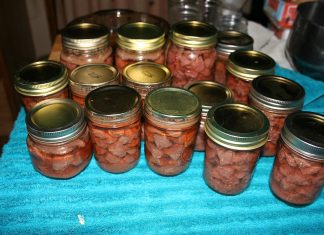
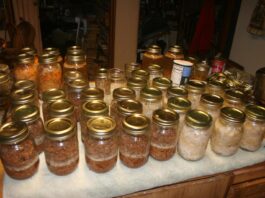
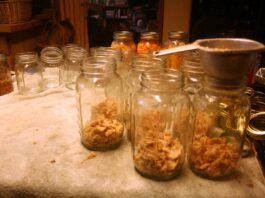
I’ve never canned homemade sweetened condensed milk. Yet. You can home can your pastrami. Just cut it into slices to suit you, pack them into wide mouth pint jars, with the top off. Then place the jars in a roasting pan full of water up to the shoulders of the jar and heat until a thermometer in a center jar, between the meat, reads 170 degrees. Then quickly put hot, previously simmered lids on the jars, tighten the rings down firmly tight and put them into a hot (not pressurized!) canner and process for 75 minutes. — Jackie

Heirloom pumpkins and sunflowers

First let me say that I recently received my copy of Starting Over and it is great. I’m usually not the type to re-read books but I can already tell that just like your magazine articles, I’ll be referring to the book often. (I’ve already tried the jerky recipe you give after telling about David’s first deer and even though I only got a couple small pieces I can say it was very tasty!)

I noticed that you said you had some of the Hopi Pale Gray seeds and would like to get just a few to start a seed crop for so I could grow some to harvest in a couple of years. I have started picking up small quantities of heirloom seeds so that I’m keeping costs down but will be growing my seed inventory so I can grow enough to harvest at the next season from the seeds I collect the first year. This is going to be a great test of my patience but I know it will be worth it.

A question I have is about heirloom pumpkins and sunflowers. I emailed Seed Dreams and received their seed list but I’m not familiar with the varieties and thought you may be able to suggest a pumpkin and sunflower variety that would be fun for my daughter to grow in her part of the garden.

Thank you for being a hero of mine.

Marlana Ward
Mountain City, Tennessee

Hero? Me? Wow, how humbling! While not exactly an heirloom variety, I’ll bet your daughter would LOVE Atlantic giant pumpkins! They’re huge! Just don’t grow them the same year you grow Hopi Pale Grey squash; they will cross. Or you might grow old-timey flat pumpkins. They are a C. pepo and won’t cross with your Hopi Pale Grey squash. I like Arikara and Hopi black dye sunflowers, although any sunflowers are great!!! Once you start saving your own seeds, you’ll be hooked. It is just so much fun. And look at all the money you’ll be saving, while preserving heritage at the same time. — Jackie

Cooking an old chicken

I have some older chickens and some younger ones. I want to thin the flock and take out some of the older less useful hens. What is the best way to cook an older hen. Some of the roosters that we have already eaten were very tough and almost inedible. I do not want to waste all of the meat that is tough. Is there a way to pressure cook the birds to make them tender?

Kathy Rayl
Concord, California

Yes, pressure cooking definitely tenderizes chickens. In fact, I can up all my tough old birds, including mixed bantam roosters that are older than sin. I skin them, cool down the carcass overnight, then quarter them and pop the meat into my stockpot to simmer until the meat is falling off the bone. I remove the pot from the stove and let it cool down to lukewarm and I can handle the meat without burning my hands. I debone the meat, then can up the broth and meat together in quart jars. This makes the BEST chicken and dumplings, chicken and noodles and other yummy chicken based meals. And no one knows they were old, tough birds! — Jackie

Kerosene heaters

With the economy and the election, I am somewhat fearful. I thought that you guys had some articles on emergency heaters (kerosene) in case the electricity goes out.

John E. Harper
Peninsula, Ohio

Where kerosene USED to be an economical fuel for heating, it sure isn’t anymore! Ouch! Boy has it gone up in price. Now I’d advise buying small propane heaters, instead. The Big Heater Buddy is UL approved for indoor use, and will keep you and your pipes from freezing. Or better yet, have a direct vent propane heater installed on a wall of your house. They aren’t “cheap” but will work without electricity and propane is MUCH cheaper than kerosene today. We have one in Mom’s room, along with my kitchen wood range and the new wood stove out in our new addition that I built mainly so we could add more wood heat in the house. I could see the writing on the wall. We have lots of wood! — Jackie

Buying corn to grind

Can you give me a good source to buy corn to grind for bread? We have a big deer problem this year no corn to grind. Also, where do you get your dehydrated cheese,butter, and eggs.

I just subscribed to Backwoods Home and really love it. I have been a real backwoods homesteader for over 20 years and love all the canning,preserving,and tips.

Eunice Harvey
Mouth of Wilson , Virginia

Do you have a Sam’s Club in the area? You can buy 50# sacks of popcorn there very reasonably. And popcorn grinds very nicely for cornbread! I just bought two sacks, myself to last until we can get up and growing dry corn, ourselves. You know…new garden thing! We’ve got the deer problem, too. But hunting season is right around the corner, so that’s a two edged sword! — Jackie

Homesteading in Alaska

I know from your articles that you did not recommend Alaska as a future homestead, but I don’t remember why. Could you enlighten me? We are desperate to get out of California and would appreciate any info you could pass along.

Kay Williams
Placerville, California

Alaska is a great place. But we decided against it for a couple of reasons. First, we like to be isolated from other people. In many parts of Alaska, most of the private land that is 4×4 accessible is right next to other private land, next to other private land, on a major highway. Even the fly-in only land is in remote State subdivisions, in most cases. And the price of accessible land is NOT cheap. Nor is it cheap to get to Alaska or live there. We would have done it if we could have found the right land at a price we could have afforded. — Jackie

Jackie Clay

My long awaited apple fell off the tree and the goats ate it!

Sunday, October 26th, 2008

Yep, that lone apple in our beautiful orchard disappeared. I checked it yesterday and it was fine. I even debated on picking it and eating it. It was ripe. But I decided to let it stay on the tree for a few more days. I’d been watching it and drooling over it all summer. First there were five apples, but one by one, the wind took ‘em down before they were ripe. Then there was just one beautiful Fireside apple hanging there, calling to me. Eat me…eat me…

Then this morning, I went out to feed the goats and I couldn’t see the apple on the tree. I was a little concerned, but figured I probably just missed it among the leaves. But when I fed the meat chickens, I went in the orchard and looked. IT WAS GONE! Desperately, I looked around on the ground. Even in the wire cage around the tree trunk. No apple. No deer tracks either.

Then I remembered the wind we’d had during the night. It had to have blown the apple off and it rolled down the slope…right up to the goat pen. And, of course, some goat spotted that luscious treat and had a great breakfast. I almost went around smelling goat breath to see who got it! I was that desperate. Sigh. Oh well…maybe next year. At least the trees know how to make apples now. See, you’re not the only one who has a disappointment in the gardening department!

Readers’ Questions:

Feeding goats, storing fuels

In the “Economic Squeeze” issue, you said your goats have hay available all day, what do you put it in and how do you keep them from wasting too much of the hay? What kind of grain do you supply for them? I didn’t want to give them the medicated feed because I intend on milking the does eventually. What kind of dewormer do you recommend?

Also if I’m not mistaken I read a little about fuel storage in one of your articles. How do you store gas and other fuels safely and correctly?

Lisa Barger
Nashville, Tennessee

I feed all my hay outside my stock panel fences, so the goats have to reach through to eat the hay; no poop, no waste. Of course, this only works with dehorned goats, which all of mine are. I feed my goats a 16% horse sweet feed. It has no medication whatsoever. We use our milk to drink, make cheeses, yogurt and ice cream from and don’t want antibiotic residues, either! I run fecal exams on my goats twice a year, spring and fall. We’ve been pretty lucky; I’ve only had to worm them a few times with fenbendazole and Ivermectin. I believe that the reason we have so few problems with worms is I check twice a year and both the feed and water are OUT of the pens, so there is no fecal contamination.

I store my gas in plastic 6 gallon jugs with a few ounces of Stabil added to keep it from getting “old”, which makes carburetors varnish up and get gunky. I’d like to have a farm-style gas barrel on legs, but so far, I haven’t been able to work it into the budget. I would like to have more fuel stored. Just in case. All fuel should be stored out of the sun and away from any source of spark or flame.
For instance, I don’t store my gas or kerosene in the generator shed or home. Because it’s in plastic it can just go outside, on the north side of our generator shed; it’s handy, yet safe out there. Underground storage tanks were popular prior to the Y2K, but they are expensive and that much fuel is hard to keep fresh, even with Stabil. — Jackie

Learning to use a pressure canner

I am a beginner in gardening. Although my grandma raised me on a farm I was not paying attention to the canning of the foods. I was regulated to shelling or snapping. I have a pressure canner here at the house but I am very very afraid to use it. I have never used a pressure cooker. How do I start learning how to use this thing? Or is blanching and freezing veggies enough?

Jonica Kelly
Randallstown, Maryland

Don’t be afraid of the pressure canner. They are VERY easy to learn to use, don’t explode and are the easiest way to put up food that lasts for years and years. I understand your fear, though, we’ve all heard the “stories” of canners blowing holes in the kitchen ceiling. Pressure canners have a safety valve that lets off steam, should the pressure get too high…usually from someone going out of the house or into another room and NOT watching what’s going on in the kitchen. You must monitor the canner all the time while you are using it. But you can be washing dishes, making dinner or whatever…as long as you are there to keep watch over it while you are canning. Do you have a friend or relative that could come over and can up a pint or two of food with you, showing you the ropes, so to speak. You could even can store bought produce, such as green beans…just to get the hang of it. Once you find out how easy it is, you’ll quickly gain confidence and be canning up a storm. And I’ll be right here to help you out. The best of luck! Go girl! — Jackie

Canning pepperoni and bologna

How do you can pepperoni and bologna? I was searching your archives for hours but haven’t found it. I have been a fan of yours for years and love the blog. As you said we never stop canning. There is something to can almost everyday. Even now that I’m in a mobility chair I have still found a way to keep on canning (with the hubby’s help) We work harder now that we have retired than we did when we were both working and raising 5 boys ! I love my Backwoods Home Magazine and look through them over and over!

Judith Mimranek
Live Oak, Florida

Pepperoni is real easy to can. I can the slices by just putting them in the half pint jars, with no liquid, and process the jars at 10 pounds pressure for 75 minutes. The bologna I can is homemade. I can that in pint jars. But because it is so dense a product, I put the open, bologna filled jars into a roasting pan with water up to the shoulders and heat it on the stove until a meat thermometer in the center of a piece of bologna, in a center jar, reaches 170 degrees. Then clean off jar rims and put on hot, previously simmered lids and process for 75 minutes at 10 pounds pressure in a pressure canner. — Jackie

Dehydrated butter

If anyone can answer this question, you can. Do you know of any recipes for making your own dehydrated butter or margarine? If not, can you recommend a good source? I’d also be interested in a good source of dehydrated eggs, since you don’t recommend making them yourself.

Jack Kavanaugh
Groton, Connecticut

Sorry Jack, I don’t. I buy mine from Emergency Essentials (BePrepared.com). They also have dehydrated eggs that are very good. I’m sure that other companies that carry emergency preparedness supplies would have these products too. — Jackie

Cold packing potatoes

Can I “cold pack” potatoes? The book that came with my pressure canner (1982) gives directions for it, but my Ball Blue book only gives directions for hot packing them. I’d like to have them stay more firm, even though I’m canning in quart jars.

Jamie Shelton
Monterey, Tennessee

It’s best to boil your potatoes before you pack them. With cubed potatoes, you can boil them for only 2 minutes; just enough to heat them thoroughly. For whole small potatoes or large pieces, you need to heat them more thoroughly, so that the centers get hot enough before they’re packed. In the past, people packed them cold and poured boiling water into the jar. This usually worked fine for the diced potatoes, but folks ran into trouble with the larger ones spoiling during storage. It’s best to boil ‘em. I “cheat” and can a lot of new potatoes with the skin on. The skin helps hold the potatoes together, keeping them from getting too soft. I do boil these, too. — Jackie

Storing Hopi Pale Grey squash

This year I planted seeds for Hopi Pale Grey Squash (I got them from Baker Creek) and I now have a dozen squash left, after we’ve eaten the two earliest to mature. I remember you said you kept yours on the floor in your kitchen. I can’t keep these in the kitchen, so I have to choose another spot. What is the best for them? Warm or cool, definitely dry air, or okay if a there is slightly moist air, or? The texture and taste of this squash is really good.

Joan Farmer
Pomona, California

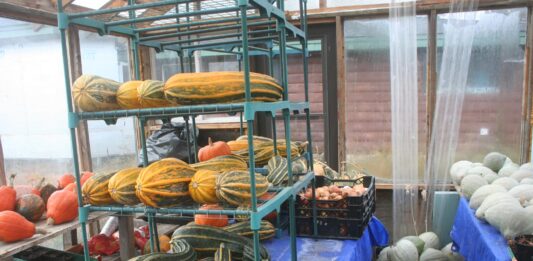
I’m happy you like Hopi Pale Greys! I think they’re the best all around squash, not to mention how long they store…up to 2 years!!! They will keep just about anywhere. Now I have them in my cool pantry, in plastic bins. But I’ve stored them in the kitchen, under the bed and in the clothes closet; they are not fussy! Enjoy. And be sure to save seeds! — Jackie

Making sauerkraut

I really enjoy your site here and your articles in the magazine. My question is about sauerkraut. I haven’t made it in a long time until now and I’m following the recipe in the Ball blue book. It states to ferment until the bubbling stops which should take 3-6 weeks and then process in a boiling water bath. I’m past week 2. Does 6 weeks seem like a long time for a vegetable to sit out at room temp? It smells like its getting closer to sauerkraut but still kind of “ripe”.There’s bubbles in the bowl when I stir it so I assume its still fermenting. Any hints?

Katherine Jordahl
Fergus Falls, Minnesota

Keeping sauerkraut in a crock for 6 weeks isn’t a problem, as it is fermented. As long as it is completely covered with brine and a weight to hold it submerged, it will stay fine. Do be sure you remove the scum daily, as if you don’t, it can taint the taste of the kraut. — Jackie

Best pressure canner

I’m wanting to get a new pressure canner. I used to have a Mirro and it was awful. I’d rather not pay tons of bucks if possible. Is a Presto better than Mirro? I guess the best I’ve seen is the All American–which I’d love–but just wish I could find it for less. What do you think of presto? Have you used one?

Mary Thompson
Charlotte, North Carolina

I have a newer Presto and have used a Mirro, as well, with good results. I’m sure that, like everything else, once in awhile, you get a lemon…in most any brand. My huge canner is like an All American, but was originally made for a hospital autoclave to sterilize dressings and instruments. Mine was bought new, in the box at a State Hospital auction for $50, and I’ve used it every year for over 30 years now! As I’ve often said, I prefer the dial gauge to a weighted gauge, in a canner, but really don’t have a “favorite” brand. I also prefer a gasket-less closure to the top, as it’s one less thing that you will need to replace in the future. — Jackie

Preserving Jerusalem Artichokes

Thanks Jackie for being such great inspiration to your readers! I have greatly expanded my food preservation efforts because of your encouragement. It’s always great to start the day with one of your new blog entries. I’m hoping you can answer a question about Jerusalem Artichokes. I planted them for the first time this year, and the harvest is huge! We enjoy the flavor and would like to do so this winter if we can save them. Can you suggest the best method for preserving them? The ones already dug are getting soft after just one week, so I’m assuming they won’t keep like potatoes.

Wendy Hause
Gregory, Michigan

Thanks for the kind words, Wendy. Jerusalem Artichokes don’t keep long after they are dug. But you can harvest them all winter long by stacking straw bales over your row or bed, then pulling them up to access the area to dig them. The straw keeps them from freezing in the ground and the chokes stay nice and crisp all winter long. Seeing you have already harvested yours, you can put some up as pickles. I’ll bet you never heard of that, right? Well they’re not too common, but are good. Here’s a recipe:

8 quarts Jerusalem artichokes
vinegar to cover them
2 cups salt
4 Tbsp. turmeric
1 gallon vinegar
2 Tbsp. turmeric
1 box mixed pickling spices, tied in a spice bag
6 cups sugar
dried red peppers, if desired
sliced onions.

Wash and cut artichokes. Pack in a large crock or enamel pot. Cover with vinegar. Add 2 cups salt and 4 Tbsp. turmeric. Soak for 24 hours.

The next day, make spiced vinegar by combining in a large saucepan, 1 gallon vinegar, 6 cups sugar, 2 Tbsp. turmeric and pickling spices in a spice bag bring mixture to a boil. Meanwhile, drain artichokes. Pack in pint jars, add sliced onions and a red pepper, if desired. Cover with boiling spiced vinegar to within 1/4 inch of the top of the jar. Process the jars for 10 minutes in a boiling water bath. — Jackie

Canning apple cider

I have been given a quantity of apple cider, and since I’m only one person, I’d like to save the bounty. Is it easy to can? Can I use a hot water bath, or does it have to be pressure-canned? Thank you for your wealth of knowledge and wonderful, positive attitude!

Susan Womersley
Petersburgh, New York

YES! You can certainly can your apple cider. Congratulations! And it’s easy, too. Just heat your cider in a large kettle to 190 degrees. Don’t boil. Just keep it at that temperature for 5 minutes. Then pour it into hot jars, leaving 1/4 inch head room. Process for 10 minutes in a boiling water bath. Enjoy! — Jackie

Using citric acid

Do you recommend using citric acid to increase acidity when canning low-acid foods? I have used it when canning roasted red peppers (with roasted garlic) in half-pint jelly jars. I use a pressure canner as well, but was wondering if processing times are different, and if you actually recommend it.

Also — do you still offer the Hopi Pale Grey seeds? You’ve piqued my curiosity on it!

Howard Tuckey
Lisle, New York

No, there is no need to add citric acid to low acid foods canned in a pressure canner. Just follow your canning manual directions, which don’t call for it, either. Citric acid is added to tomatoes and tomato products that are water bath canned to ensure that the tomatoes are high enough in acid to be safely processed in a water bath canner. Other options are vinegar and lemon juice. Or just use old fashioned, high acid tomatoes!

I’ve got plenty of Hopi Pale Grey seeds. If you’d like some, let me know. No cost, but keep them pure and share your seeds with someone else. — Jackie

Making applesauce

You have mentioned cooking down your applesauce in the oven. That sounds like a real time saver to me. Would you, please, share the recipe that you use; what spices and flavorings you put in ?

Borah McEnulty
Priest River, Idaho

I just put my puree or chopped apples in my large roasting pan, without sugar or spices, then cook at a low temperature until they are reduced and as thick as I want. THEN I add cinnamon and a dash of cloves, along with sugar to taste. Cook it just a little longer, stirring it well, then it’s ready for the hot jars and water bath canner. — Jackie


Have questions regarding this Blog? Just email us and we'll try to help. Comments may appear online in "Feedback" or in the "Letters" section of Backwoods Home Magazine. We read every email you send us, but due to the sheer volume of mail we receive, we can't always respond to each one.


www.backwoodshome.com designed and maintained by Oliver Del Signore
© Copyright 1998 - Present by Backwoods Home Magazine