

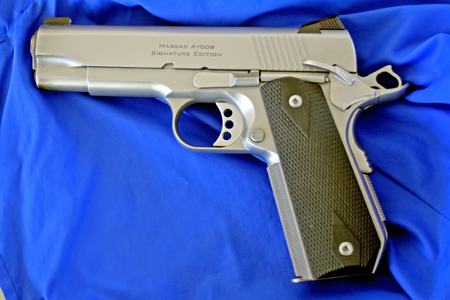

Being in sort of a “1911 season” I’ve been packing this timeless pistol design again. Got a couple of 1911-oriented pistol matches coming up in June, too. It’s reminded me of this article on handling tips that came out this month in Armory Life.
One tip not in the article was sort of a life lesson. In the 1970s, I was a young patrolman carrying a cocked and locked 1911 .45 auto on duty in uniform. My sergeant happened to glance at my sidearm. He did a double-take and then exclaimed, “Your gun is cocked!”
I patiently gave the standard explanation of John Moses Browning design and protocols for single action firearms in general.
When I finished he said, “It still scares me.”
Before I could stop myself I answered, “That’s OK, Sarge. It’s normal to be frightened of things you don’t understand.”
Life lesson: This turns out NOT to be the right thing for a subordinate to say to a superior officer…
Hilarious! You are correct, but Sarge should have taken it in stride. Learning is always a good thing. Humble pie is healthy.
That fear makes sense. Since 1836 seeing a cocked hammer on a revolver means a light touch to the trigger will produce a loud bang! So, it’s easy to think the same when seeing a cocked 1911.
All my life, when I saw white lights lit on the back of a car, I knew it was in “reverse” gear, and might soon back up. A few years ago I learned that some new cars have those white lights on even when in “park.” Exceptions to every rule.
I didn’t realize that. I better catch up, huh?
Cops who don’t understand firearms concern me. Any on patrol MUST be experts. I’m just an unwashed civilian and I went out of my way to train for defensive combat. Truly a strong case for armed civilians instead or unarmed targets.
This statement:
“That’s OK, Sarge. It’s normal to be frightened of things you don’t understand.”
could apply to nearly all of the anti-gun crowd!
Couple comments that might help someone interested: I was born in the ‘40s, been in the army, likely as many readers here. I’ve witnessed extremely close and personal what a pistol shot can do to the human body, as I expect a few readers likely have as well. Many years with the 1911, I see it as a much safer design than anything of the striker systems. (1) I use the press check with my grip hand thumb hooked over the hammer. (2) When holstering my grip hand thumb is under the thumb safety pressing upward. These things have always been routine for me almost without thinking…I say “almost”…if/when I catch myself distracted or for some other reason not thinking clearly, I put firearms up until I am clearly thinking, because I’ve had two close calls in my life when I wasn’t; it was never the pistol, only me. I trust the design of the 1911, and its redundant safety features, more than I trust my brain. When I teach others I have three rules that I emphasize: (1) safety, (2) safety, and (3) safety. The 1911 is intrinsically safe…at least as safe as the human mind. Therein lies the problem.
Oh so true. “Too soon old, too late smart” my dad used to say.
Pretty good description of the antis, who are everywhere. But the thing is, their everything is based on emotion and twisted ideologies. Therefore, most refuse to listen and evolve or learn. Sounds a lot like mens rea to me.
Oh that’s funny!! “Discretion is the better part of valor.” Lesson #1, Grasshopper.
Maybe I’m the odd man out but I really think handgun carried in public needs to be drop safe.
I’ve seen ADs in 1911 style pistols demonstrated with primer loaded only ammo when the gun was dropped. The free floating firing pin initiated the primer even without the hammer falling. Ex. https://www.youtube.com/watch?v=RMTe87kATmU
Most modern revolvers have addressed a similar problem decades ago so, with so many alternatives, why choose to carry a firearm with a known safety deficit?
Fortunately, 1911s such as the Colt Series 80 have passive firing pin safeties, and manufacturers such as Springfield Armory make them with light firing pins and/or heavy firing pin springs to render them drop-safe.
Great story, Mas. And amusing to think that someone as word-wise as you would reflexively utter an untactful truth to a superior officer…but then, such wisdom comes with experience, which takes time to acquire. Sometimes someone sets you up for a great quip that is just plain too hard to pass up!
I liked to remind my students that good judgement comes from experience; and our most instructive experiences often come from our bad judgements.
In defense of your Seargent, even though I knew and understood the 1911 safety system, I confess it still gave me a moment of pause the first dozen times I saw one carried cocked and locked. I rationalized my concern by telling myself that, absent an ambidextrous thumb safety, I couldn’t really be sure that the wearer had remembered to activate that safety. Indeed, I was horrified to learn later in life that some even advocated carrying a 1911 cocked but not locked—on the theory that they couldn’t be sure to disengage the thumb safety under stress! I still think that’s a very bad idea. But, I can’t really say that a cocked-but-not locked striker fired gun of the same trigger pull weight is really safer. It just conceals the “scary” part. Carrying the weapon concealed achieves the same effect.
I prefer constancy of operation plus the added protection upon reholstering that comes with a manual safety. So all the guns in my carry lineup, 1911 style or P365 versions, have ambi thumb safeties. Same drawstroke, same reholstering ritual. Individual choice in the risks we undertake is one of the great things about being an American.
I learned to shoot a pistol using my Gramps’ bring-back (WW I) 1911 .45 (no “A1” on that pistol). When we got “shall-issue” carry permits in my former home state of MN I had already been shooting a slightly-tweaked Springfield 1911A1 in timed-fire NRA bullseye matches, so I decided to carry one. I found a couple of close-out Springfield MicroCompact V10’s from CDNN for a very low price and bought two (one for me, one for my wife).
But the very idea of carrying one cocked-and-locked bothered me. I tried a bunch of different holsters but found that in all of them every great once in a while the manual safety (thumb safety) had been moved “off” by body motion and that all that was left were the grip safety and trigger movement.
I found Don Hume holsters and tried their H715M T.B. version for a compact 1911.
https://www.donhume.com/index.php?main_page=product_info&cPath=65_5&products_id=36
The “T.B.” includes a thumb-break retention strap which goes between the cocked hammer and the back of the slide. It not only provide incredible retention (I’ve fallen down while hiking and done a couple of rolls while wearing it with zero movement), but that thumb-break acts like a third safety in the event the hammer could somehow fall.
At the time I started carrying I was still working for MiddleSizeCorp, which banned any firearms within the company buildings. It was okay to have a firearm in your vehicle since when they initially banned that a lot of people pointed out that they would be going shooting or hunting after work, but they got rid of that. So I wanted to have a holster that allowed safe and quick removal and reattachment without removing the pistol; the IWB with spring-steel clip did that perfectly. The pistol, still in the holster, went into a locked steel box connected by cable to my vehicle’s interior.
Mr. Ayoob, I hope it’s okay that I included a link to their web site. I am not in ANY way connected to Don Hume Leather other than as a very satisfied customer, having bought these holsters in all three available sizes as well as some of their mag carriers.
“but found that in all of them every great once in a while the manual safety (thumb safety) had been moved “off” by body motion”
It’s fairly simple to put a leather wedge inside a holster that holds a 1911 thumb safety up. Most of mine will click the safety on even if, when testing, the gun is inserted with safety off. Too band holster manufacturers don’t include the feature.
Very good article and great.comments. After I was blessed to marry.my beautiful wife (now safe in Heaven for almost 20 years), my Dad would ask me how things were going. Inevitably I would share that my wife and I had a disagreement and I (as an engineer) had provided her the “correct” information. My Dad asked.me if that ” correct” information made things better, of course I had to tell Dad that my response did not help, but I was “RIGHT!”. As a newlywed he finally convinced me that some ” battles and being right” were less important than having some harmony at home. My lovely bride was able to train me so I could tell when I should just keep my mouth and my opinion closed! Communication coupled with experience and wisdom served me better than saying the first thing I thought, even if I “was right”!!!
I am thankful for Mr and Mrs Ayoob and all they have done to educate me and make me laugh and think about all of the great men and women that laid the foundation of safe firearms and great training
Just before I got married Dad gave me a bit of advice. “When your wife brings you a problem, use your ears, not your mouth. She needs you to listen, not solve it.”
May 31 was 58 years and counting. I’m sorry yours passed.
I knew Todd Green had the pistol-training.com site, didn’t know he had the other.
I must confess that I view the forward slide gripping areas as dangerous. I won’t buy a handgun with them, so obviously, I haven’t been buying any recently.
I carried a 1911 in a Safailand 55 duty holster with the muzzle forward rake. One night I learned that the pressure of the seat back against the butt could allow the safety to be moved to off. It was a simple matter to make it a practice-as I was getting out of the car-to slip my thumb in there and make sure the safety was ON. Probably why that design was discontinued later. Todays more close fitting/rigid holsters make that amount of movement much less likely.
I only had one citizen notice the cocked gun and comment upon it. Explaining the various safety features-including the safety strap between hammer & firing pin- seemed to satisfy him, there might have been some comment about the military empty chamber . I then asked if he was a hunter and he was. I then asked if he hunted with an empty chamber? There was consideration and a slow smile followed by “I take your point.”
In USAF training you may be taught that times obtain when it will be appropriate to ask a caller if they have a need to know certain information. Please make sure that you know at your duty station ASAP what kind of information needs what kind of clearance, and you may stay out of very hot water. From the voice of experience.
Comments are closed.