

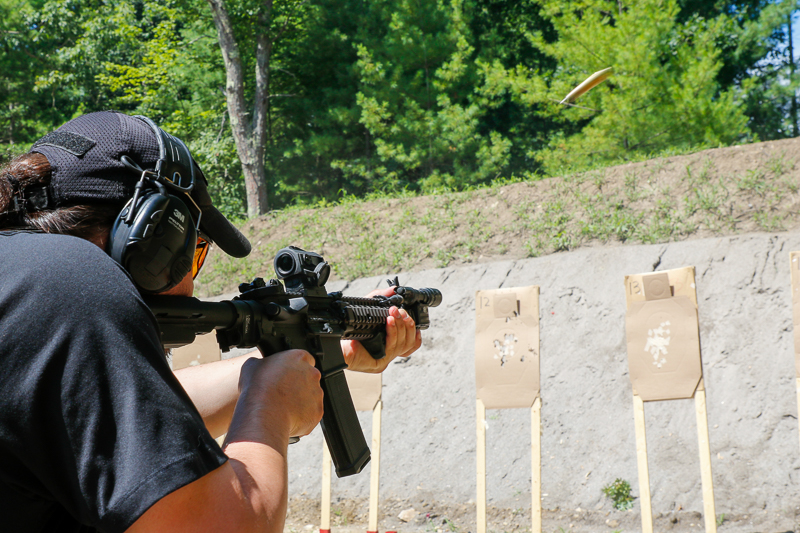

In the world of America’s most popular rifle, the AR15, one debate is whether to top the gun with an RDS (red dot sight) or an LPVO (low power variable optic). Each has its strengths and its weaknesses.
How to choose? Use common sense: tailor the tool to the task.
Is your AR strictly for home defense? The red dot sight wins. It’s functionally parallax free, meaning the dot comes to the eye quicker than the reticle of a telescopic sight.
Is it also going to be used for coyote hunting, or deer hunting with an appropriate load? Greater distance favors the telescopic sight: the LPVO dialed down to 1X or 1.5X magnification at home, but cranked up to 4X or so when long shots are anticipated.
The LPVO and its mount will be heavier, and more dependent on a repeatable cheeking of the stock, which may be more difficult with most collapsible stocks. On the other hand, it won’t be battery-dependent like the RDS.
The individual shooter’s eyesight must also be taken into consideration. When I had cataracts, electronic dot sights were out of the question for me. Where you might have seen the bright, clear, distinct dot my own eyes could detect only a sometimes misshapen red fuzzball. After cataract surgery – which gave me the best vision of my whole life – I could use RDS again.
When in doubt, do some research and analyze the arguments for and against each. A couple of hours on YouTube will expose you to many different elements of the RDS v. LPVO debate.
And speaking of research, let me ask you to comment here: what thoughts and experiences can YOU share with us?
How do you feel about 45-degree off-set mounts, so you can mount a RDS or iron sights along with a LPVO?
Basically, the LPVO goes in the “standard” place on top of the rifle, but the off-set mount means you tilt/cant the rifle ~45 degrees and now you’re looking down iron sights or a RDS. Since the axis of rotation should be centered on the barrel, zeroing the off-set sight(s) should be fundamentally the same as the primary one.
I’ve never used one, but it seems to me, the pros are having a back-up/alternate sighting system, and the cons are extra weight and bulk (especially if using a RDS; off-set iron sights wouldn’t seem to add much of either) and having to train to cant the rifle to “swap” sights quickly.
I’m curious if anyone here has tried these. Gimmick, or viable option?
Mas, I purchased a green dot for my pistol. Same thing as you, I saw a big fuzzy star. I thought it was the optic and contacted the company. They asked if I could have an astigmatism. I already knew I did from past eye exams. I took the sight, mounted to the slide, to my eye doctor, had my exam with it in mind and got a prescription for shooting glasses. Lo and behold, a perfect little Green dot.
I found that a RDS with magnifier is a good compromise. I have a Primary Arms ACSS reticle with a SIG 5X magnifier on my Colt AR and a PA ACSS reticle paired with a 3X Primary Arms magnifier with a QD mount on my Adams Arms piston AR with suppressor. If needed, I can clear the QD mounted magnifier quickly from the piston AR for in-home use.
I am patiently awaiting the time I can have cataract surgery to address the red dot issue you described. I might even ditch the red dot on pistols and go back to irons. With the ACSS’s inverted “V” reticle, I do not have the problem of the blurred or “comma” shaped red dot, but always have a clear, easy to read inverted “V” to sight on target, even when using 5X magnifier. The inverted “V” is also etched so if dot goes dead, I still have something available. Parallax error is minimal.
I’m no AR specialist, but I realized I wanted to cross utilize (optimize?) my AR’s. I decided quality flip up sights were a start, and a quick detach red dot on the factory pic rail would work well for both, and would be easily portable between the AR-15 and the AR-10. I have also mounted mid quality Leupold scopes with Burris QD mounts. I tend to keep the 2×7 on the 15 for turkey (fixed shoulders don’t like sgotguns) and a 3×9 on the 10. I can co-witness the red dot on both rifles with the opens. I was worried about repeatability of zero when re-attaching but they are surprisingly repeatable. Life is good so far.
In my experience battery powered sights or devices of any kind can acquire “Gremlins” when sitting for a while. Have to push the on button several times to get it to go on, comes on at much higher/lower setting than supposed to, battery dead, etc. Not what I want to figure out at 0 dark thirty while someone is kicking down my front door or a bear or (rabid) racoon is taking an unhealthy interest in the grand kids. I prefer etched reticles that work without power if needed or a light compact LVPO.
The world of “dot” optics have come a long way. The easy way to determine if that “blur” of the dot is your eyes or a faulty optic: use the camera function of your smartphone and look at the optic. A nice clean dot, you have astigmatism, a blur in the camera, faulty optic.
If you have astigmatism, all is not lost. Try either prescription shooting glasses, or a different color of dot, “green” or one of the new “gold” dots out there. The gold dots also help for those that might suffer from “color blindness”.
Blue dots can already be found on some LPVO scopes. I expect to see them on pistol optics soon.
One can also consider a prism sight, from a high-end ACOG to a more affordable Primary Arms model.
I’m a long time user of RDSs on serious firearms. First off, for serious use, iron sights are a MUST, the RDS is a supplement to the irons, but you may use them as your primary sight. The tower front sight and a cheek weld can be a more than sufficient sight alignment at close range. If the RDS has failed, you have your irons right there. If your gun came with a flat top receiver, Troy makes a quality metal rear sight that attaches with a screw. And holds it’s zero close enough that if removed & replaced, you’re unlikely to have to re-zero.
If you’re looking at a blurry dot, the intensity is may be too bright for the lighting conditions. However, that might also be a reflection of the quality of the product you bought, as are functional issues. Mr. Palmer’s post above is how to deal with eye issues. I’ve always bought Aimpoint-they originated the RDS-and my 40+ year old 3000 still works fine. I’ve also got a newer PRO.
I have, occasionally, wished for a LPVO, but I can’t find one with a long enough extended eye relief (due to the rear sight) that won’t be massively over size. A pistol scope is a possibility, but, going with Mas’s concept of tailoring the tool for the intended task, the RDS is my preference.
Oh, after my cataract surgery, I had to slightly refocus my scopes, but didn’t have to a thing to my RDS’s.
I prefer the LPVO because I like having magnification for better target acquisition at longer distances, since my eyesight isn’t as good as it used to be, but I also have a red dot for when I want something lighter in weight. The LPVO I like the most is a Bushnell R5 1-6 x 24 with an Illuminated DD2-QA Reticle on a Burris AR-P.E.P.R. Quick Detachable Mount. On 1X, I can turn on the illumination & use it as a red dot, or zoom in up to 6X with or without illumination for longer distances. My red dot is a Sig Sauer Romeo 4 which comes with a quick detachable mount, so I can switch back & forth between the LPVO & the Red Dot quickly & easily as needed.
I also have a Crimson Trace Rail Master Laser, mounted (upside down) on the front of my upper rail, which I really prefer to the LPVO & the red dot for close range because I don’t have to shoulder my firearm at eye level to use it. That allows me to get a wider view of everything going on around me & it allows me to track my target(s) quicker & easier just by putting the red laser dot on the actual target & pulling the trigger. The laser dot is almost always visible indoors, as well as in the shade, shadows, or in low light—pretty much anywhere except outdoors in bright direct sunlight. The other nice thing about the laser dot is that it’s easily visible to me without my glasses on (although larger & fuzzier), so it could be a solution for those with astigmatism (like me) when aiming at an attacker or a full size silhouette target. It’s something to keep in mind, especially since the Rail Master is much less expensive, as well as much smaller & lighter than either a red dot or an LPVO.
I used a RDS in competition twice… until I encountered a metal silhouette target in the shade of a tree at 100 yards, while the rest of the range was in bright sun. I could not see it through the RDS. Barely, naked-eye. LPVO and never looked back. But… make it a GOOD LPVO. They aren’t really getting better. There seems to be a “magnification race” with them. The more magnification at the high end, the finickier they are about eye box, even at low magnification, which defeats the whole purpose of having a 1X in the first place. You want one with a good 1X eye box. 12X is kinda pointless on an AR if it’s not a precision target gun. 4X will get you hits at 600 yards, and that’s the effective range of the ammo. But 1-4X scopes are hard to find… if anyone still makes them. I’m keeping mine. That’s my experience, anyway.
I wanted a rifle to do everything I’m capable of with 5.56mm, so I decided on a 1-6x LPVO. It’s heavy. But I’ve run that rifle through shoot-houses and I’ve run it at 500 yards. I’m happy with my choice.
On my 9mm PCC, I chose a red dot.
I have and appreciate both types of sights and strongly second Mas’ identification of one particular strength of the LPVO over an RDS: it runs without batteries. At a rifle night match last year at our local club, the stage designer announced a surprise “universal battery failure”, running the stage in low light without powered optics or lasers (flashlight/weaponlight allowed). By luck, I was testing my new LPVO while all the others were running red dots. As a result I outscored several better shooters who usually outperform me.
Forced to choose, I’d take my LPVO-equipped rifle if the range might exceed 100 yards or where target identification beyond 50 yards was an issue.
But frankly, if I anticipated that degree of social conflict, my first choice would be avoidance. That’s why I spend 95% of my practice with pistols: it’s what I’ll have on me if trouble unexpectedly raises its ugly head. And while long defensive pistol shots are rare, I still find it comforting to hit a steel 18” x 12” target first shot at 100 yards with my carry pistol whenever I get the chance to do so.
Since light gathering capability was just mentioned…..my last instructor school was a patrol rifle class and one guy had a pilot German LPVO (can’t recall brand right now, think 1-8 power range) for trials. The light gathering capability at night was phenomenal, but the scope was a bit bulky. In retirement, while considering an optic for my carbine I recalled this and started looking. I found the then in production item and it could have been mine for a measly $2800.
I passed.
I took an astronomy class in college and the light-gathering ability of telescopes was discussed in depth. Basically, the human eye’s average pupil diameter is about 6mm, with a light-gathering area of 9*pi square mm (6mm diameter means 3mm radius, and area of a circle is pi times radius squared), so a telescope’s objective (front) lens or primary mirror must be significantly larger to gather more light for clear magnified images.
For an optic (be it a telescope or a rifle scope) to have the SAME light-gathering ability as the naked eye — assuming perfectly clear glass, which though they get pretty close, doesn’t actually happen — the magnification must be proportional to the square of the objective lens diameter; a 4x magnification should have an objective lens at least 4x the area of a human eye’s pupil, a 9x magnification should be have at least 9x the area. (Or, if it’s simpler, the square root of the magnification factor should be proportional to the diameter of the lens — 4x magnification should be at least double the lens diameter, 9x should be at least triple, 16x should be quadruple, 3x should be ~1.7 times the diameter, etc.) More than that means it’s gathering more light than your naked eye for a given magnification, the further above that proportion, the better (in theory) it should work in low light.
In astronomy, the ideal is to have a HUGE objective lens or primary mirror to gather as much light as possible, in order to see very dim celestial objects that the human eye simply can’t pick up. But the “light-gathering” concept is equally applicable to rifle scopes in low-light conditions. It just gets balanced against a practical size/weight limit (read: what will fit on top of a rifle and not weigh a ton) and how much magnification is actually necessary based on the effective range; we don’t need crisp detail at 3000 meters if the rifle can’t shoot that far.
Comments are closed.