

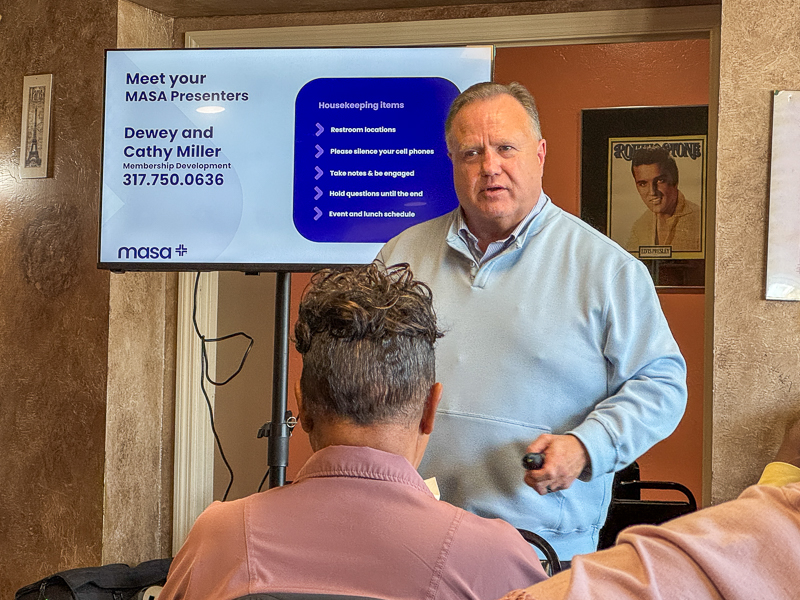

Those of us whose age makes us more likely to break a hip or have a heart attack need to think about ambulance runs. Even if you have medical insurance there may be a deductible. I recently took a lecture from Dewey Miller of MASA (seen in photo above), the member-supported Medical Air Services Association. He pointed out that the average ground ambulance ride bills at around $1700, and taking the ride by helicopter runs more like $50,000.
I know of a case near me where a patient was med-evaced by helicopter to a hospital eighty miles distant, with a bill in the $30K range. Jack Dixon mentioned that MASA paid for his whole $37,000 ground ambulance run during a storm too bad for helicopters to fly.
Those are particularly hard hits for those who don’t have medical insurance at all. I noticed at the seminar that the youngest attendees were in their sixties. Apparently the young think they’re immune. Having taken my first ambulance run as a patient at sixteen and my second at twenty-five, both from totaled automobiles, I don’t think the meat wagons are just for the elderly.
On a related note, one of my pet peeves is self-defense instructors who tell their students, “If you have to shoot someone in self-defense, fake a heart attack and ask for an ambulance so the detectives can’t interrogate you.” Quite apart from establishing that you’re a liar (because emergency room records will show there was nothing really wrong with you) as you enter a legal situation in which your credibility is going to be vital, even if you do have medical insurance it probably won’t pay for an ambulance ride which lacked medical necessity. You will also have tied up limited emergency medical services that might have been needed for a genuinely stricken patient elsewhere in the community…kind of hard to reconcile with being the proverbial “good guy or gal with a gun.”
All to delay being questioned by police…when all you had to do to accomplish that was to say, for free, “I will cooperate with you as soon as I’ve spoken with legal counsel, but for now I’m invoking my right to remain silent as to any further questions.” For more information on MASA check out their website.
Considering where I live, gonna check that out. 3.5 miles from the EMS station, lot farther to hospitals.
Something to bear in mind, if the cause of the EMS call involves violence, they’ll be near, but not at the scene until LLEA declares it clear/safe. In any event, some home supplies beyond band-aids is a very good idea.
I work in heath insurance. When these bills come up, I try to explain it like this. That helicopter ride cost nearly $300,000 as billed. you are being billed a percentage of that cost, which might be $30,000. Yes, that is a significant amount of money. However, if you are transported by helicopter, it usually means that it was the best option to save your life.
Think of it this way, your insurance company just sold you a $300,000 life saving product for $30,000. That’s a good deal.
I am sitting here with the EOB for some minor surgery I had last fall-took about an hour but did involve anesthesia. Various providers billed $121,000. Insurance paid $6000, I paid $200 and the providers took the money and ran. I have seen this repeatedly as have others. Lessons are: 1. Never pay anything until you get the EOB; 2. If there is anything you weren’t expecting, appeal it; 3. If appeal doesn’t work, go outside the process to government, plan sponsor or provider; 4. If all else fails, cut a deal. In my case there is a lot of room between $121k and $6k that would have been negotiable. Why the providers charge so much when they know there is no chance of getting paid, is a mystery. Perhaps it is to show tax loss.
I suspect that they charge what they charge because in some cases the patient has the means and may actually pay it. However, I would think that any patient that has the means would also have the savvy to play “Let’s make a Deal”. My daughter’s mother (my ex)ended up in the hospital about 18 months back. My daughter had inadvertently canceled her insurance to get her on medicaid eligibility – long story. I believe the hospital bill was around 150K and my daughter was sick with worry about what she had done. I told her that hospitals cannot get “blood out of a turnip”. Same with the IRS. Its time for “Let’s Make a Deal!”. It turned out that her mother’s insurance was still intact and her mother was only billed around $800.
Despite one’s alternatives, I am 76 and will look into MASA to see if their coverage cost is reasonable.
yes to show tax “loss”, but I believe also to try and get as much as possible out o the ones who can/do pay, to make up the loss on those who cannot.
I nkow three people now who, in he past coiuple years, have had emergency medivac ides, all three were almos dead by the time they got into those choppers. No way any one o them had a small percentage o what the billed cost probably was… Two have well recovered, the third is surviving and will eventually be OK, but sill “on the ropes”. He too nearly died.
How those choppers ge paid I do not know, but coincerning those three I am cerainly glad thos birds were available and used without regard to how the bills would get paid.
All this is timely. I already pay a fee for possible helicopter evacuation. Time to look into corollaries and alternatives. I, too, do not live far from Sun City. One thing to remember about helicopter landing zones, an open area about 90 feet or more across can be necessary.
Something extraneous: I am watching a film called “The Hunting Party.” Reminds me of a fairly remote surprise desert encounter I had with a man and a woman where the woman may have been willingly used as a stalking horse to accompany a man who employed a blatant furtive move to intimidate me that made be wonder if I should not myself deploy and engage, although I did not. You want to always choose your companions carefully, and you probably do not want to ambulate remotely alone.
If you require ground or air transportation to a hospital while you are exercising your right to carry concealed, what do you do with the gun?
In my experience, hospital security puts in in a locker until the patient is discharged.
That’s good to know since I always carry and may get a ride.
I carry a laminated card with the following on it:
Massad Ayoob’s Five Point Checklist
1. Tell responding officers “I’m the victim; he is the perpetrator.”
2. Tell responding officers, “I will sign a complaint.”
3. Point out pertinent evidence.
4. Point out any witnesses who saw what happened.
5. If there is any hint that you are a suspect, say “Officer, you will have my full cooperation after I have counsel here.
Also:
6. Point out any suspects
7. Document your injuries (however minor)
If you feel you must speak, say something like:
“Officer, this man attacked me and I had to shoot him.
I would like to file charges against him.”
After you do that, SHUT UP!
The officer will continue asking questions. That’s his job.
You don’t have to answer. Not incriminating yourself is your job.
Thanks for the great advice.
For a time I had Medicare Advantage.
I can no longer afford it so I’m back to plain ol’ Medicare.
The Advantage plan I had would cover your ambulance ride 100% if the hospital kept you over night.
It is good to know the details of your plan.
What should those of us who are not completely heart healthy do under those circumstances? I have afib, caused by high blood pressure for which I take several prescription medications. I think I read somewhere – maybe In The Gravest Extreme? – that the adrenalin dump will cause even normal blood pressure to spike into dangerously high levels. I’m thinking that I should request monitoring by the emts and let them make the call? Assuming they’re on scene.
Interestingly enough, I only discovered I have afib when I attended LFI1 back in the day, and for some reason Mas had us take our own pulse. It was the first time I’d ever done that.
Live a mile from ER. In ‘013 I took the ride. No lights or siren, just a 3rd degree then announcement to ER staff what I had said. Billed $800 out of pocket.
Shall drive if possible and let valet park my car.
George
Your? It goes to security, meaning your knife, gun, and anything metallic as soon as you hit the ambulance, or the hospital door, even a single cartridge.
Many items of medical service are overpriced because of 50 years of Medicare/Medicaid’s legally required “best price” rule. No provider (doctor, hospital, surgery center, home health, etc… is allowed to charge the government more than the lowest price they offer anyone privately). Medicare fines for “undercharging” others can cost a hospital millions of dollars. Consequently, “charges” are generally far above what the hospitals expect to collect. But, the law addresses charges, not collections! Risk-bearing payment formulas also exempt providers from the limitations of the “best price” law.
Health systems are paid via complex mechanisms that are not accurately reflected in the EOB (explanation of benefits). An EOB for $121,000 that is paid off in full by $6000 from the insurer and a $1500 (or less) deductible from the patient is not unusual.
Some younger patients bank on good health to save thousands of dollars per year by “foregoing”health insurance—a strategy that works quite well until it doesn’t, such as being in a major accident. Often such individuals have spent the money they saved by not purchasing insurance and then cannot afford the medical bills. I say this without judgment as some folks truly cannot afford health insurance. That said, I know of a number of 20-50 year olds who could have paid for insurance but who prioritized their spending elsewhere. Some regretted that decision after they experienced catastrophic medical situations.
If you find yourself with a large uncovered medical bill, ask the provider for a discount. Many hospitals will allow an uninsured patient to pay the Medicare rate, if the patient will jump through a few hoops to make the request and can demonstrate financial need. Some Not-For-Profit hospitals have care funds set up by community donors that might even cover the whole bill.
The key point is DO NOT have a heart attack over a ginormous EOB—most of it is accounting fiction mandated by archaic Medicare billing rules. It will usually get reduced dramatically. If not, you can negotiate. Even weak insurance plans will at least get the bill reduced to a more realistic cost.
And if you’re having a stroke or heart attack, or a major bleed, or severe abdominal pain, take the ambulance. For “mere” small broken bones or lacerations without significant bleeding, it’s OK to have someone drive you to the ER. Don’t try to drive yourself to the ER. Crashing your car due to pain or fainting is far more expensive than the ambulance, and it will worsen your medical situation.
Don’t forget to read the line items. My 75-year-old Mom was in an ER…she encouraged Dad to go home & get some rest. Possibly someone thought she was not capable of remembering what happened, & many things were added to her bill that never happened. The big mistake was the line item for a pregnancy test — which, while laughable, made it simple to contest the other erroneous charges.
Yes, mu uncle had a line item for a mammogram on his bill.
Good information Mas. I spent 38 years as a Registered Nurse and EMT-P (paramedic). In West Virginia it was not unusual to discover a handgun on a patient while doing an initial physical assessment prior to transport. If the Pt. was alert and oriented and at home we would pat the weapon and ask “How ’bout we leave this here so we don’t upset the hospital folks?” If in the field, bundled with personal possessions (unloaded usually) for return to the patient. This applied to ground or air evacuation. We are not the police and you should always be honest with the personel that respond about anything on your person. They really don’t care what you have, they’er there to treat you and are reluctant to do anything that might make people hesitate to call for help in the future. In the field, the decision to air transport is based on a series of protocols and the weather. The decision is made by the responder with the highest level of certification. Sometimes it’s actually faster to go with the ambulance you have than to wait for a helicopter to arrive. Everyone stay safe. Cars kill a lot more people than guns ever have!