


You’ve heard me yell before about people who abuse their guns – slamming slides closed on empty chambers or worse, on hand-chambered rounds, or whipping cylinders in and out of revolvers. Here’s another useful bit of advice on this topic from a respected gun expert.
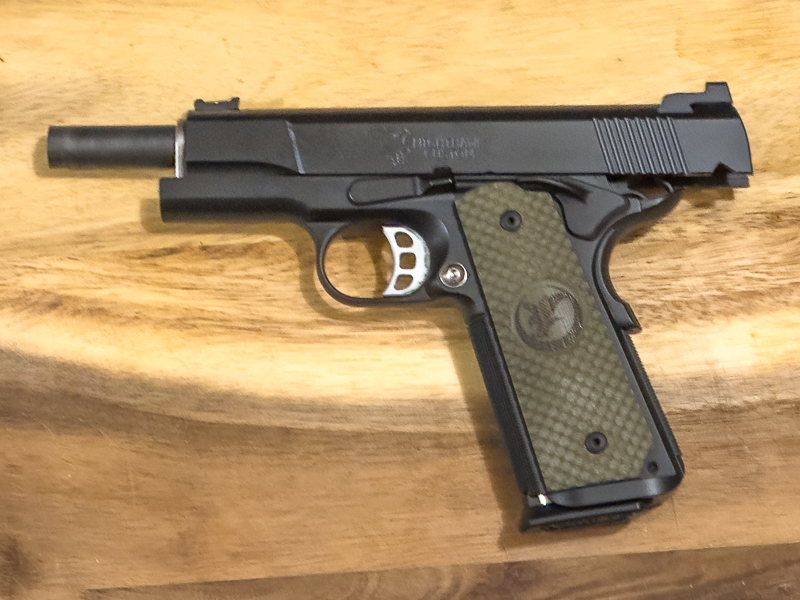
During guard mount in the mid ‘70’s, United States Army, we slammed the slides on empty chambers every time we were inspected, and pointed the 1911A1 straight up and pulled the trigger to prove clear. I personally did it, as did every other person standing guard. This occurred each and every day for years. I cannot say whether it had any effect, but my pistol was at least 11 years older than I was at the time. I can, however, verify that all weapons rattled like nobody’s business.
I know a now-retired USAF officer who had a Government Model .45 ACP go out of control somehow at a target range and wound him in one hand. He went out of his way to caution me about old, worn out pistols like that.
My thoughts exactly. Why abuse a fine and expensive piece of machinery if you don’t have to.
This is good advice which I do follow, ever since I heard it from Mas for the first time a few years ago. I am low-tech. I can be trained to operate machines, but I can’t fix them. So, I treat every machine very well. I do that because I don’t want it to break down on me. When a machine breaks down, I am helpless, and I don’t like feeling helpless. So, every machine gets tender, loving care from me, especially cars.
Hollywood has probably caused more violence to guns than ignorance- that’s a lot!
It’s a pretty safe bet: If they do it in the movies, don’t do it at home or on the range.
One of my “favorites” was a very popular cop show where every time the agents returned to their office they took off their guns and put them in their unlocked desk drawer. Even if they were wandering around the facility, including downstairs and in secure rooms, they left their gun in their desk. Of course, every time they got called out they had to stop, get their weapon out of the drawer, and stick it back on their belt.
First, that’s a safety violation. The gun isn’t secure.
Second, trouble doesn’t RSVP. You don’t want to end up a couple of rooms away from your desk if you need to defend yourself.
Three, you get an emergency call and get to the scene with your pistol still sitting in your desk.
Since becoming familiar with the operation of the 1911, I am surprised at the number of movies where the 1911 is featured that it carried with the hammer down, the operator cocks the hammer back when getting ready to fire it, e.g., prior to room entry, or trying to influence someone to “talk” or “cooperate”. Nick Nolte and Eddie Murphy in “48 Hours” comes to mind. It means that the 1911 was carried with the hammer down on a loaded chamber. My understanding is that this is the absolute worst way to carry a 1911. It makes for a dramatic movie shot, though!
Four, the VAST majority of “mishaps” (a.k.a. negligent discharges) happen during “administrative handling” of firearms — e.g. holstering/unholstering, strapping/unstrapping, loading/unloading, etc. — when the user isn’t giving proper attention to what they’re doing.
Limit those unnecessary activities, and you limit NDs.
@Richard James Boll II: Ah, yes, the old Dramatic Gun Cock trope.
Variants include pulling back the hammer of a revolver (which if it’s single-action, should have already been back) or racking the slide of a semi-auto handgun or pump shotgun that should have already had a round chambered … with no wasted round flying out.
Only yesterday I took a relatively gun-inexperienced nephew to the range and watched him drop the slide on an empty chamber. It prompted a useful moment to educate him on handgun etiquette on this same topic. He learned how in Mas’ classes, such a transgression elicits a “meow!” from other students and instructors–on the theory that slamming the slide on an empty chamber is akin to kicking a kitty. That nephew is smart, considerate and talented. He absorbed the lesson earnestly and proceeded to shoot the center out of the target, never repeating the transgression for the rest of the session.
Tom points out one of a number of habits practiced in the Army over the years that are sub-optimal, stemming more from someone’s idea of what best reflected military discipline coupled with parade-ground flair. In the same general era, the FBI also taught point-shooting one-handed from the hip with the pistol while in a semi-crouched position.
Pointing the gun straight up and pulling the trigger to demonstrate an empty chamber is a fundamentally short-sighted procedure. If the chamber were not empty and a round fired (the exact condition supposedly being guarded against), it will go straight up and come straight down. I just hope everyone on the range was wearing helmets when this “safety” step was being performed.
More charitably, the empty chamber was being confirmed by inspection and the pulling of the trigger was merely to return the hammer to its resting position in a now-empty gun.
The “traditionalists” at one of the action shooting disciplines at a local range insist on individuals “proving safe” by aiming their supposedly empty pistols into the trunks of their own cars and dropping the hammer, on the theory individuals will be more careful to confirm an empty chamber before holstering their empty guns when “gunning up” before a match. This is despite the presence of a USPSA “safe” area with berm located between the parking lot and action shooting bays. This practice survives on the basis of historical pride in being different for that group of action shooters. They are meticulously safe in all other regards. And, the one guy who failed his own chamber check a number of years ago managed to miss his gas tank, suffering only cosmetic damage to his own car. His lasting ignominy serves usefully as a cautionary tale told to all newcomers to that group of shooters. My solution to this requirement to be able to participate in this group is to put a bullet resistant panel in the back of my SUV to serve as aiming point when preparing my gun for the match.
I also highly recommend traveling with a bullet resistant panel in luggage or a backpack to use when loading or unloading a gun in hotel rooms. That simple precaution can save a person from a boat-load of legal and civil liability in case of an unintended discharge.
Its just scary how many people DONT KNOW that its not ok to “Bogart” a revolver cylinder. Ive seen gun counter employees do it to brand new revolvers when they showed a gun to a customer. Yep, I dont believe I want to buy a sixgun from that place!
Ive contributed to one of those poor little kittens with that heartbreaking meow… I have since been reformed.
A minor point on letting the slide slam on a chambered round. The 1911 extractor has an angled front face and the whole item is a spring. So, the extractor will snap over the case head of a chambered round. However, the edge of the extractor hook takes a beating from this and can chip, resulting in failures to extract. I think it’s obvious how I know this, but I discovered it in matches, not when my life depended upon it. Don’t do it.
The design of most other pistol extractors is different and intended only for the round to slide up the breech face under the extractor. Yes, they will snap over the rim of a chambered round, but the stress is much greater as is the chance of extractor breakage. REALLY don’t do it. This is often in the owners manual, but we all know how many treat those.
Finally, with all due respect for the author, the usual cause of bullet set back is too many trips through the feed cycle into the chamber. Once upon a time, semi-auto pistol ammo had cannelures on the case at the base of the bullet to help avoid bullet setback. That’s largely been gone for decades. A combination of improved manufacturing tolerances and a need to reduce costs. While some handgun designs have better feed mechanics than others, the basic idea is you should minimize the number of times you chamber a round. If you can see a difference in overall length compared to an unchambered round, that short round needs to be set aside.