

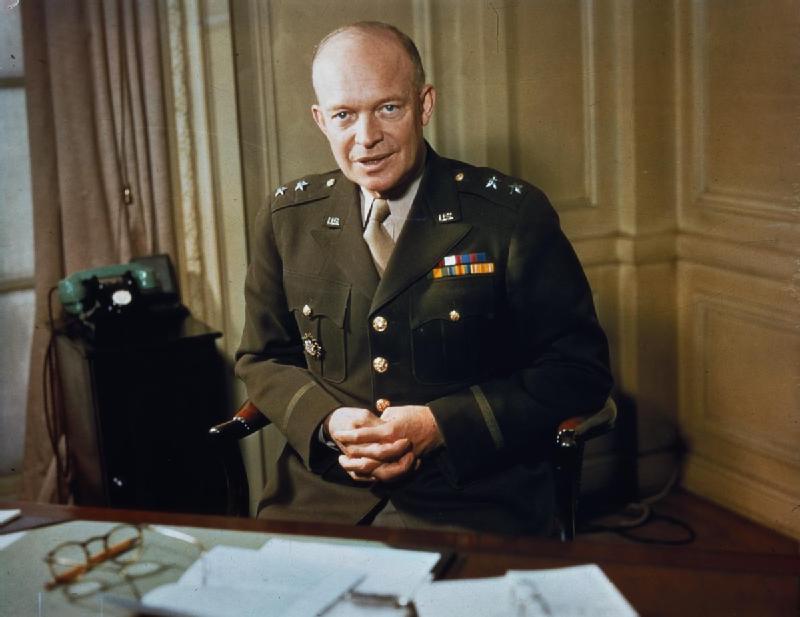

I tell my students that if anyone tells them only bad people carry guns, they might wish to respond with the fact that a number of universally respected US Presidents among others have been known to pack iron. One of them was Dwight Eisenhower. Though his most famous personal hobby was playing golf, another was hunting birds and he had quite a collection of fine shotguns.
Also, in the Springfield Armory Museum in Springfield, Massachusetts is a copy of the revolver he carried, a .38 Colt Detective Special. He always kept it concealed. General officers of his time had the choice of the Colt Pocket Model in .32 or .380 caliber, or if they preferred a revolver, the Detective Special. George Patton had one in his “carry rotation” along with his more famous ivory-handled Smith & Wesson .357 Magnum and Colt Single Action Army .45, in addition to a Remington .380 and assorted other handguns.
It’s a little-known fact that when he was president of Columbia University he had a concealed carry permit from NYPD and told one biographer that during that period, he never set foot on the streets of New York City without “his old service revolver”…the Detective Special.
Interesting story on him and that gun, here:
My biggest gun regret was not buying a Detective Special in 1985.
I was living in Birmingham Alabama, and headed for Birmingham Pistol Parlor to buy my second gun. I was deciding between a Ruger Speed 6 in .357 for $239, and a Detective Special for $269. Money was tight in those days, so to save $30, and get 357 capability, I went with the Speed 6.
I know I can get a modern snubby for less money, but I just love the styling and design of the Detective Special. I just can’t bring myself to pay $1000 for a used one.
Kansas likes to claim Ike and that’s OK. But… he was a native-born Texan (Denison).
He was among the privileged who was able to get a carry permit from NYPD.
It’s…too…bad…this…was…AI…narrated.
What was Kay Summersby packing?
While the message of why one would carry a concealed piece is quite good, whoever did the captions for the narration was obviously incompetent. One would think that consistent and correct spelling would be considered a necessary feature of something supposed to be a historical document. Does make one wonder about factual accuracy.
Ike never mentioned a .38 in Crusade in Europe. However, on one occasion in Tunisia, he was travelling with just two staff when there was “… an outbreak of sporadic firing ahead of us.” They made “a reconnaissance in force, in which my aide, Captain Lee, and Lieutenant-Colonel Akers composed the assault wave, while I with a .45 formed the mobile reserve…”
As to who else carried a gun: how about Eleanor Roosevelt? She ditched her Secret Service escorts several times, and the SS Director said “If you won’t let my men protect you, then you have to be able to protect yourself.” He issued her a .38, which she trained with, and carried for the rest of her life. She had it in 1955, when she went to speak at a civil rights rally in Tennessee despite threats from the Ku Klux Klan.
“I don’t think I’d ever want to use it… but I suppose it’s better to have it than not.” ER.
Thanks for the information, Mas. I knew that Eisenhower was a gun owner & an avid hunter, but I didn’t know that he was also a concealed carrier. That makes me respect him even more than I already did. I wish we had more leaders like him now.
As many of you already know, Winston Churchill was a firearms aficionado who was also a believer in concealed carry. He bought himself a Colt 1911 Government Model in 1915 & carried it concealed with him for the rest of his life. It was his favorite sidearm. During WWII he also carried a Thompson submachine gun with him on the backseat of his car, along with an occasional Sten submachine gun or an M1 Carbine. It is reported that he was an excellent shot with all of them.
Here, for your entertainment, is a video showing Eisenhower, Churchill, & Omar Bradley firing M1 Carbines during a weapons inspection:
https://www.youtube.com/watch?v=0AJ5FKO-VbE
A lesson for every CCW holder, and especially for anyone who is not.
Thanks! I didn’t know he was a concealed carrier, either
.
Since virtually all of NYC is a gun free zone, he couldn’t carry today even with a permit.
I knew one of the 47 American commando troopers that trained in Ireland and Scotland in the summer of 1942 before the Army Rangers were formally organized. He was served with a surprise (to him) spy mission on the first day and night of the landing in Algeria in Operation Torch. He and the rest of a five-man team, including two French spies, survived a shootout in the Casbah in Algiers to deliver back to Allied headquarters, according to the two Frenchmen, a complete Vichy record of all the Nazi collaborators in North Africa. Big stuff recovered from what could have been a suicide mission. Likely the 400+ pounds of gold that General “Mark” Clark had in his bribery supply fund had a big part in keeping the road available between Bouzareah and Algiers, and back. The commando soldier returned alive and well with the rest of the team to his billet in Bouzareah, to witness the developing Allied strategy for the entire war. Turns out that Ike was also staying in the same Normal School as was the commando. Ike was apparently a very take-charge guy. He shortly had a very high-level meeting with the assembled Allied brass, including British Field Marshal Bernard Montgomery. “Monty” laid out his plans in detail before all the gathered commanders. Ike’s reply to Monty word-for-word that I have heard repeated a hundred times was: “Those may be fine ideas, but I think that we will do things my way. That way if something goes wrong, the big boys will blame me.” Monty was visibly fit to be tied, but Ike’s “broad-front” strategy was firmly established right away as the plan for the whole war. I imagine that Ike was able to decide on his own as well whether he was going to pack a hidden “pistola” or not. The commando often referred to Ike as “common as an old shoe.