


Most of my recreational reading is history and biography. One of my favorite writers is Tom Clavin. I just read his new book “Vengeance: the Last Stands of Custer, Crazy Horse, and Sitting Bull.” I had been reading about Custer’s Last Stand since I was a little boy, and this book taught me a few things I didn’t know.
It turned out that the fierce Crazy Horse took his time getting to the battle. Writes Clavin, “According to Thomas Powers in The Killing of Crazy Horse, ‘Without his medicine and time for a prayer or song, he would be weak. A 17-year-old Oglala named Standing Bear reported that after the first warnings Crazy Horse had called on a wicasa wakan (medicine man) to invoke the spirits and then took so much time over his preparations’ that many of his warriors became impatient.”
Clavin doesn’t dwell much on weapons versus weapons. The old saw that the “blue coats had guns and the Indians only had arrows” doesn’t stand up here. The cavalry had single shot Springfield rifles (and there were allegations that spent casings were jamming in the chambers when the guns heated up) while as Clavin notes, “Troopers on the high ground were being targeted and were trapped by the firing of Winchester and Henry repeating rifles.” Moreover, when cavalrymen went prone behind dead horses for cover against straight-in rifle fire, the opposing warriors arced arrows over the barricades of horseflesh and into the soldiers.
There were many lessons from this incident. There is such a thing as payback. Massacre of innocent Indian women and children prior had aroused a burning hatred for the US Cavalry among the tribes. There’s a reason the historian titled this book “Vengeance.” Don’t rush into the unknown if you don’t need to. Never underestimate a foe. If you can’t outnumber the enemy, you can at least hope to outgun him. (Custer had reportedly left multiple Gatling guns behind, reasoning that the heavy weapons would slow down his troops.)
Crack open this new Clavin book. I found it a fascinating read.
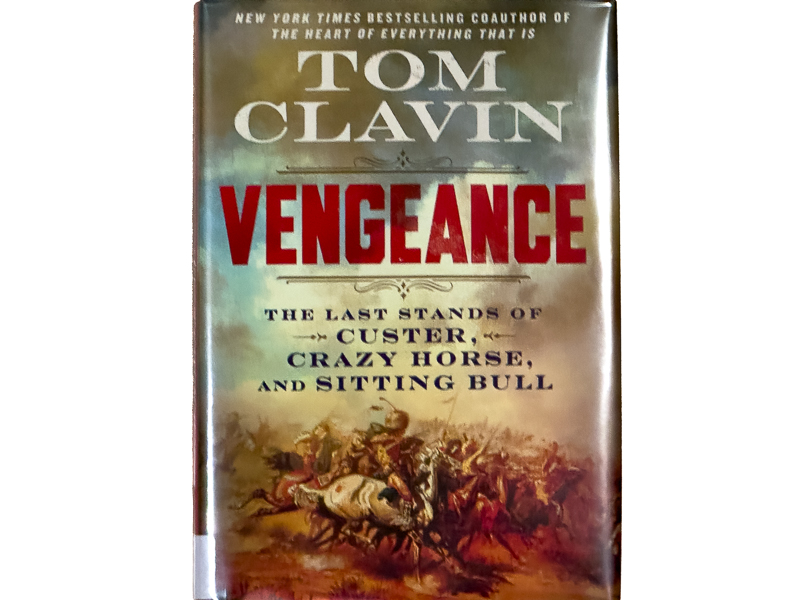
I recently finished his book “The Heart of Everything That Is” about Red Cloud. Great read.
Brigadier General Alfred Terry offered General Custer the use of three Model 1866 .50-caliber, six-barreled Gatling guns. Custer declined his offer. If Custer had accepted the gatlings history may have recorded a different outcome of the battle.
Considering the number of the Indians, do you really think the Gatling guns would have made any difference? How much ammo would the troops have and how long would it take for it to be expended? Then what? Maybe more Indian casualties, but the same ending.
Custer dashed in at little big horn because his biggest worry was that the indians would run (which is what everyone thought). What he got was: Indians eager to fight, who outnumbered him 10 to 1, hundreds of them with repeating rifles that had 4 times the firepower of his troops’ carbines. The size of the village would have made him cautious. No one had ever taken on indians at those odds before. But it was too late. He had split his force into four parts, too far apart to support each other and was facing the entire village with just 210 men. In the end he had to do the last thing one should do with indians; run. ‘To run from Indians is to die’. You can’t shoot them and they are doing what they have practiced countless times; a buffalo hunt. Another problem was the army reasoning that the indians repeating rifles faster firing, would be overcome by the superior range of the armies single shot rifles and their continuous fire (the indians magazine loaders only had a faster rate till they had to be reloaded).
wikipedia: ‘lever-action rifles, after a burst of rapid discharge, still required a reloading interlude that lowered their overall rate of fire; Springfield breechloaders “in the long run, had a higher rate of fire, which was sustainable throughout a battle’.
‘in the long run’: But the troops had to still be alive by the time the Indians needed to reload. There was too much cover for the army rifles range to help (the indians had been hunters all their lives and knew how to creep up on prey and there was lots of cover in those brushy hillocky rolling ridges) and the indians firepower so overwhelmed the cavalry, they were falling too fast to stay and shoot and ended up losing hundreds to the indians few dozen.
The side throwing the most lead usually wins. In later years, Gall recounted his role in the battle. He had mistakenly thought the survivors of Custer’s three southeastern companies fled northwest to Custer because they ran out of ammunition. Other evidence suggests the horse soldiers ran out of the will to fight and yielded to the flight instinct, with many men simply running, even abandoning loaded rifles. the shell cases proving that the soldiers started to bunch together, support this.
Even the Indians ‘inferior’ weapons turned out to be superior. The Indians’ bows and slings provided indirect fire that the troops didn’t have. The indians could stay completely safe in cover and rain arrows and stones. Knives and tomahawks were better melee weapons than rifle butts and never ran out of ammunition or jammed. The only weapons that have spare ammo lying around on the ground are slings. Of course you can just be unlucky; The cavalry’s crow scouts started the battle by killing the wives and children of Gall; the most dangerous Indian there, ‘an Indian in a million, one with an eye for ground like Wellington’. Morning mist obscured the size of the village. If it wasn’t for a box of hardtack dropping off a mule and being seen by indians, Custer would have had time to reconnoitre and rest his men all day, then attack the next (what he intended to do), they had been riding hard for days and ridden all night. (the Indians said the troops and horses legs were shaking with fatigue). Would even he have rushed into a village that size, with only part of his force? The army gave Custer mules but no mule handlers. So the mule train fell behind. Lowering his numbers and he lost a box of hardtack. When troops went back to retrieve it they spotted some indians who they assumed would alert the village so Custer had to attack immediately.
The ‘facts’ Custer relied on that had always been true till then, were wrong.
1) The Indians ran instead of fighting. The indians were eager for a fight. Under Sitting Bulls and Crazy Horses inspiring leadership.
2) The Indians would fight as a rabble. They’d all rush to wherever the first cavalry were, leaving the village undefended, so other cavalry could capture the women and children. Ending the fight and forcing the warriors to follow meekly wherever the cavalry bought their captives.
For the first time Indians ran away from the fight; because crazy horses’ prestige was so great they followed him when custer was spotted
And worse off all. There were just so many indians.
Mistakes don’t matter if there aren’t enough enemy to take advantage of them.
The reservations had reported only a fraction of those who had left to join sitting bull. Possibly for the notoriously corrupt agents to keep claiming their rations.
njk
Excellent. Thanks.
So many grave mistakes make by Custer that fateful day near the banks of the Greasy Grass (what the Plains tribes called the Little Bighorn River): ignoring his crow scouts’ accurate estimates of the very large Lakota, Cheyenne and Arapaho encampment; splitting his command in half; allowing the use of soft copper-cased cartridges that jammed his troopers’ single-shot Springfields, etc. etc.
I just put a hold on Clavin’s history at my local library and look forward to his interpretation of the famous battle.
Now that I’ve finished Tom Clavin’s book about the famous late-19th-century battle in Montana, it’s clear that he doesn’t cover any new ground, nor provide recently discovered primary source materials. Instead, he offers (in my view) fair and honest explanations of what led up to Custer and about half his troopers’ defeat that awful day in late June 1876, the battle itself, and the long-lasting consequences. To arrive at those conclusions, Clavin borrows from the writings of many other historians to arrive at his own conclusions.
For anyone who doesn’t know much about the Battle of the Little Bighorn, Tom Clavin’s “Vengeance” is an excellent, fast-paced read.
Custer was no military genius. He only knew how to do one thing and that is to load and go. Many of his men under his command in the Civil War were slaughtered by ill thought out charges. I believe he also graduated at the bottom of his class at West Point. He was a gun slinger with a cavalry troop behind him. Most of his celebrity status was due to the unrelenting promotion by his wife after his death. The warriors that defeated the troops at Little Bighorn scattered over the battlefield after the battle mutilating all the dead. They believed that you went into the after-life minus any appendages, eyes, ears, etc. that were removed. Vengeance is the word.
This is a battle that you can learn a lot by touring the battlefield. The interpretive displays are very good with the viewpoints showing a map and a semi-contemptuous photo to compare with what you are seeing. There is no way that Custer could not have known that this was a huge village. Reno attacked the village down what is now the median of of I-90, well away from the river. The horse herd was on the opposite hills and may have been the largest collection of horses seen in North America. In Custer’s defense, experience did show that the Indians would run instead of fight. He had no way of knowing that the same Indians had fought Crook’s column to a standstill a few days before in an all day battle. A fire on the battlefield a few years back had allowed some forensic anthropology shedding some light on the battle itself. If any of you have seen the painting of the Last Stand that graced a number of bars showing Custer surrounded by dead soldiers, Indians and horses blazing away with his revolvers, this appears to be fanciful as Indian tradition holds that Custer was killed at the very beginning. It is a possible depiction of the end of Tom Custer though. It would be in character since he was one of the few individuals to win the Congressional Medal of Honor twice.
Sorry for the expense I’m about to hand you. This is going on your bucket list:
C-SPAN Cities Tour – Billings: Battle of the Little Bighorn
https://youtu.be/q2UzKRUgzJ0?si=jn4-GZVRIvqO5XEa
Comments are closed.