


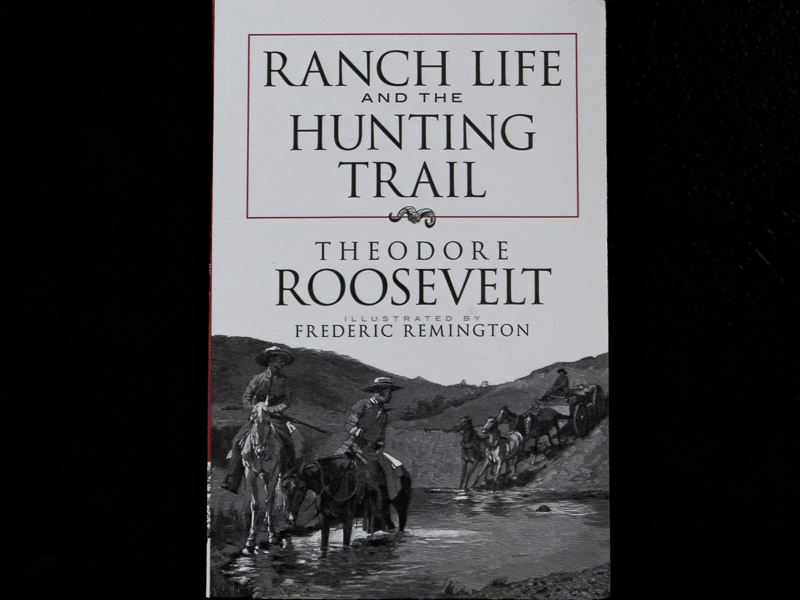
One reason I haunt used bookstores is to find great old tomes that time seems to have buried. At McKay’s in Chattanooga, TN I found a copy of Theodore Roosevelt’s “Ranch Life and the Hunting Trail,” originally published in 1888.
TR had a keen eye for the habits and beauty of wild game, and was not hesitant to pursue same under the most strenuous and demanding circumstances. The illustrations, line drawings by Frederic Remington himself, were a wonderful bonus.
“The hunter is the arch-type of freedom,” TR wrote, but he didn’t glamorize the frontier lifestyle without warning of its extreme dangers and hardships.
Roosevelt also understood that on a lawless frontier, citizens sometimes had to enforce the law themselves. He writes of a long trek to bring three thieves to the distant authorities at gunpoint. He commented, “The prisoners being unarmed, and kept close together, there was no possibility of their escaping, and the guard kept at such a distance that they could not overpower him by springing on him, he having a Winchester or the double-barreled shot-gun always in his hands cocked and at the ready.”
Things were different then…
Mas, I may have read years ago the book that you mention. The hunting of mountain lions with dogs was thoroughly described in what I read. The description of detaining “thieves” at gunpoint leads me to wonder about the organization of justice in territories like the old Dakota, Minnesota, and more yet, “unorganized territories,” would make interesting study. I am thinking now of TV shows such as Gunsmoke and Laramie, vs. the actual history of the U.S. Marshals. Jamestown, North Dakota has a fascinating history as the home town of luminaries such as Louis L’Amour, Eric Sevareid, and General Dupuy. I have always thought that the public school there must have had at least one or two outstanding elementary teachers!
I have been in the visitor center at Medora. Every photo of TR shows him as being armed except the one from his inauguration where he was probably carrying concealed. (It is known he once carried concealed when he was the keynote at a Harvard graduation.) That not withstanding, visitors are barred from carrying in the visitor center. Sensitive place, my ass. There is a lawsuit, currently, about this which hopefully will prevail. GFZs are the most important front in the fight for the 2A.
The manliest man to have ever manned. Teddy Roosevelt. Did you know he was once shot in the chest before he was supposed to give a speech? He decided that since the wound was not through the lung it wasn’t that serious and he didn’t want to disappoint the crowd so he gave the speech anyway and then had it treated. No kidding. He then insisted on leniency for the man who shot him.
October 14th, 1912 in Milwaukee, Wisconsin. He spoke for an hour and twenty minutes after being shot!
The correct spelling of the name of the especially prominent Army General that I mention is William E. DePuy, using “the American spelling” of DuPuy. William was one of the most accomplished doctrinal developers in the American progression of military thinkers, and a battlefield veteran of much distinction.
“Things were different then . . .”
Yes. Since then, technology has advanced, while criminal justice has declined.
For further reading on what type of man “TR” was, may I suggest RIVER OF DOUBT by Candace Millard. It is the story of Teddy’s adventures in the Amazon Basin with his son.
Excellent narative about facing grief, danger and uncertainty in life.
Someone recently posted this but it’s worth reposting:
Wikipedia:
‘Citizenship in a Republic is a speech given by Theodore Roosevelt, the 26th President of the United States, at the Sorbonne in Paris, France, on April 23, 1910.[1]
One notable passage from the speech is referred to as “The Man in the Arena”:[2][3]
It is not the critic who counts; not the man who points out how the strong man stumbles, or where the doer of deeds could have done them better. The credit belongs to the man who is actually in the arena, whose face is marred by dust and sweat and blood; who strives valiantly; who errs, who comes short again and again, because there is no effort without error and shortcoming; but who does actually strive to do the deeds; who knows great enthusiasms, the great devotions; who spends himself in a worthy cause; who at the best knows in the end the triumph of high achievement, and who at the worst, if he fails, at least fails while daring greatly, so that his place shall never be with those cold and timid souls who neither know victory nor defeat.
njk
A hell of a man!
Or as Senator Marcus Hannah put it:
“Do whatever you damn please! I’m through! I won’t have anything more to do with the convention! I won’t take charge of the campaign! I won’t be chairman of the national committee again! When asked what the matter was, Hanna replied,
Matter! Matter! Why, everybody’s gone crazy! What is the matter with all of you? Here’s this convention going headlong for Roosevelt for Vice President.
DON’T ANY OF YOU REALISE THAT THERE’S ONLY ONE LIFE BETWEEN THAT MADMAN AND THE PRESIDENCY?
…. What harm can he do as Governor of New York compared to the damage he will do as President if McKinley should die?
That question everyone asks:
‘Who’d win a fight between Teddy Roosevelt and T. E. Lawrence?’
https://youtu.be/NNNVf01vgaQ?si=yEilkczHG48WQnwj
Comments are closed.