

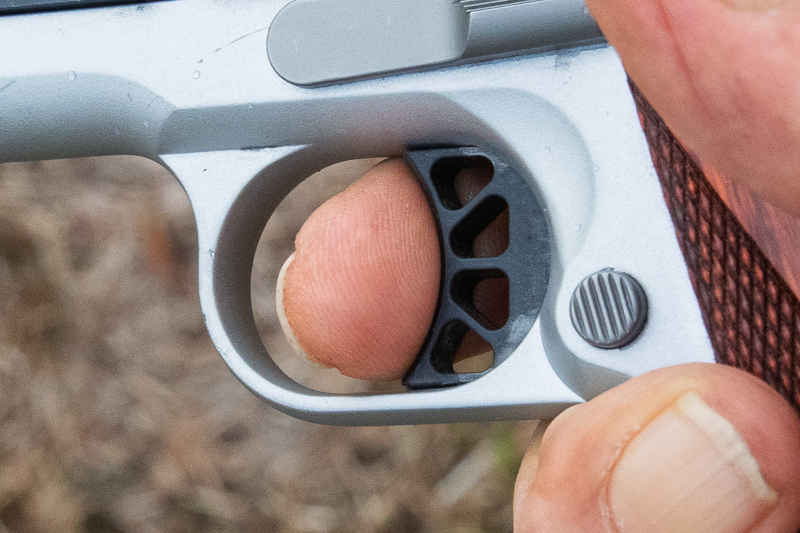

If you’re familiar with my work in the field, you know I’m not an advocate of very light trigger pulls on defensive firearms. Here’s a thoughtful fellow from TFB TV who agrees, and who demonstrates part of the problem. Less than nine minutes, and it will be time well spent.
or watch video here
Good video. It would be interesting to see if there has been an uptick in police NDs with the increased use of light triggered 2011 pistols by less than well trained officers.
This is a great question! It would also be interesting to see if any reduction in ADs associated with the introduction of NYC’s very heavy Glock triggers was offset by worse hit ratios.
Of course, both better accuracy and fewer ADs can occur together with better training. Also, the Hawthorne effect dictates that simply studying an issue tends to improve the results measured. I think both police accuracy and ADs have improved in recent years, as attention has been focused on these problems.
The other problem in sorting out the positive and negative effects of issuing 2011s is selection bias: a percentage* of better shooters is more likely to gravitate to 2011s. Some LEOs are not “gun guys” and just don’t care.
*I acknowledge that a certain percentage of excellent shooters prefer polymer, striker-fired pistols. They just don’t understand that Glocks are inferior and, not appreciating their inferiority, they shoot superbly despite the impossibility of doing so (I’m talking to you, Gail P., Bruce B. and Tom G.).
Overall, good material. I learned to shoot with rifles that had two stage triggers and I’m still fond of them. In fact, I spent good money to fit 2 stage triggers to my 2 precision rifles, but some folks would still consider them too heavy at a total of 3 lbs. Handgun 2 stage triggers reset for repeat shots at much less than full travel.
Over decades I learned I shoot pivoting handgun triggers better than sliding triggers. Light triggers are neither needed or wanted on defensive handguns. Reasonable yes, light no. If it hasn’t already, your opinion of trigger weight gets revised the first time you stack on a door for a dynamic entry. Unless maybe you’re last in the stack.
Good Stuff! Thank you!
Great video. He’s preaching to the choir with some of us. I like consistency, so competing and training with what I carry for self defense works best for me.
“…I’m not an advocate of very light trigger pulls on defensive firearms.”
I happened to finish re-reading “No Second Place Winner” by Bill Jordan just yesterday. Double action revolvers with trigger pulls of 15lb and more.
Single action army style – the trigger return spring is just ounces. It is possible to be ‘pulling the trigger’ and not realize it. If the thumb slips while cocking, “BANG”. (Thinking of an anti-gun actor who fatally shot a coworker on a movie set in New Mexico several years ago.)
Eye opening to say the least. However, in line with what we learned in the MAG 40 class, and why all my pistols still have stock triggers.
Polished not lightened.
Shaken not stirred.
Good one.
Explained well. Thanks, MAs.
I liked this video a lot. In the beginning, he spoke of a very light trigger potentially sending you to prison. While that thought is enough to give nightmares, the other part of that is that you could possibly shoot someone you should not, including a loved one, or an innocent civilian, etc. Either scenario is bad, and even if you don’t go to prison for shooting someone unintentionally you still would have the horrible thought that you took a life or gravely injured someone.
This is a great point. For many of us the worst outcome would be to shoot a friend or family member or other innocent person.
While I strongly agree with the point made in the video, there are limitations in interpretation of the presenter’s results.
First, good technique dictates turning the eyes to identify the potential target before moving the gun to where it is pointing at the target. Under the experiment as conducted, the presenter pointed his gun at the indicated target and then was given an audio indication of whether to shoot or not to shoot. But the delay in speaking the shoot/no shoot command added an artificial delay to the recognition phase that would be shorter if the target had a visual shoot/no shoot indicator that appeared simultaneously with the command that identified the target’s number.
To be clear, the overall point being made is still valid. But, in many real scenarios the shooter would begin to process the shoot/no-shoot indicators at the same time he realizes that the new potential target is present, not 100 milliseconds later when the verbal no-shoot command is given. This, plus the use of a 1.5 pound trigger exaggerates the effect.
But, the central premise is still very much valid because bad habits abound, like searching with the direct beam of a weapon mounted light or pointing first and identifying the subject over the sights, especially under the stress of a real-world scenario, with finger on trigger.
The heavier trigger is the last layer of defense after someone has failed the other layers:
Low ready stance.
Finger off trigger.
Identify target prior to muzzling.
Note: While audio processing is theoretically faster than visual processing, both are substantially faster than the time consumed by the spoken command.
It would be interesting to re-do the experiment with red/green lights that simultaneously indicate which target and whether or not to shoot.
Great video, emphasizing what you’ve preached for years.
Mas, you’ve mentioned 4 lbs. as the threshold for a defensive 1911 pistol. Given that springs can weaken over time, do you recommend a particular schedule to check trigger weight to ensure a 1911-style gun preserves the factory-new trigger spec?
Also, some major manufacturers deliver high-end carry pistols with 3.5 lb. triggers. Would you leave such a pistol “as is” at factory spec or send it back to have trigger adjusted up to at least 4 lbs?
The video makes a powerful point but does so with a 1.5 pound trigger, which is absolutely too light for a carry pistol. However, the presenter doesn’t give any suggested minimum weight.
Are you aware of any studies/data that has looked at trigger weights between 1.5 and 4 pounds, to see if there’s a clear deflection point in the data?
Police bureaucracies are likely more sensitive to Unintended Discharges than they are to missed shots that failed to stop the lethal threat, leading indirectly to added harm. Such missed shots caused in part due to heavy triggers would be hard to separate from other causes of suboptimal marksmanship.
It’s a shame we don’t have data on both Unintended Discharges and practical accuracy in police shootings, both plotted against trigger weight. I suspect the “New York” Glock trigger has saved a few ADs, but also significantly contributed to a sometimes abysmal hit rate. It may be important to note that an innocent bystander struck by an errant bullet in a justified gun battle presents less legal jeopardy and liability than one struck by an AD, coloring the way police departments view the two events, even though both may have identical outcomes for the innocent bystander.
Jeff, it seems that after a 1911 trigger job the trigger loses another half pound as it wears in, and then settles where it is. You’re right, more empirical study needs to be done.
Having smithed 1911s for a long time, spring let down really isn’t an issue given the design. Unless the springs are flawed. The real problems can be some unskilled person messing with the parts, parts that don’t meet design specs and simply wear on engagement surfaces.
I once had a gun built by the late, great Armand Swenson come into the shop (Frankly, I was thrilled to be able to study Swenson’s work and see if there was anything I could learn.) because the trigger seemed too light-after decades of service- to the owner. He was right, the trigger was a stunning 1.5 lbs but the hammer didn’t follow the slide or have any other issues. All spring tensions were good to go.
I had access to an optical comparator and was able to examine the sear/hammer interface at 3200X. No issues. My only conclusion-barring defective parts-was that long and heavy usage (plus Swenson’s finish) had polished the surfaces to the point that the trigger was virtually frictionless. Rather than mess with it we returned to gun to Swenson who corrected the problem at no charge. And no comment on what had happened.
My personal observation was that the sear & hammer engagement surfaces were HIGHLY polished. I don’t know, but I suspect the surfaces burnished themselves enough to reduce the trigger to a far less than safe weight. If it feels too light-below 4 lbs-it probably is and needs checked.
Related topic: on the S&W Forum a number of folks have been sending one of their newer designs back to the factory for a heavier trigger pull. While I had over 15 years experience with 1911s, my later, longer work with longer travel, heavier issue triggers makes me prefer them for serious use.
Maybe it is my (lack of) skill but in defensive shooting drills, trigger pull weight doesn’t seem to make any difference. 1911s, Glocks, some other brands with truly awful triggers or revolvers fired double action, it doesn’t matter.
I find this presentation thought-provoking. I have just four hand guns, and I rely on selective muscle memory for distinct trigger press on each one. With my single-action plow-handle heavy revolver, having the trigger finger inside the guard is the same as touching the trigger, unless I press forward inside the guard, which I will do if I remember to. My spurless double-action revolver gets similar treatment, although more wiggle room obtains. My striker-fired semi-auto with a Safe Action style safety does not get trigger finger inside the guard until the thumb safety is off and I begin to engage the trigger safety, and trigger press is imminent. My pistol with the heaviest trigger is a mouse gun that gets treatment similar to the other semi auto. The mouse gun, while minimally intimidating, at least makes enough noise to scare a mouse. I would say that “trigger pull” is part of a process that needs to be kept simple, but may not automatically be so.