


Paul Howe is one of the nation’s recognized experts on the use of firearms in life-threating stress situations. Here he talks about the importance of using the manual safety on powerful weapons deployed under extreme pressure.
If you’ve never heard of Paul Howe, I’m glad we caught you in time. When this man talks, professionals listen.
I thank another solid professional and good friend, Greg Ellifretz, for turning me on to the article I share with you below. Howe is talking about long guns but it’s just as important with manual safety-equipped pistols such as the 1911 or the Browning High Power.
In the context of this article, should a trigger safety pistol, such as a Glock, be considered as “dangerous” as a pistol with a thumb safety that is not used?
I follow Paul on UToob and love his “get to the point” teaching style refined in the furnace of combat. I don’t carry striker fired guns for a reason, and that reason is assurance of weapon status when I holster. I carry a Beretta 92FS with the G safety, which is really a decocker. I chose this because my build allows concealed carry of this weapon and I know where the hammer is at any given moment because I holster with my thumb on the hammer. When I draw I know the first trigger pull is long and heavy. I also know I won’t have a dead trigger on a draw.
I also carry the 1911 which IS locked and cocked with a manual safety, but I sweep my thumb down the left side of the frame on both weapons anyway reinforcing a standard manual of arms under stress.
No, I am not a professional trainer or a weapons expert, but this philosophy has served me well in both flat range and tac house training. In each case, both weapons have become an extension of myself.
Correct me if I’m wrong, the slide mounted safety of the Beretta is the typical Beretta slide mount configuration. Sweeping your thumb DOWN on draw engages the safety, rather than disengaging it as would be the case for the 1911 and virtually any frame mounted thumb safery.
My Beretta has a G safety so it really doesn’t matter. I use the same draw style for both the 92 and the 1911 to remain consistent. If a weapon has a stub safety on the frame like a SW MP 9 or 45 I would surely fumble with it if I changed weapons.
⁹Did you intend to post his article?
Its not here.
Thank you,
George
The recent death of the unfortunate, belligerent anti-ICE female driver in Minneapolis appeared 100% typical, deliberate, heedless homicidal/suicidal insurgent strategy. Where does anybody. get the idea that law enforcement is a crime? It would be a good place for ICE to deploy an accurate match-grade 1911 with a precise trigger under control from secure 1911 safety. Good job to the fortunately surviving ICE agent!
Sorry, I think the shooter is a trigger happy fool. He was not in any imminent danger and the young woman certainly was not guilty of any felony.
The Paul Howe articles have made me think. First of all, on my likable Ruger EC9s, I am now practicing conscious coordination of index finger and thumb, paying considerable attention to the different movements between on-safe (thumb isolated, vertical), off-safe with keep-trigger-above-trigger(with safe action) & a more full grip than pushing to off-safe), and trigger press, basically including finally depressing the safe-action upon my shooting decision. I practice keeping the grip constant, putting the trigger press well forward of the first joint, almost to the finger tip. All this fits together well for my accuracy, although I can shift to a fuller grip with trigger finger (index) at the first joint. I will sometimes carry my spurless Ruger Sp101 at right-front appendix in a Bianchi holster, but I make sure to fully control the spurless hammer with thump press, reach in front of the trigger guard to draw, and index until triggering until time to shoot, should the time come. I am not sure about carry at the appendix with anything else. Could be called being “nervous in the Service”?
Right up front I have nowhere near the credentials that Howe, Ellifretz, or, Ayoob have and this is not a criticism or contradiction of anything they are saying.
This is all about me and what I personally feel comfortable with.
IMO, mechanical devices fail and therefore a mechanical safety can fail.
According to Murphy’s Law, it will fail at the worst possible time.
When it comes to pistols, I own nothing with a manual safety.
In my early days of ownership, I owned several that did have safeties, but the problem is that the direction for engaging and disengaging safeties on semi-automatic pistols can vary by model. Some safeties may pivot downward to disengage, while others may work in the opposite direction.
I found that training with all of them, even while just punching holes in paper, I was constantly double-checking the safety because under stress I wanted to be sure which way was which for what I was carrying.
I did not have this stress when using my wheelguns and I determined that I wanted to totally eliminate that possibility of stress, hesitation, etc. and just train with the semi’s as I did with the wheels . . . that I am the safety.
Some told me that I should just keep the safety disengaged. If I was just going to keep the safety off, then the point of the safety is useless anyway, and under the stressful conditions of a need to use it, I didn’t want to worry that somehow, someway it gets engaged by accident.
Nothing worse than getting a click when you expect a bang.
Also, I wanted to be sure that my wife was comfortable using whatever is in the house she can get her hands on and not have to worry about is it on or is it off.
Under a high stress situation, having one less thing to stress about is important to me.
Thanks for another good discussion of the appropriate use of safeties, Mas!
I am a devotee of thumb safeties–to the point that I have installed them on all of the Sig P365 variants that I use for EDC. This not only gives me added protection in holstering, but it also keeps the manual of arms similar between my striker-fired Sigs and the Wilson X-9 variants that I also use for EDC. The safety comes off only when I have identified a target worthy of shooting and a dearth of “friendlies” between me and the lead-worthy target.
Many may view me as over-cautious, but knowing that I require a second or two of “wake -up time” when aroused from the deepest levels of sleep–and knowing that my bedroom has deadbolt-secured, solid doors, giving me a few additional seconds of time between the time a home invader breaches an outer door and the time they can enter the bedroom–I prefer to force myself to take one more step to be sure I’m fully awake and that I really want to start slinging lead, so I keep my night time bedside gun in Condition-3 (Israeli Carry). However, I would not carry my CCW/EDC in this condition. For on-body guns, Condition-1 is the way to go.
The one exception is for newbies, who are trying to get accustomed to carrying. I have seen Israeli Carry serve as a useful crutch to get them used to carrying without being too nervous about a gun being cocked and locked. This is a psychological crutch and mostly applies to guns with external hammers. Striker-fired guns where the cocked striker is not visible don’t seem to generate the same angst.
A titanium firing pin can improve “drop-safety” in a Series-70 style gun that lacks the trigger-actuated firing pin safety of the Series-80 guns.
It occurs to me that while a 1911-style grip safety will not prevent accidental discharges from holstering your gun with a full grip and your finger on the trigger, it would prevent ADs that happen when keys or other foreign objects slip into the funnel-like openings of modern light-bearing duty pistol holsters. The Springfield XD series has this feature. A grip safety would likely have prevented many of the so-called “Uncommanded Discharges” attributed to the Sig P320 (which were in many if not all cases, I believe, unrecognized trigger actuations by fingers or foreign objects).
That said, I do not feel that a grip safety is an imperative. I have personally experienced a failure to fire due to an imperfectly-gripped grip safety. It cost me a second to correct in a match. It might have carried a greater penalty in a defensive application. While that problem is partly remediable with training, obtaining a perfect combat grip with either hand under all circumstances is susceptible to failure under stress. None of my current favorite EDCs have grip safeties and I don’t find myself worrying over this.
Also, Mas’ technique of holstering any gun with the thumb on the hammer or backplate allows any present grip safety to be activated. The more I carry and handle guns, the more I appreciate all the small nuances Mas taught me in MAG-40. One might begin to suspect that he has been a serious student of pistolcraft for more than 60 years…
I prefer the manual thumb safety to help prevent ND during holstering (in/out). I have guns with no manual safety which makes me a little more anxious when carrying. So manual thumb safety or decock or double action revolvers are my carry choice. I am at the range often enough and hope the muscle memory in practice will get me through a stressful situation if needed.
You really have to keep on your toes to keep ahead of Spellcheck these days. Thumb may keep coming back as thump. If you don’t follow the ghost-ahead verbatim, you may never get straight on-path again today. You can lose a whole word any time. Like having a jumpy, fast high school runner on first base with a confused base umpire on board, and the uninformed visitors’ bench shouting “balk, balk, balk” like a noisy chicken coop. Too likely a thought-control policy of the Speech Police. Groom everybody into a docile stupor.
I have to edit, edit, edit. Or, I could say proofread, proofread, proofread. Haste still makes waste, even in modern times.
PS: Regarding the recent Minneapolis ICE shooting incident: The NYT claims that the fact that the car wheels just starting to turn to the right at the moment the agent commences shooting indicates that the shooting was not appropriate. Such an analysis reflects ignorance of, or deliberate dishonesty regarding the human reactionary gap–the fact that it is humanly impossible to “un-pull” or stop the pull of the trigger instantly in response to seeing the wheels turn (if the ICE officer could even see the wheels from his position in front of and above the hood of the car). The same NYT “analysis” states that while it appears that the car struck the officer when viewed from one angle, that another angle shows that the tire did not touch his foot. Huh? The car hit his thigh, not his foot! And one can see his upper leg propelled backwards rapidly as the car lurches forward while the agent leans over the hood with his gun extended. As the car lurched forward, he could not be reasonably expected to assume that she would turn her wheel to the right at the last fraction of a second, such that she only clipped him and didn’t run him over! Had she survived, she should rightly be charged with interfering with law enforcement, evading arrest & fleeing from a valid law enforcement order to stop and get out of the car, reckless endangerment of the officer standing beside the car whose hand was entangled with her car door latch and whose foot barely escaped being run over by her “peel-out” and, finally, aggravated assault of the officer she clipped with her left-front fender/bumper.
Many of the incidents where officers are charged with excessive force start with the suspect attempting to evade or resist arrest. We need to get rid of the notion that it is acceptable to resist arrest. Most if not all of these instances would have been resolved without injury to anyone if the suspect had simply complied with the legal requests by the officer.
It is often-times referred to as “The Talk” that thoughtful black fathers have with their sons–that it is better to submit to detention and arrest peacefully–even if one thinks one is being disrespected and the victim of racism–and then address the disrespect or unlawful actions by the police later in court. But, I can tell you that I have had the same talk with my children and that it applies regardless of race. We must all do our best to rid society of the notion that it is OK to resist arrest or to flee (especially in a vehicle). Unless you have a solid, well-founded belief that you are about to be murdered by a corrupt cop, it is best to submit to arrest and sort it all out in court. Fleeing from police in a vehicle endangers others of death and great bodily harm and should result in significantly enhanced penalties. Moreso than whatever we are doing at present, which is clearly insufficient to discourage such behavior.
Sorry for the rant–but I am frustrated with uninformed “narratives” and the vilification of officers who are simply trying to carry out the reasonable laws society has charged them with enforcing.
My father had the same talk with me when I got my first DL. “If the flashylights come on, pull over. If the officer wants out of the car, get out. If he arrests you, take the ride. The ONLY place to argue with an officer of the law is in the courtroom with your lawyer.
I also never remember leaving on a date, all the way through high school, without my mother reminding me “Nothing good happens on the street after midnight.”
And no, I’m not Black.
Jeff,
You wrote well. I totally support law enforcement, and I believe this was a justified shooting. To be fair to the other side, I will point out the best argument against the ICE officer I have heard. I saw a post that claimed, the officer was able to jump out of the way of the car, while shooting his pistol. If he was able to jump out of the way of the car, while shooting his pistol, then he could have jumped out of the way of the car, while not shooting his pistol.
The officer could not have reasonably known he would be successful in jumping out of the way, so I support his actions. She fought the Law, and the Law won. However, if I had to prosecute the ICE officer, I would use the argument I just wrote above.
If the President was a Democrat, or a RINO, the ICE officer would be arrested, tried and imprisoned. Thank God for President Trump, the common-sense, highly gifted, blue-collar billionaire. Apres Trump, le deluge. (After Trump, we are doomed).
It’s not over yet, and he could possibly face charges. She hit him with her car, so I don’t see how he will lose in court. Both lives are over, even though he is still alive.
Look at what actually happened. The politics have nothing to do with it.
He was only just in front of the car and could have simply jumped out of it’s path:
https://youtu.be/Mp7psfEayHE?si=OXA2lEZWVAhFWlmb
Where is the post????
Click on the word “Here” in blue.
Definitely concur with Paul Howe on the use of the safety on an AR. I have seen way too many photos and videos of poorly trained officers stacked up with fingers on triggers and muzzles pointed at each other. The time required to bring the rifle from a ready position and thumb off the safety is minimal.
From that radical lunatic left media err….. Fox News.
Here is what acually happened, as you have all seen with your own eyes before now:
https://youtu.be/Mp7psfEayHE?si=OXA2lEZWVAhFWlmb
The bungling ICE ‘lets have our first move be armed masked men rush up and try and open the car door, while one of us stands a foot from the front of a car on ice’ is dumb. But that doesn’t justify killing them.
But trying to drive away at 1 mile an hour isn’t attempted murder either. As soon as the car starts to move, the shooter doesn’t take a couple of steps to the side, he draws his gun.
You are absolutely right about ‘The Talk’. ‘Passing the attitude’ goes a long way. One chap we had was possibly over the drink driving limit. But it was a slim possible. We were waiting for a car to bring us a breath test and had decided to let him go. It was a busy night. Then a panda car passed and motorist said “oh look a piggy wagon!”.
He was disqualified for a year.
BUT that is not the law. The penalty for failing to stop is not summary execution.
‘We need to get rid of the notion that it is acceptable to resist arrest’
Yes it is.
As Fox shows ICE policy is:
‘Deadly force shall not be used soley to prevent the escape of a fleeing suspect’.
nicholas kane,
Thanks for being reasonable. The video was helpful.
It was a piece of the puzzle but not all of it. There is lots of video with more emerging. There was another video that was slowed down. Andrew Branca used it in his analysis. In that video you can see the drive wheel of the van spinning on the ice as she accelerates and on the sound track you can hear the spin as well as the engine racing. Don’t know whether the officer had the position to see the wheel but he certainly could hear the noise. Anyone who has ever driven on ice knows that the tire can suddenly grip and make the car lurch or race forward. Others have criticized the officer for coming around the car but while that may have been a bad idea, it was pretty irrelevant to the decision making right at the shooting. If you look at the splits on the shots (shown in the video), they were about .1 seconds which means that all three shots were part of the same decision.
Curious to see whether Mas has anything to say. His analysis would be the only thing comparable to Branca in my opinion.
Waiting for more info. Perceptions of the involved officers, for instance.
Nicholas, I didn’t understand your reference to a “panda car” and the motorist’s reference to a “piggy wagon” or how that made him “disqualified for a year” or how his disqualification was “not the law.” Pardon my ignorance of your jargon. My children occasionally roll their eyes at my ignorance of modern slang terms.
I fully agree with your statement that, “The penalty for failing to stop is not summary execution.”
But, I think it misses the point in the Minneapolis ICE shooting. The reason the woman was shot was not because she was fleeing, but rather because the ICE officer reasonably thought she was about to run him over with her car.
The active problem in the video (link thoughtfully provided by Nicholas Kane) is that when the lady first spins her wheels they are pointed forward and the car is aimed directly at the officer. If you use the “pause” button frequently during this video, you will see this quite clearly. Frame-by-frame viewing shows that he draws his gun right after she spins her wheels in forward. The car lurches toward him. He is already aiming his gun at her in apparent response to her starting directly toward him when her tires begin to turn to the right. From his position looking over the hood and directly down the sights toward the driver, he would not be able to see her tires turn and in any event, human reaction time would not allow him to decide that she had changed her course (and apparent intent) in time to stop the act of pulling the trigger. When he was actually struck by the car, almost at the same instance that he pulls the trigger, it would only cement in his mind that her intent was to injure or kill him with her vehicle.
This is a very unfortunate event. It is always possible to speculate that it might have been avoided if various parties had taken different actions. But that fails to address the actual issues at stake. The officer did have the right to be standing in front of her initially stationary car. She did not have the right to accelerate towards him, putting him in fear for his life, even if her real intent was to scare him out of the way and veer to her right, missing him entirely (which she apparently failed to do).
It is not the duty of any pedestrian (including this officer) to leap from the path of a car that has suddenly spun its tires in an effort to accelerate forward. It IS the duty of a driver with an officer standing in front of her car telling her to stop and get out of the car to comply with that directive. She could have passively resisted arrest by not moving at all and waited for the officers to pull her from the car.
Furthermore, officers cannot be expected to know her INTENT. They can only read her ACTIONS. By spinning her tires forward when one officer was standing in front of her car, she created the reasonable perception that she was attempting to run him over. Maybe she INTENDED to miss him (she was unsuccessful). Maybe she only INTENDED to frighten him. She succeeded, in putting him in fear for his life. It was a dumb plan on her part and a reasonable person could easily predict that putting an armed LEO in fear for his life was a good way to get shot.
She didn’t “deserve to die”; but, she did greatly contribute to the unfortunate circumstances that ended with her death. She basically committed one of those “Hold my beer and watch this” moments. I’m sure she thought it seemed like the right thing to do at the time.
Any argument that that these were unknown masked men with guns approaching her car falls flat when it is clear that she knew these were ICE officers and the driver’s wife was actively filming this INTENDED confrontation with ICE.
I still maintain that it is NOT acceptable to resist arrest. This does not mean that I support the use of deadly force on a shoplifter fleeing on foot. There’s a big gulf between “not acceptable” and “capital crime”. I was making the point that leading police on a chase should carry an additional penalty over and above the initial crime in question and that such penalty may need to be increased because so many criminals still do it. Furthermore, when that flight is in a vehicle and in a manner that jeopardizes pedestrians and other motorists, the penalty should be substantial (note that substantial does not equate to summary execution). Sometimes, flight can be so reckless and dangerous (think of a fleeing truck that cuts through a heavily traveled pedestrian mall) that lethal force may be appropriate to stop the flight as soon as possible. But, that does not apply to all instances of flight to avoid arrest.
Let us not lose sight of the proximate cause of her demise:
She wasn’t killed for attempting to flee. She died because she accelerated her car, even spinning her wheels, while her car was pointed directly at a Federal Agent who had directed her to STOP. Frame by frame viewing of the provided video clearly shows that the agent was directly in front of car’s left headlight when the woman accelerated.
the officer was indeed struck (as one video seems to show) on the left thigh and he was transported by another agent, treated and released at a local hospital. That he was seen immediately afterwards the shooting with only a minimal limp does not mean he did not have a significant thigh bruise or leg injury. Adrenaline is a marvelous pain killer. I am aware of people who walked some distance with a broken leg after such adrenaline-dumping incidents.
Attempting to drive off while one officer has hold of your door handle and another is standing in a position where he might be struck by your advancing vehicle is illegal and potentially deadly to the officers. As a physician, I am quite aware of very concrete (pun intended) consequences that can result from being dragged or run over by a car–even at relatively low speeds. I think the car was moving at more than 1 MPH in the video when it struck him. And, with over 1000 pounds of weigh distributed to each tire, being rolled over at “only” 1-2 miles per hour still produces severe, even lethal, injury. It was lucky he was able to shuffle quickly to his right and did not slip on the icy road and fall under the car.
The NYT assertion that his left foot was NOT run over is a red herring–no one is making that claim. But officials have confirmed that the officer was treated and released after being treated for injuries sustained when he was struck by the car. Based on my view of the video, I would speculate that he has a thigh bruise and/or a left knee injury.
Sorry to be so long-winded.
Respectfully,
Jeff
Jeff,
Thanks for your post. I will attempt to define “panda car” and “piggy wagon.”
Pandas are black and white. Police cars used to be black and white, and I guess some still are. AI said “panda car” is in fact British slang for police patrol cars.
AI did not understand “piggy wagon.” Here’s my guess. In the early twentieth century, there was “paddy wagon.” That was the horse-drawn carriage that picked up the crooks in New York City. Since a lot of the crooks at that time happened to be Irish, and Patrick is a common Irish name, many of the crooks were “Pats” or “Patties.” So, if a police wagon has a bunch of Irish crooks named “Pat” in it, you could call it a “Patty Wagon,” or “Paddy Wagon.”
In the 1970s, I remember several deragatory terms which anti-establishment types had for the police. One was “pigs.” My guess is that someone has taken to calling police cars “piggy wagons.”
May God’s curse be on all criminals, and may our legal system stop trying to rehabilitate them, and simply punish them harshly. Punishment is rehabilitation.
Yes he chose to make a derogatory remark against police when they were wondering wether to let him go. Result; “blow into this please” and he was disqualified for a year.
Sorry keep forgetting this is an american site.
You should have seen the reaction the UK girl counsellors got when we were working on US summer camps and they’d asked a chap to “knock me up in the morning”.
It means wake up in the UK :-).
njk
I have read that his same ICE agent had been in a similar incident just weeks prior to this one, and was out o service recovering. Also,, that the driver o the car that got shot/killed had ben accosted not long prior doing some rather similar antics in an earier situaion.
Having been hurt in this way recently. I rather expect this agent was rather chary o enduring a repeat and being disabled or dead in result.
Tionico,
That same ICE agent was dragged 100 yards by a car last June. It resulted in at least 20 stitches for him.
For a recent example of what can happen, see this post on X by Mike Nellis (@MikeNellis) with video of an ICE agent slipping and falling on a frozen sidewalk. In so doing, his carbine discharged, presumably because “something” got into the triggerguard *and* the carbine’s safety was not engaged: pic.x.com/rkx3Iy9IuN
James M
(MAG40, MAG80)
Getting back to the original topic and a slight off shoot…….
First, switching back and forth between action/safety types is setting yourself up for failure. Experiment, make a decision and then stick with it.
Most of the handguns with slide mounted safeties that “work the wrong way” can be quickly taken off safe from the holster by keeping the thumb straight while getting your grip on it. (Thanks Mas). Once out of the holster, they have a long revolver like double action trigger stroke needed to fire the first shot. So, the safety really isn’t an issue there. Out of the holster, off safe, muzzle in a safe direction or toward the threat. If you fire any rounds, only decock after the festivities are complete.
Mr Howe didn’t do any comparative times with the weapons off safe, but I’d suspect no significant difference. We did such trials when the 3 safety rules became 4 and the “troops” started the “We’re gonna git kilt!” whine. The spread between high and low times was generally greater than the difference between finger on trigger and finger off trigger. And, the thumb and finger can move at the same time.
There is however, one issue with the safety in at least one of the situations Mr Howe mentions. I’ve seen a couple of horrific ER photos from transition drills where dummy rounds weren’t used. The safety and/or trigger snagged on clothing or equipment and the chambered round fired. One of the safety rules is that we’re not supposed to trust the safety. Applying the safety prior to movement does seem like a good idea. Unlikely to hurt, might help.
BTW, should you find yourself in a course that doesn’t use dummy rounds to cue a transition from long gun to handgun, this is a good time to have some digestive distress that takes you off the firing line. Besides safety, another issue with the verbal command is that in the real world, there’s no Range Master In The Sky to tell you to resolve a problem.
Over decades, I saw a lot of folks stare in bewilderment at a gun that didn’t fire when it was supposed to. Even on stages where they were TOLD they’d run out of ammo and have to reload under time.
One of the reasons I prefer a revolver. Mostly because of my experiences with them. I enjoy all of their nuances, Colt’s cylinder release versus S&W’s versus Dan Wesson’s versus Ruger’s versus Charter Arms – where you could pull the ejector rod forward to release the cylinder. I like the Mossberg 500/590 thumb safety as well, over the Remington’s. I take great care with an M-1 Garand or M1-A with the trigger-guard mounted safety. Other than these, learn the mechanisms of your individual choices.
Like cops point out:
‘They’ll spend three days in court, debating what you had to decide in a fraction of a second, with your life in danger’.
Which is what everyone, including us, is doing.
The bottom line is:
do you really think a car you are one foot in front of, moving from stationary, is going to ‘run you over’?
Thanks! That makes sense now. I have encountered other idioms that mean very different things in the UK vs the US. The differences can be quite funny–once you get over the embarrassment!
Yes, the stopped car one foot away can run you over.
With the reaction time of an elite athlete, it still takes 1/4 second to START to react to an expected stimulus. Most people have reaction times closer to 1/2 second. A Porche Spyder can reach 60 MPH in 2.2 seconds. An average car (not a high-performance car) can accelerate to 60 MPH in about 6 seconds, which translates to about 14.7 feet per second per second. This means that the average car can move forward a little over 42 inches before you even start to react. Even cutting that by half, the car will move nearly 2 feet from a dead stop in a half-second. Starting with your foot 12 inches in front of the bumper and the car moving at 2 feet per half second from a dead stop, one half-second later your foot will be stuck on the road 12 inches behind the bumper with the bumper pushing on your knee and your shin will be at a 45-degree angle. Good luck recovering from that position. Usain Bolt can accelerate about 30 feet/second/second, provided he’s in a sprinter’s stance facing the right direction. But, he’ll lose a quarter second just turning around. He might make it but, yeah, the average person is probably going to be run over by the car because at least one foot will get stuck under the car before he has a chance to move it, at which point his only acceleration is down. If you’ve thought it through ahead of time, you’ll probably try to roll onto the hood and quickly pick up your feet, assuming the bumper hasn’t already pinned one leg. You might avoid being “run over” (unless you slipped on the icy road); but, you will be hard-pressed to avoid contact with the car. The officer may have been saved by the fact that her tires spun (front wheel drive) on the icy pavement when she first stepped on the gas (the tire spin is quite visible in the published video). The fastest NFL stars reach speeds of 22 MPH (about 32 feet per second), but it takes them several seconds to accelerate to that speed. Your average sedan is much faster in both acceleration and top end than the average person. The pedestrian’s only hope is to start moving laterally before the car does. Police and school crossing guards expect cars to stop when they raise their hands–and not to start up until signaled to do so. Otherwise, the pedestrian/police/crossing guard loses big time.
Thanks for an interesting discussion–although we did drift a bit off topic.
In the eyes of the law, in most states anyway, you don’t have to be right. You only have to be reasonable.
Even if that car would have missed him or just pushed him aside without rolling over him, he could not possibly see that possibility, decide on the perfect course of action, either move or draw a weapon, and fire in less than a second especially with someone known to be confrontational and combative with law enforcement. Even if videos from all angles proved he had 6 inches of room to spare, the cop did what was reasonable and stopped the threat.
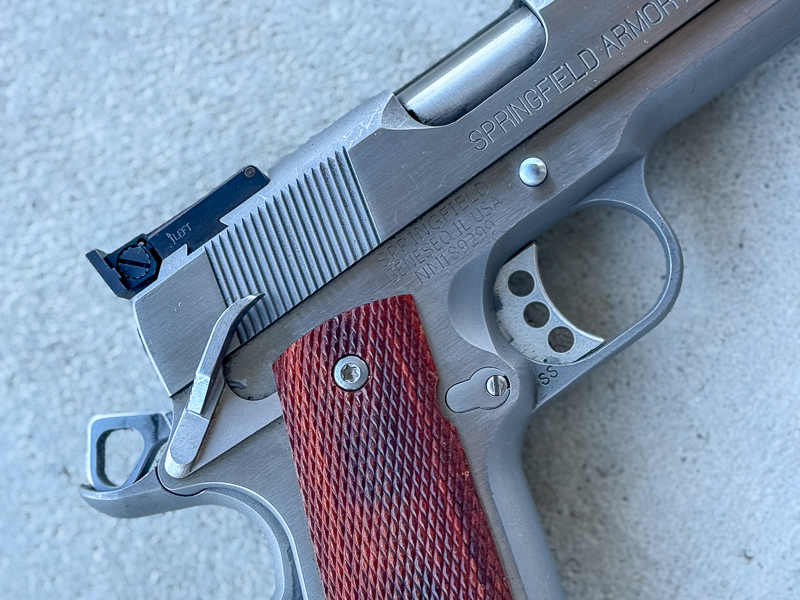
Due to the photo, I expected a piece on handgun safeties, not long arms.
Using the safety in the described context makes total sense, as the people are in close proximity to other team members.
I don’t believe that it necessarily follows for non-mil, non-LE daily carries where they are not on a team.
Yup!
Yup.
In my view, a major cause of this tragic incident for both the deceased (and also for the shooter) was the intentional interaction with the ICE agents brought on by stopping and interfering with the officers performing their duty and blocking traffic on the street just so the driver’s partner could exit the vehicle and video the confrontation they caused while taunting the officers. They could have just continued on their way without obstructing the road and probably none of this would have happened.
Certainly not worth it just for a few minutes of footage on social media. They spoke English. “Stop” does not mean “go”.
Thank you, Mas! I hope your are doing well!
Mas – just curious about your thoughts on Paul Howe’s regular employment of the SUL position in his instruction given your “pet peeve” video on the subject.
Simple difference of opinion.
Back when I first got into shooting (and reading Mas’s articles) as a teenager in the early 1990s, I shook my head in disbelief at the so-called “experts” who claimed that the safetyless revolver was somehow “safer” than an autopistol with a manual safety.
Indeed, whenever my local mainstream media TV news stations would exploit the latest tragedy of an accidental shooting involving a child, the gun in question was invariably a revolver. In each instance, I’d think to myself, “You know, that tragedy might’ve been prevented with an autopistol on-safe).
I carry a S&W SD9ve. No safety, kinda like a revolver. The trigger pull is moderate, so my adrenaline isn’t likely to cause a negligent discharge.