

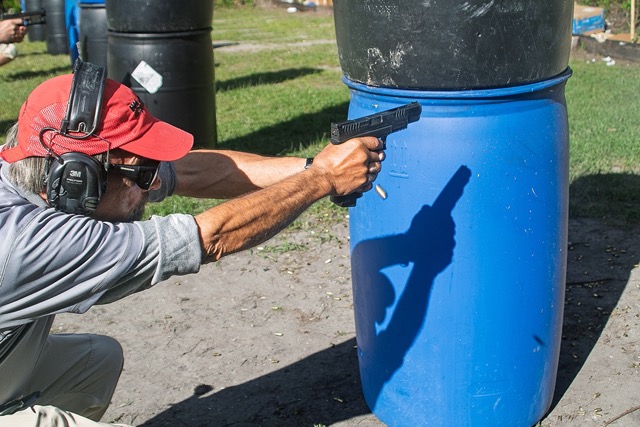

In armed self-defense training, “get off the X” means don’t be standing still in a gunfight. The theory is that a static target is easier for your opponent to hit. True enough, but the totality of the circumstances is sometimes such that “standing your ground” and shooting from a solid stance is the defender’s best bet.
I discuss that here on Springfield Armory’s channel. They have it set up so you can read it or listen to it.
Your thoughts, as always, are solicited.
If “the X” provides cover and/or concealment, getting off it could prove more dangerous than staying on it.
It seems to me that “get off the X” is like “if all else fails, push a pawn” in chess. There are times when it’s solid advice, and times when it’s not. “Getting off the X” solely for the sake of getting off it (or pushing a pawn just for the sake of pushing it) ignores that in both cases there may be better, more tactically-sound moves. In a gun fight (unlike in chess), NOT moving might be the best option.
Keep your head on a swivel and your wits about you to decide based on the facts at hand.
Training students to always take a side-step while drawing seems like range dogma similar to the scanning stuff you see. Moving without taking into account your surroundings may do more harm than good. Prepositioning yourself vs. a potential threat seems more prudent.
Being arthritic and tied to a walker. Bursting of the x isnt an option. That leaves stand and deliver
No walker (yet) but I am certainly not moving fast. It also makes running away impossible unless I am attacked by someone using a walker. Further, I have to spend a lot of time looking at the ground and shuffling to avoid falls, thus obviating a lot of the advice about avoiding selection by predators.
Big Ditto. Have to stand firm and deliver all the shots I can.
Great article, and I like the “real world” examples.
Figuring out if moving is better than shooting, or shooting while moving, should be worked out long before the actual fight. I find competition, even an informal pistol shoot, is a good place to see if you are up to it. Unless I am nearly on top of a target, my accuracy takes a nose dive if I shoot and move at the same time. I go from A zone hits at 7-10 yards in a stable stance to C and D zone hits while in motion, especially if I am tracking laterally from center. Point being, try it before you buy it. Participate in a few moving while shooting drills at events before committing to them to defend your life or the lives of others.
I’m a senior with really bad knees and a questionable back. I’m the first one to admit I’m not moving and hitting a damn thing. I’ll have to hold my ground, get a proper stance and go for it from where I am.
The old expression was to “get off the dime”. In a Sci-Fi series set 600 years from now they wondered what a dime was.
With that out of the way, moving is situational. Moving away from cover is pointless. And yes, if you’re gonna move, MOVE-at speed. That said, a BIG side step while getting the gun into action might not be a bad idea. The shooting while moving stages I’ve seen in competition mostly seem to be set up for a pace suitable for century old emphysema patients. I’ve run over a couple of ROs where the course required a retreat while engaging.
20 some years ago I revised my draw and arm position with the handgun (I’m not dogmatic about the arm position). I find flexed arms (lower & upper arms near a right angle) with isometric tension the gun stays on target and any gun movement from body movement is greatly reduced. Ross Seyfried knew what he was about.
Brian Parrish did an analysis of an interview with Eli Dicken. He apparently went cover to cover and mostly(?) shot from cover. He may have been using the movement of folks fleeing the area to conceal his movements. He repositioned several times, closing the distance.
Went and found Brians PM, Dicken fired every round from a braced position, so he did all his firing from cover.
Speaking of which, braced or supported position shooting is a great addition to training drills.
Comment distantly related to the topic and some concerns expressed above. Something over 50 years ago, a wise old oriental gent convinced me to learn to stand and move with my knees very slightly flexed. This improves balance and moves the body’s weight from the knee joint to the quadriceps. (Watch some NFL corner backs stand/move.) Took me about 3 months to build up the quads to be able to do it full time, but it does eliminate the bounce you see with the gun while moving. Per a Doc, also has saved me from knee, hip and/or spine issues.