


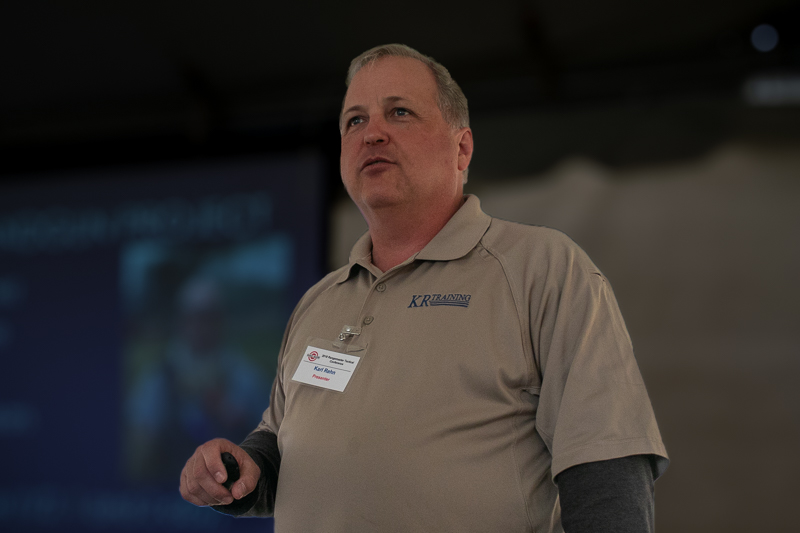
I’ve attended Tac-Con, the RangeMaster Tactical Conference, almost every year since 2009. It provides a smorgasbord of more than 40 subject matter experts in areas of self-defense ranging from emergency medicine through hand to hand fighting to live-fire handgun and shotgun. More courses are offered than any one person can sign up for over the intensive three days. I usually attend with the Evil Princess and we each take different classes and compare notes later to maximize the training experience. This year she was recovering from knee replacement surgery and I had to go alone. I’d like to share some of the bounty of information presented there. Let’s start with my friend Karl Rehn, who synopsizes his own class in handgun ergonomics, here.
Outstanding piece! I realized a long time ago that on a semi, if the middle section of my fingers were at a right angle-or just a tad less- with the barrel axis I had better control of the gun.
I built compensated guns back in the day and still have a .45 compensated slide assembly. Most would be much better off if they spent that money on training & ammo. I can see the redirected gases & particulates being potentially bad in a real world encounter.
Very interesting. I always thought my hands were large until just now when I measured my trigger finger at 3″. I’ve been shooting a 19 or 34 for many years until I picked up a 365 that felt perfect in my hand and shot that way as well. I couldn’t figure out why I shot better with that shorter sight radius until now. Thanks!
Something also to look at is the tactical reload. Perfect practice makes perfect performance, and the tactical reload should be practiced thoughtfully. Unfortunately, the overall length of a cartridge may be critical to feeding function. Attention to overall brand cartridge length and whether all rounds are going to feed perfectly are totally important. If your cartridges are too short, you may get one that drops down the mag well instead of feeding correctly, making you Shortly Out of Luck in a confrontation. I have never had a round be too long to feed well, but I would not arbitrarily rule out the possibility. Also, I use essentially the same grip on my Ruger EC9s as a on a 1911, but the way the hand fits the handle differs. I get about the same trigger push angle, though, as well as equal counter pressure between the palm and base of the thumb.
Small hands, short fingers, yup, that’s me. The only semi-auto pistol that has felt comfortable in my hand was a Type 94 Nambu pistol – which I never fired – no ammunition for it in Australia in the 1960’s. (Wikipedia has photographs. The grip is skinny.)
Double action first shot – say the Baretta 21 or the Bersa Thunderer, not the best. I do better with an elderly Davis P380. (“Bedside” gun: a S&W J-frame.)
Excellent teaching by KR. Ben DeWalt has taught me several of the same things. I have that same grip tester. Even on a bad day my grip is over 100# on either hand so there are multiple options. I’ll bring it to Live Oak next time I’m up to test anyone who wants to.
Karl is one of the best trainers around and a very approachable guy. His points about gun fit are spot on, and I really appreciate the fact he continues to learn and adapt as new information becomes available. His range is somewhat equidistant from Austin, San Antonio and Houston, so if you are in central Texas, he’s a great option for good, solid firearms training.
Mas, as you know quite well, I’ve been working to adapt big guns to small, weak hands ever since Bonnie & I got started in shooting (over 40 years now). You may recall the 11.5″ LOP on her 11-87 shotgun at the Pin Shoot. Years ago, I had our gunsmith cut the grip frame of her S&W M-29 (used only with .44 Spl) to the size of a K-frame round butt, because it fit her hand better. Her pin gun (1911 in .45) had extra-thin grips and a short Videcki trigger with the grooves ground out, plus a big triple-port comp. It also had a game-gun-only 2 pound trigger. This all made the pistol usable by a woman whose hands were the same size (and probably lesser strength) as Justine’s when your daughter was 11. I learned early on to spend the gunsmithing budget on her guns, because I could use almost anything. She needed “orthopedic” guns.
Comments are closed.