

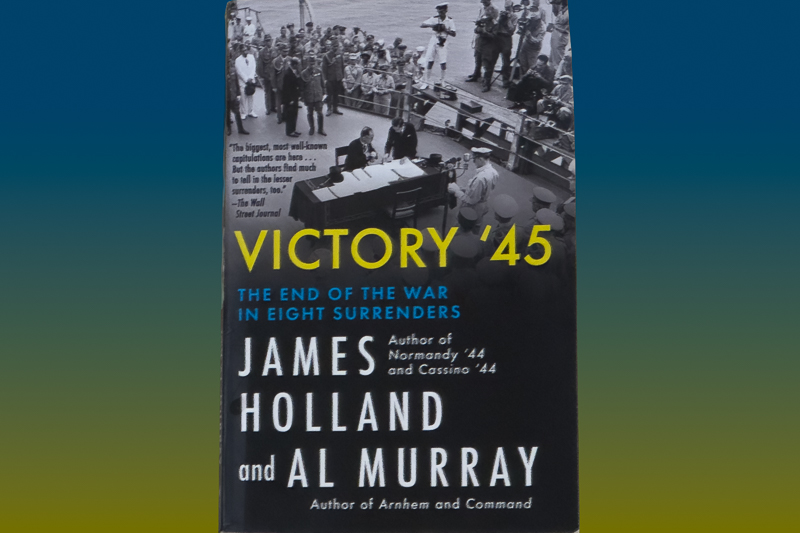

World War II was the war of my parents’ generation. They remembered where they were when they first learned of Pearl Harbor the way I remember where I was when I got the first report of the Twin Towers attack on 9/11. That massive conflict involved so many moving parts, and so many people, that we’ll never know all the details.
Fortunately, thanks to dedicated historians such as James Holland and Al Murray, some of those details constantly come to light even today.
Flying home from teaching a MAG-40 class at the excellent Nebraska Shooters range near Lincoln and not far from Omaha, I read the book “Victory ’45: the End of the War in Eight Surrenders,” in which co-authors Holland and Murray taught me some things I didn’t know even though I had been reading about the conflict my whole life.
For instance, though Franklin Delano Roosevelt had seen the war coming on both fronts, he seems to have concentrated on Europe more as he built his “arsenal of democracy” beginning in the 1930s, but appears to have neglected the Pacific element. American interests in the Philippines were woefully inadequate. The White House had to have known that Corregidor was doomed, leading to its fall and the Bataan Death March. General MacArthur can be forgiven for abandoning the place – FDR apparently ordered him to do so – but he left General Wainwright in charge along with his hopelessly small and undersupplied contingent of troops. At the end of the war, the survivors of the brutal treatment at the hands of the Japanese Empire were a sorry sight, Wainwright himself down from 170 pounds to a skeletal 125. When he finally met MacArthur again after the war was won, we are left surprised that he greeted his commanding officer collegially instead of kicking him in the crotch.
“Victory ‘45” is a great read. Don’t be surprised if you see parallels with eighty-plus-year-old history and today’s headlines.
World War II affected virtually everyone in this country, from those in uniform, to workers in defense plants, aircraft factories and shipyards, to rationing, relocation camps, scrap metal drives, and on and on. Today, most people can’t even tell you when it began and ended.
It’s been often, and accurately, noted that most militaries continue their readiness preparations to the requirements of the immediately previous wars. Yet, the blame doesn’t rest entirely on them. The pols are reluctant to spend money where it doesn’t directly benefit either their political subdivision or viewpoint.
If you can find a copy, you might read “East Wind, Rain” (IIRC) written by MacAuthur’s Chief of Staff. He was Inspector General in Hawaii up to Pearl Harbor. The title was allegedly the “GO” signal for the Pearl Harbor attack. He paints an interesting picture of “readiness”.
My Dad (God rest his soul) graduated high school 6 months before Pearl Harbor was attacked and ended up serving with Marine Air Group 61 (MAG 61) from
1943-1946.
Meanwhile, my Mom (God rest her soul) was a 2 y/o girl living in the Philippines when the Imperial Japanese Army invaded; she lived three years of her toddlerhood under enemy military occupation until Gen. MacArthur made good on his “I shall return” promise.
“Those who do not remember history are condemned to repeat it.”
George Santayana
Check out
Downfall: The End of the Imperial Japanese Empire
By Richard B. Frank
Great read, meticulously researched…
1 million men wasn’t the tally to take Japan. It was the monthly losses.
The Unconditional Surrender theory is still with us. Really, only Germany and perhaps Hungary fit that model. Japan got one condition (the Emperor). Italy, Romania and Bulgaria basically switched sides and got lots of conditions (not that the Soviet promises were worth anything). Finland negotiated peace and preserved their existence, though with territorial loss. Without reading the book, I am not sure who the other one was. Slovakia? Germans surrendered 3 times in various places so maybe another on of the surrenders?
Wars end with negations much more often than surrender at least in modern times. Even the 30 Years War, the worst one before the 20th Century had a negotiated end.
Fun Fact: The U.S. military fought World War II on two different fronts with five (5) four-star generals. Today there are 37.
WR Moore wrote:
‘It’s been often, and accurately, noted that most militaries continue their readiness preparations to the requirements of the immediately previous wars.’
Or you can be the currenet US Military, who after four years of war in Ukraine, didn’t know you can’t stop every drone.
njk