

Backwoods Home Magazine


Remembering
Sept. 11, 2001

Subscribe to Backwoods Home Magazine

Features
   Home Page
   Current Issue
   Article Index
   Author Index
   Previous Issues
   Newsletter
   Letters
   Humor
   Free Stuff
   Feedback
   Recipes
   Tell-A-Friend
   Home Energy Info
   Ask Jackie Online
   Print Classifieds
   Trading Post

BHM Blogs
   Dave Duffy
   Massad Ayoob
   Ask Jackie Clay
   Bramblestitches
Retired Blogs
   David Lee

Quick Links
   Jackie Clay
   Ask Jeff Yago
   Dave Duffy
   Massad Ayoob
   John Silveira
   Claire Wolfe

Forum / Chat
   Forum/Chat Info
   Enter Forum
   Member Chat
   Lost Password

General Store
   Ordering Info
   Subscriptions
   Anthologies
   T-Shirts
   Books
   Back Issues
   Help Yourself
   All Specials
   Classified Ad

Advertising
   Web Site Ads
   Magazine Ads

More Features
   Links
   Country Moments
   Radio Show
   Meet The Staff
   Contact Us/
   Address Change
   Write For BHM
   Privacy Policy

News/Politics
   Dave Duffy
   John Silveira
   Columnists


Vise Dremel Moto Tool mount

By Dana Martin Batory


Sometimes it seems two hands are not enough—three would be nice, four even better. This economical, easy to build jig solves that common workshop problem. Designed to make use of standard pine 2x4 scrap lumber and some ordinary hardware, it firmly holds a Dremel Moto Tool (or a similar tool) and in turn is supported securely between the jaws of a vise, freeing both your hands for grinding, carving, etc.

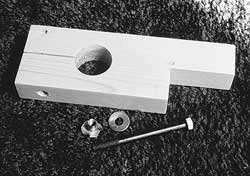
The parts making up the vise mount. Holes have been drilled in the blank and the expansion slot has been cut. The bolt, Tee nut, and washer are ready to be installed.

The project can be accomplished using hand tools, but power tools will give more precision.

General construction

Pine 2x4s under ordinary conditions will work fine. If the jig is going to see long and rough use, a hardwood such as oak, beech, or maple should be used. If you have access to a machine shop the jig can be duplicated in brass, aluminum, or mild steel. Be sure to measure the diameter of the tool’s housing before drilling. They can vary.

The vise mount in use (horizontally)

Materials:

  • one blank, 10" long by 3˝" wide by 1˝" thick

  • one 3/8"x16 4-inch-long bolt

  • one 3/8"x16 Tee nut

  • one 3/8" inside diameter washer

Instructions:

Cut blank to length and width. Lay out all lines and holes. Drill opening for Dremel Tool with a 17/8-inch bit, hole saw, or circle cutter. If using a drill press do not hand hold—use clamps and plenty of them. Prepare bolt hole by first countersinking for the 1-inch flange of the Tee nut. Use a 1-inch spade bit and drill about 3/16 inch deep. Follow this with a ˝-inch bit using the first hole as a drill guide. Saw kerf in end. Cut out tongue. Sand, varnish, and wax the jig. Tap Tee nut firmly into place. Run through bolt and washer.

The vise mount in use (vertically)

Use of the jig

Place the jig in the vise and tighten jaws. Slip the Moto Tool into the jig and snug up with the bolt. Do not over tighten, as you can break the motor housing. The jig can be used vertically, horizontally, or even tilted.




Read More Building & Tools Articles


Comments regarding this article may be addressed to editor@backwoodshome.com. Comments may appear online in "Feedback" or in the "Letters" section of Backwoods Home Magazine. Although every email is read, busy schedules generally do not permit a personal response to each one.


www.backwoodshome.com designed and maintained by Oliver Del Signore
© Copyright 1998 - Present by Backwoods Home Magazine