
 |
|
| Issue #52 • July/August, 1998 |
“If you’re going to make something that you want to last, why not start with good quality material,” says Margaret Boos who raises and spins her own wool. She makes and sells beautiful hats, purses, scarves, and many other things, and I recently had the chance to learn how she does it and make some with her.

Annie Duffy spins Cotswold wool. |

Some of Margaret’s ski caps that she made out of un-dyed yarn |

Some of Margaret’s other projects |

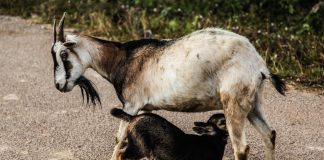
Mother takes interest as Margaret Boos plays with lambs. |
Margaret and her husband, Paul Boos, have raised their own sheep for 20 years. They are currently the only owners and breeders of Cotswold sheep in Siskiyou County in northern California. Cotswolds are a long-wooled breed of sheep. Their wool is curly, rather than crimpy, and has an amazing luster that is apparent even when the wool is dyed and felted. They are on the rare breeds list of sheep, the livestock equivalent to the endangerd species list.
Along with her blue-ribbon Purebred Cotswolds, Margaret also raises Corriedale-Cotswold and Rambouillet-Cotswold crosses.
The Booses hire a professional to come sheer their sheep. The last time they sheered sheep they got 33 fleeces.
Margaret individually wraps and labels each wool fleece with the sheep’s name, because each sheep produces a different texture of wool. She wraps it with a bed sheet instead of a plastic bag because the wool has to breathe.
Before she washes the wool, she shakes out as much dirt as she can. Then, using her washing machine as a basin because it is large, she fills it with hot water and soaks the wool adding Orvis, a mild detergent used for 4-H animals and handmade crafts. Orvis has no chemicals and leaves no residue.
Margaret said it’s important not to agitate the wool, or even let the water beat down on the wool, because that can ruin the wool by making it turn to felt.
After the wool soaks for a few hours, she pulls it out, drains the washer, and refills it with lukewarm water to rinse it. She takes the wool out again, drains the water, and puts it back in and runs the machine on the spin cycle to spin the excess water out. She then lays the wool out to dry on racks out of the sun. Once the wool is dry, she picks out the remaining burrs.
I got to help Margaret when it came time to spin the wool into yarn. The first step to prepare the wool for spinning is to card it. Carding wool is like brushing it: it lines up the fibers so they can be easily spun. Most people don’t have the luxury of an electric carder, but Margaret wanted to save herself the nasty task of hand-carding. She says hers was expensive but well worth it. Depending on how smooth you want the finished yarn, you can run the wool through the carder as many times as you want. Today we ran the wool through the carder twice so it wouldn’t be too lumpy to work with. If we wanted the coarser “home spun” look, we would have only run the wool through once.
Then I spun the wool into yarn on a spinning wheel. It was hard for me to keep the yarn from over-twisting on the wheel because I’m so inexperienced, but after a while I got the hang of it. My finished yarn had some huge nubs in it, but Margaret said it looked pretty good for the first time.
Once all of the wool was spun into yarn, I took one end of the yarn and wound it onto a yarn winder to count the yardage. Each time the rack makes a full revolution it equals two yards. I tied the yarn on one side so it wouldn’t get tangled, then took the yarn off the winder and put it in a sink to get it wet so we could stretch the kinks out. We didn’t let the yarn soak, but just swished it in warm water, then spun the water out in the washing machine. We put the yarn on an Umbrella Swift, a rack that expands to any diameter to get some of the kinks out by stretching it a little bit, then wound it back onto the yarn winder. We let it dry overnight.
The next day, when I got back from school, I went back to Margaret’s to finish my project. I wasn’t even sure yet what I wanted to make. I decided to make a dream catcher-like weaving. Margaret had made a circular frame by weaving small sticks together and I wrapped yarn around it to make the warp of the loom, then wove some of my yarn back and forth. Margaret gave me some of her dyed yarns to intersperse with mine. I wove in some green, blue, and red. Once I finished weaving, I tucked some feathers into it and tied on some beads. It now hangs on my wall near my bed. Not only did I learn a lot about making yarn, but I also made a good hand-made addition to my art collection.