
| Issue #69 • May/June, 2001 |
The wild plum is a fickle fruit, ripening any time between late spring and late summer. It comes in a bunch of colors, shapes, and sizes. Some are sweet, some tart. And it boasts one of the highest food values20% carbohydrate contentof any other fruit.
From late May to midsummer, wild plums (Prunus americana and other species) are ready to be picked. Throughout the U.S. there are about 30 varieties of native wild plums. Additional natural hybrids add to the complexity of variation and dilution of “purity.” In the Northern Hemisphere there are 2,000 variations of these main varieties.

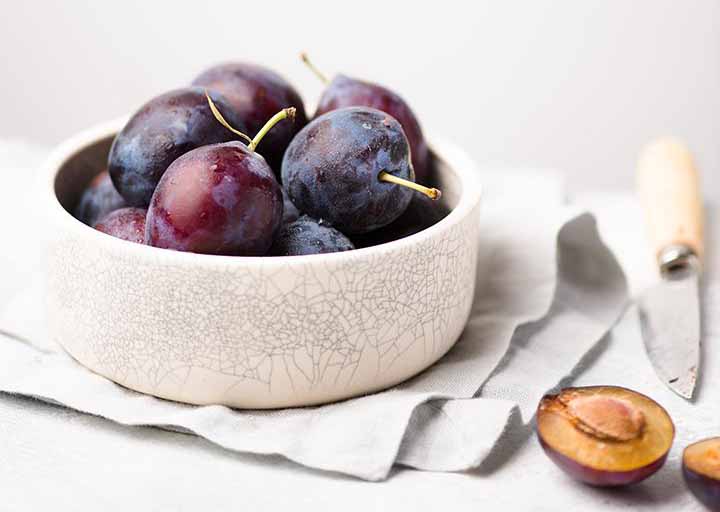
Some plums are the size of cherries, some the size of golf balls. Wild native types range ½ to 1½ inches in diameter. And skin color is diverse: deep vivid red, glowing orange, bluish crimson, bright red, bright yellow, dark yellow. All are smooth skinned, hard-pitted dupes, with yellow juicy “meat.” Shapes may be round, oval, conical, or heart-like.
Ripe plums drop into one’s hand at a finger’s slightest provocation, and yield an elastic sensation to the squeeze of pinching fingers. Many times ripened fruits which are still warmed by the sun, and yet untouched by the ravages of decay, can be retrieved from the ground. Most of the harvest for jelly should be ripe.
Plums that do not separate easily from the twigs are not fully ripened. However, a few of these should be included in your harvest to add a tang to one’s batch and, more importantly, natural pectin, the substance that makes jellies jell.
While picking plums, exercise caution. The twigs of these scrubby trees are covered with dull pointed thorns. The fruit itself grows singly, not in clusters as do cherries.
Six pounds of plums should make four or five pints of crimson jelly or jam. After they are washed and pitted, the plums should be placed in a pan with two cups of water, covered with a lid and put on a stove on “high” and occasionally stirred until the mixture boils. The mush should be stirred while the fruit is softening up. The process shouldn’t take longer than 30 minutes.
Once “mushified,” the plum residue should be left to cool and then poured into a jelly bag which has been draped over a colander inserted into another pot. The plum mush should be left to drip through the jelly bag until all the juice has been collected in this second pot. This may take several hours. Letting it drain overnight may be practical. One should not squeeze the plums to get the juice out. Doing this clouds the jelly.
Plums may be kept in the refrigerator for a few days if a delay in preserving them is necessary. This may occur when there has been a limited daily harvest because of slow ripening of the crop. The delay will enable one to replenish the harvest on subsequent days.
To ensure jelling, one box of prepared fruit pectin (1¾ dry ounces) should be used for every six cups of the cooked plum juice. To begin converting the juice to jelly, the juice should first be brought to a boil, then the pectin added. Next, 7½ cups of sugar should be added and the mixture stirred to avoid scorching. Bring it to a boil again and keep it boiling for a minute before removing the pan from the heat.
Foam should be skimmed off the top before the remaining hot juice is poured into jars. Jars should be heated beforehand, either by scalding or by heating them in an oven at 200°F for about 15 minutes.
Some homemakers may prefer to seal the preserves in paraffin, or seal with domed lids according to package directions.
The native wild plum, made into preserves as early as Colonial times, is not important commercially in this country, but it is tasty nevertheless when homemade.
UPDATE—Carole Evans writes:
I am a Certified Master Food Preserver since 2007 from OSU Extention in Oregon.
It is no longer recommended to scald or put jars of jam in the oven or using paraffin wax. You should be using canning jars lids and rings and using a water bath canner. The time for plum jam up to 1,000 feet is 10 minutes and 1,000-3,000 feet add 5 minutes. Adjust for altitude. Please check an up to date canning book so everyone has a safe product to eat.