

 |
|
| Issue #41 •September/October, 1996 |
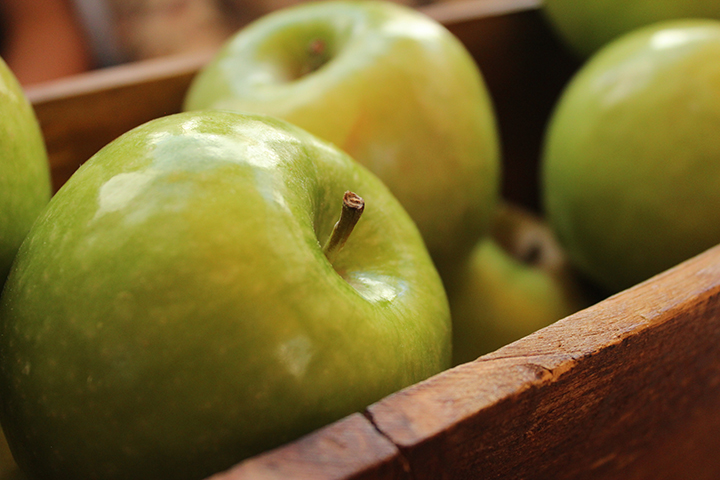
Almost any kind of apple will keep for three or four months, or even longer, if stored properly. It’s cheap and easy to do. All you need is newspaper, a box or basket, and apples. A root cellar is optional, but not necessary.
The main causes of apple spoilage are time, bruises, and contact with a rotten spot on another apple.
Time
Time can be stretched by selecting long-keeping varieties of apples for storage. Tart and thick-skinned apples like Jonathans generally keep longer than sweet or thin-skinned ones like Delicious. Good keepers also have very firm flesh. The best keepers I have found are Spur Winter Bananasfrom C&O Nursery, P.O. Box 116, Wenatchee, WA 98807.
They are yellow and tart at harvest, but get redder and sweeter, and actually taste better after a couple of months in storage.
Contact
Prevent contact between apples stored for the winter by wrapping them individually in sheets of newspaper. The easiest way to do this is to unfold a section of newspaper all the way and tear it into quarters. Then stack the quarters. Avoid sections printed with colored ink, which contains poisonous heavy metals.

Place an apple on top of the stack and fold the top sheet of paper up around the apple, wrapping it in paper. Give the corners a slight twistjust enough to make them stay wrapped. If you twist them too hard, the paper will tear. It’s not necessary to exclude air. Just twist hard enough so the paper doesn’t come unwrapped before the apples are boxed. The paper prevents contact between apples, so just one rotten apple won’t spoil the whole bunch. With practice, you’ll be able to wrap and store apples as fast as you can scan them for bruises and sort them.
Sorting
Always handle apples carefully, to avoid bruising them. Apples with even small bruises must never be stored with “keepers.” Only perfect apples should be used for long-term storage. Even minor imperfections speed spoilage. While you’re wrapping, check each apple for cut skin, soft spots, or bruises. Even bruised apples taste fine when they’re fresh, so sort the best culls into a box to be eaten right away. If there are too many, make apple pie filling out of the excess. Use culls with extensive blemishes for cider. Or cut out any really gross parts and make applesauce.
My family owns two Victorio strainers. We blanch the apples to soften them, cut them in half, throw them in the hopper, and turn the crank. The Victorio separates the pulp from the skins, seeds, and stems, and produces fresh applesauce, ready for canning. With both strainers going, we can put up more than two bushels of apples an hour.
Canned pie filling, applesauce, and cider will keep for a year or more. Fresh cider that has started to turn sour can be made into hard cider, vinegar, or applejack (see Issue #35, Sept/Oct 1995). All three will keep indefinitely.
Storage
Boxed apples need to be kept in a cool, dark spot where they won’t freeze. Freezing ruptures all of an apple’s cells, turning it into one large bruise overnight. The usual solution is to store apples in a root cellar. But root cellars often have potatoes in them, and experts say that apples and potatoes should never be stored in the same room. This may seem incongruous, but there is a reason. As they age, potatoes release an otherwise harmless gas that makes apples spoil faster. If you can keep the gas away from your apples, they will keep just fine. Just don’t store them right next to potatoes.
I keep wrapped apples in a cardboard box. It need not be airtight, just tight enough to impede air circulation. I’ve kept apples in an unheated basement, a pantry, an enclosed porch, an unheated attic, even in a root cellar, potatoes and all. Using these simple methods, I have kept ordinary apples until late February, and Winter Banana apples into March.









I recycle purple cardboard apple box liners that I get free from supermarkets. I set one box liner inside a shallow grape or strawberry box that I also get free from supermarkets. Set one apple in each cup. Invert another purple box liner underneath the box on a shelf or cold floor so that there is also air circulation underneath the box. Best if you have the shelf or floor space for only one box without stacking them. if you must stack, turn them crosswise to allow for air circulation. Do not store near potatoes as it will make the potatoes mealy. Rotate at least once a week early in storage, more often later in storage. Late season apples develop sugars in storage, so will last longer. “Summer apples” have higher concentrations of sugar and spoil faster. Sort out any apples going bad for critter food. Apples are not keeping as well this year, but I still have about half the apples I picked in early September that are lovely. Only the best and nicest apples go into cold storage. The rest get made into applesauce, used for baking, pressed for cider, or juiced and canned.
Short, sweet article, thanks!Most anything will store well in a basement at 40 degreesF, but I’m not sure where that is, or how deep that cellar would be underground. Thanks for the tips.
Very Nice information i wan to store too many apples for eating them daily. is it possible?
Can I use packing paper instead of newspaper?
Which type last years please
Some apple will keep for a couple of years in a cellar with our any special preparation, They have tough skins and gradually wither. excellent for slicing and putting on flans.