
 |
|
| Issue #59 • September/October, 1999 |
If you plan to freeze your vegetables, it is a must to blanch most of them. Blanching slows or stops enzyme action which can cause the vegetables to lose flavor, color, and texture. It is very important to remember that blanching time varies with the size and variety of vegetables. Underblanching stimulates the activity of enzymes and is worse than no blanching. Overblanching causes loss of flavor, color, vitamins, and minerals.
There are two ways to blanch vegetables: boiling water or steam.
- First wash, drain, sort, trim, and cut vegetables as for cooking fresh.
- Use one gallon of water per pound of prepared vegetables, or two gallons for leafy greens.
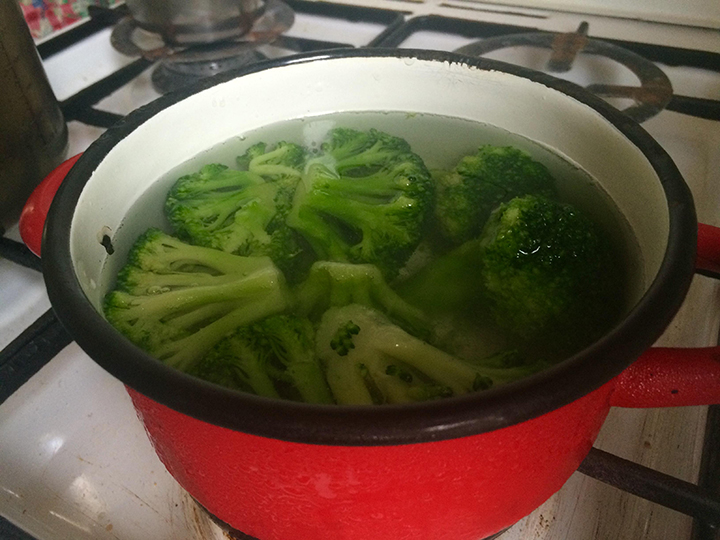
- Put vegetables into blancher (wire basket, coarse mesh bag, or perforated metal strainer) and lower into boiling water.
- Place a lid on the blancher and start counting blanching time immediately.
- Keep heat high for the time given in the directions.
- Cool immediately in ice water for the same time used in blanching (except for corn on the cob). Stir vegetables several times during cooling.
- Drain vegetables thoroughly.
- Pack into container or spread in a single layer on shallow trays.
- Freeze.
Vegetable Blanching Time (minutes)
Artichoke, Globe Hearts 7
Artichoke – Jerusalem 3 – 5
Asparagus
- Small Stalk 2
- Medium stalk 3
Large stalk 4
Beans, Snap, Green, Wax 3
Beans, Lima, Butter, Pinto
- Small 2
- Medium 3
- Large 4
Broccoli (flowerets 1½ inches across) 3
- Steamed 5
Brussels Sprouts
- Small heads 3
- Medium heads 4
- Large heads 5
Cabbage or Chinese Cabbage
- Shredded 1½
- Wedges 3
Carrots
- Small, whole 5
- Diced, sliced or lengthwise strips 2
Cauliflower (flowerets, 1 in. across) 3
Celery 3
Corn
- Corn on the cob: (Cooling time for corn on the cob is twice the time for blanching).
- Small ears 7
- Medium ears 9
- Large ears 11
- Whole kernel or cream style 4 (Ears blanched before cutting corn from cob).
Eggplant 4
Greens
- Collards 3
- All other 2
Kohlarabi
- Whole 3
- Cubes 1
Mushrooms
- Whole (steamed) 5
- Buttons or quarters (steamed) 3½
- Slices (steamed) 3
Okra
- Small pods 3
- Large pods 4
Onions (blanch until center is heated) 3 – 7
- Rings 10-15 seconds
Parsnips 2
Peas – Edible pod 1½ – 3
Peas – Green 2
Peppers – Sweet
- Whole 1½
- Halves 3
- Strips or rings 2
Potatoes – Irish (new) 3 – 5
Rutabagas 3
Soybeans – green 3
Squash – summer 2
Turnips 2