
| Issue #68 • March/April, 2001 |
Here’s a gadget I developed to run barb or barbless wire. You mount it on the back of a pickup truck using the ball hitch (see drawing) so the wire can spin off the roll. I call the device the Fencerunner and am currently trying to market it. It works like a charm and saved me hours of work, enabling my sons and I to do a quarter mile fence in 45 minutes.
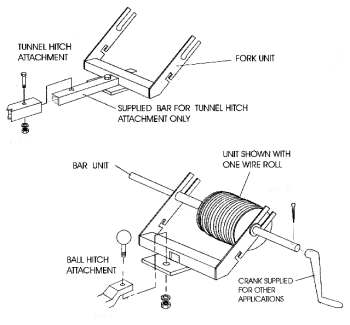
The unit uses the ball hitch or tunnel hitch attachment found on some cars and most trucks. It can be adjusted to use one or two rolls of wire. It consists of two units, the fork unit and the bar unit. The fork is installed as shown in the figure. The ball itself is used to secure the fork unit to the hitch. The bar unit consists of a shaft assembly to hold the wire rolls. The shaft of the bar unit is inserted through the wire rolls. The disc is next and then the spacer. The bar unit has three spacers for different width wire rolls. The next step is to lift the bar unit and insert the two slots on the fork unit.
 Two views of the Fencerunner, one showing a tunnel hitch installation and the other a ball hitch installation. |
With my first prototype, I had to lift an 80-pound roll and drop it over a vertical shaft. I found this difficult, so with my second prototype I made the fork unit with more of a horizontal angle.
You need to park the vehicle as close to the fence posts as possible, securing the end of the wire from the roll to the first post to start the run. The vehicle is then driven slowly along the fence line as the wire spools off the roll. When the vehicle reaches the end of the run or when the wire roll has about three turns of wire left, insert the wire into one of the slots in the fork unit. This will kink the wire and keep the bar unit from turning. Then drive the vehicle forward just enough to stretch the wire. Another person can signal the driver when the wire is taut. At this point the wire is simply lifted up to each post and secured. I didn’t need a wire stretcher when I did my fence.
The crank handle on the unit allows you to reel in the old barbwire instead of just leaving it on the ground.
If you’d like more information, contact Mike Haverland at 3105 Cortina Dr., Colorado Springs, CO 80918. Phone 719-260-7848.
BHM invites readers to write about promising inventions they have created that will help others with their self-reliant lifestyle. Keep your text and illustrations to one page. If accepted, there is no payment.