

 |
|
| Issue #110 • March/April, 2008 |
Safety note: Because of drowning danger, 5-gallon buckets with any amount of water in them should never be placed where children under the age of 5 will be present.
When the mice are giving you a problem in the barn or feed shed you can put a significant dent in the population in short order with a repeating mousetrap. Standard mouse traps are a one-shot deal. Once sprung you need to bait and reset them. To be effective these traps need to be checked daily. While commercial repeating traps work well they have a very limited holding capacity until the mice need to be removed. That means you need to check the traps often as well. But there is a better mousetrap.
How would you like to have a trap that you only bait occasionally and only have to check every week or two during warm weather or maybe just monthly during the cold of winter? You can build your own repeating mouse trap from items you may already have on hand.
The only materials you will need are: a paper or Styrofoam plate, a wire coat hanger, a couple of sticks, and a five-gallon plastic bucket. The empty plastic buckets are easy to come by. You probably have some that have previously held paint, joint compound, or laundry detergent. I often see them littering the roadway. Grab one of these and you’ll also be helping clean up our environment a little.
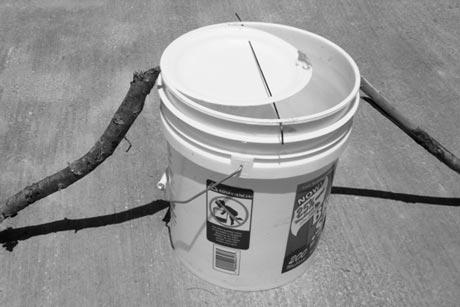
Drill two small holes on opposing sides of the bucket, just under the rim about halfway across the opening. Cut the straight and longest section from the bottom of a wire coat hanger. Insert one end of the coat hanger piece into one of the drilled holes. Turn the plate upside down and position it so it’s over the opening of the bucket with one edge of the plate resting on the rim of the bucket halfway between the drilled holes. Poke the end of coat hanger through the plate about an inch from its edge. Continue with the coat hanger by running it under the plate and through the opposite side of the plate about an inch from its edge. Run the end of the coat hanger through the remaining drilled hole. Add two or three inches of water to the bucket. Prop a stick or two on each side of the bucket to allow mice easy access. Spread peanut butter on the edge of the plate that is over the water. Flip the plate and bait the other side of the plate in the same vicinity. Don’t add too much peanut butter or the plate will tip vertically. You want the non-baited part of the plate to rest on the rim of the bucket. Your trap is now ready to work.
|

When mice get a whiff of the peanut butter they’ll climb the stick to the top of the bucket to investigate. If they want the peanut butter they’ll have to walk across the plate to reach it. Once they cross the point where the coat hanger passes through the plate, the balance of the plate will change, dumping the mouse in the bucket. The water prevents them from jumping out and will put an end to their feed-stealing ways. When the plate tips to drop the mouse it flips all the way over and rests on the opposing side of the bucket. Because you put peanut butter on both sides of the plate it is now reset and baited for the next mouse. The mice rarely get a chance to savor the flavor of the peanut butter so it will stay intact for many more mice to come. When you check your homemade repeating mousetrap you might want to empty the mousy water and replace it with fresh water to reduce any foul odor.
Allen Easterly is a freelance writer building a retirement hobby farm in the mountains of Basye, Virginia.













Score one more success for this method!
I had been leaving traditional mouse traps with peanut butter on them and the mice were eating the peanut butter without tripping the traps!
But not anymore! I put this trap together and a few hours later, the mouse population around here is decreased by one! Yay!!
If you want no kill you leave out the water. I put a layer or two of crumpled tissue or paper towel to soften their fall. Check the trap often several times a day. Release the mice at least 3 mikes from your home.
I’m training to be a veterinarian. I don’t want to hurt anyone. I’m gonna try this trap!
Thanks!
@Christopher Unless I’m missing simething, the no-kill label is false; if it’s enough water to keep the mouse from touching the bottom with his nose out of it, in order to leap out, then it’s enough water to drown. Use a trap deep enough to keep Mighty Mouse in it until you can release him far away; the fall shouldn’t hurt him. Or, you can use a substitute like maybe styrofoam packing peanuts, or maybe bubble wrap – something that will shift when pushed against to leap and thus disperse the energy.
@marie Peppermint is a repellent to mice, not a bait.
use peppermint oil
We did this camping once. Mice were really bad and getting into our camper and food.
Instead of a plate. I use a soda can and run the wire thru the can. Smear a dab of peanut butter on the can and the mice will try to get the peanut butter and the can spins and they drop in the bucket. 12 mice the first night in my basement and another 20 in my shed – it works!
I put PB on a paint stick balanced off a counter over a bucket. 10 minutes later and it hasn’t moved. Will the mouse escape if I don’t drown it in water? I think the mouse will just pull the stick in with it’s foot rather than clime out, we’ll see, maybe it’s stupider than me.
I’ve caught 14 mice in 3 nights with this contraption. I will never set a snap trap again.
This is listed under a “no-kill” heading. How much water do you use?
I have my first mouse in garage.
I used a piece of cardboard. Pushed a BBQ skewer through the space part and already had a small rectangular plastic shoe box just made two holes for skewer.
Viola! !!! I wanted something VERY simple and FAST to make. Mouse be gone! !!
My wife’s tool kit includes a butter knife for a screwdriver and a high heel shoe for a hammer. I can only say thanks to her great sence of humour cause I tease her from time to time. Its a good thing we both have that humour cause she knows how to get even.
Ms. Betty Kucera; what is it about the photo of the bucket that you do not understand how to replicate? If you can’t figure that out, you should not be using tools and you should definitely be wearing a helmet.
Please show directions how you do this not finished product. Some of us are not engineer material. Thanks