
| Website Exclusive • August, 2008 |
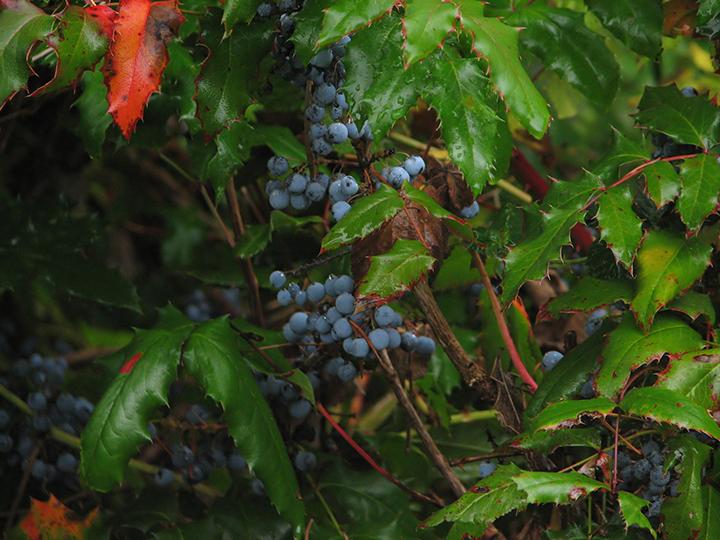
Oregon Grape (Mahonia aquifolium) bushes are native to the West Coast from northern California to British Columbia. They are the state flower of Oregon. The bushes come in different varieties from two feet to six feet or more in height. They will grow in most climates, except “Mediterranean” areas. Their leaves are very spiny, so they make good barrier hedges. Leaves may turn a decorative bronzy color at times. The dark blue/purple berries always look tempting but are somewhat sour to the taste. Surprisingly, I’ve found they make good jam during the summer season.
Harvesting tips

1. Grapes hanging at the tips of branches and in the sun ripen first.
2. Oregon Grape leaves are spiny and prickly. The berries are soft and plump when ripe. If desired, use latex surgical gloves for picking. These will protect your fingers (somewhat), yet allow you to feel the grapes for ripeness.
3. Choose berries that are dark blue to purple in color. Do not cook ones that are still green or have already matured and shriveled; they won’t be juicy.
4. A fast way to harvest grapes is to hold a branch in one hand while stripping the cluster of berries with the other. You’ll need to position your container to catch the dropping berries, and you will get debris along with your berries, but that can be sorted out later.
5. To separate leaves, stems, and the unwantedwhich usually includes a few bugsfrom the Oregon Grapes, pour the berries into a shallow cardboard box (about two inches high). Shake the box from side to side. Oregon Grape berries are hardy: you will not damage them by gentle shaking. This will also remove most of the tiny stems. Grab up handfuls of berries, inspecting them for color and plumpness as you transfer them to another container. Throw out debris and unsuitable berries. Repeat the process. Soon you should have berries free of debris and ready to rinse.
Oregon Grape jam (or jelly)
Makes approximately four 6-ounce jars
2 to 3 cups fresh-picked Oregon Grapes, rinsed
2 cups water
½ packet = 1 ounce ( ½ of a 1/3 cup measure) commercial pectin
2½ cups sugar
Before you start, sterilize four 6-ounce glass jam jars with boiling water. Wash the lids.
Method:
Boil rinsed Oregon Grapes in 2 cups of water for about 10 minutes.
Pour mixture through a colander set over a large pan. Using the back of a wooden spoon, mash the pulp then press some of it through the colander into the pan below. Discard the seeds. (At this point, to make jelly, strain the pulp through cheesecloth.)
Bring mixture to a boil again.
Stir in 1 ounce commercial pectin, then bring to a rolling boil.
Add 2½ cups sugar, stirring constantly. Stir and boil for about 4 minutes, or until the mixture thickens.
Set the glass jars on a wire rack or folded towel for cooling, then carefully ladle the jam into the jars. Cover loosely with a towel overnight.
When set (probably by the next morning), the jam may be refrigerated for up to three weeks, or frozen for up to a year. Or you may can the jam or jelly as you usually do.