

| Issue #18 • November/December, 1992 |
Recycling makes a lot of sense in these days of dwindling landfill space and non-renewable resources. But I can remember practicing recycling in my home when I was a kid, too, only we didn’t know back then that that’s what it was called. We flattened tin cans and bundled newspapers. Every Saturday we had soup made from the week’s leftovers. Nothing ever went to waste.
My parents had just survived the Depression, and they knew how to stretch a buck. My mother never threw anything away if another use could be found for it. When a towel wore out, or a sock was widowed, it became a scrub rag. Holey undershirts made good dust rags, and thin old bed linens could be torn and used for a lot of things paint rags or tie-ups for tomato plants, or even kite tails.
My favorite recycling memory involves the rag bag. The summer after kindergarten, when I outgrew my best grey and yellow plaid dress, my mom and I tore it into strips for making rugs. First, we took out the hem and some of the seams, and pulled out the gathers at the waist. We removed the buttons, of course, and saved them in the button box. Mom made little snips as starters, about two inches apart, along the edge of the fabric. And then we tore.
When we finished, we put the strips of fabric into a big brown paper bag, jumbled together with blue flowered apron strips, brown and white striped shirt strips, pink blouse strips, and red flannel nightgown strips. There were even some mysterious pieces of cloth that I’d never seen before, colors that I’d never personally experienced, in the pile of clothes we tore up that day.

Other bags of rug rags were stored in the attic. We opened the door at the foot of the attic stairs and battled our way through the cobwebs with rolled newspaper swords as we creaked up the wooden steps. The attic was as hot as melted butter, like it always was in summer. The sun slanted through the dirty window, dancing with dust motes.
After shaking and blowing layers of dust off the bags, mom unrolled the tops and dug her hands in, sifting her fingers through the cloth strips, dragging them out in bunches, judging quantities and colors. I can still remember the smell of cotton and dye, soap and sunshine and mothballs.
After they passed her test we brought them all downstairs, and that’s when the magic began.
She sewed the strips end to end, choosing each next piece by whimsy or by art. Sometimes the colors shaded from dark to light, sometimes they changed abruptly from yellow to black to green to red. Long exotic snakes of fabric coiled onto the floor behind the sewing machine.
Years later, our old black and gold treadle Singer was converted into an electric portable. But I can’t picture my mother sewing any way except with her right foot flat on the treadle, and the left cocked so that only the toes touched. She’d hit the flywheel with her right hand to start the needle driving up and down, then set the rhythm with her feet, start and stop, start and stop, adding in new scraps of color.
The next step was to roll the cloth strips into balls. Both my father and I got to help with this part. Pieces of my dress showed up in each of the balls.
Mom packed them into May Company bags with handles and carried them to Mrs. Rodecker, who had a loom. She was a widow supporting herself by doing needlework for neighbors and weaving rag rugs.
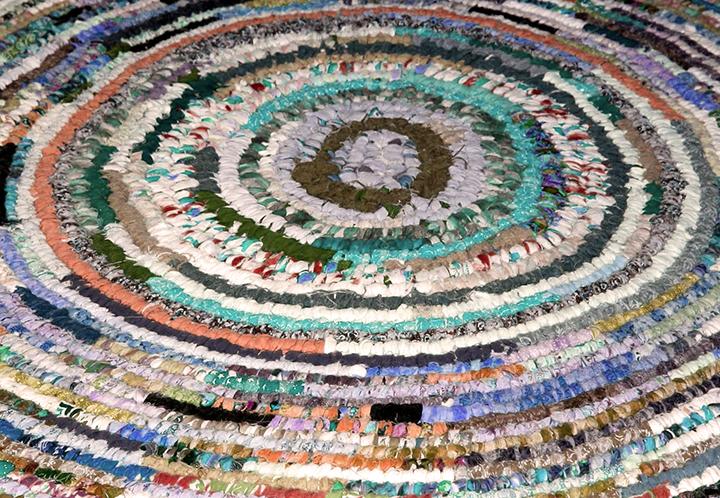
The next time I saw my grey and yellow plaid kindergarten dress, it was part of three different rugs, along with other scraps of our lives, woven closely with stout white threads and fringed at the ends. Each rug was a kaleidoscope of memories, and lasted for years.
You can buy rugs sort of like these now, for a buck or two, at the discount drugstore. They look the same, almost. But if you look closely, the cloth strips they make them with are cheap spongy synthetics, and the threads they are woven with are thin and far apart, making them flimsy landfill fodder.
And there’s never a memory in a whole pile of them.










I enjoyed this article and would love to learn to make one!
So nice you shared that