
Backwoods Home Magazine


Remembering
Sept. 11, 2001

Subscribe to Backwoods Home Magazine

Features
   Home Page
   Current Issue
   Article Index
   Author Index
   Previous Issues
   Newsletter
   Letters
   Humor
   Free Stuff
   Feedback
   Recipes
   Tell-A-Friend
   Home Energy Info
   Ask Jackie Online

BHM Blogs
   Dave Duffy
   Massad Ayoob
   Ask Jackie Clay
   Bramblestitches
Retired Blogs
   David Lee

Quick Links
   Jackie Clay
   Ask Jeff Yago
   Dave Duffy
   Massad Ayoob
   John Silveira
   Claire Wolfe

Forum / Chat
   Forum/Chat Info
   Enter Forum
   Member Chat
   Lost Password

General Store
   Ordering Info
   Subscriptions
   Anthologies
   T-Shirts
   Books
   Back Issues
   Help Yourself
   All Specials
   Classified Ad
   Trading Post Ad

Advertising
   Print Classifieds
   Trading Post
   Web Site Ads
   Magazine Ads

More Features
   Links
   Country Moments
   Radio Show
   Meet The Staff
   Contact Us/
   Address Change
   Write For BHM
   Privacy Policy

News/Politics
   Dave Duffy
   John Silveira
   Columnists


Ask Jackie Online
By Jackie Clay

April 15, 2006
Jackie Clay
Jackie Clay answers questions on any aspect of low-tech, self-reliant living.
Click Here to learn how to Ask Jackie a question.

Cattle questions

I realize I know nothing about raising cattle but I want to know when purchasing cattle, should they be steers vs. heifers? Which is easier or better?

Jo Brown
joseph0630 at sbcglobal.net

It would depend on the ultimate use of these cattle you are thinking about purchasing. Are you wanting your own beef? Do you want to re-sell them at a later time? Do you want them to eat up some lush pasture?

In general, steers are more "beefy" (no pun intended…well, maybe!). They put on more weight that is in areas of the body where the most useable beef is harvested. And they put on that weight quicker than do heifers.

The meat from both steers and heifers is equally good tasting.

Some people buy young, bred heifers, then raise them till they are just about ready to calve (six or seven months of care), then re-sell them to farmers or ranchers.

Both steers and heifers will neatly clean up overgrown pasture and one is not more easily handled than the other.

Buy healthy animals at a good price (shop around a little first). Make sure your facilities are adequate. (It's frustrating to have to chase escaped cattle through the neighborhood!!) Feed them well and treat them kindly and you'll enjoy good beef, nice profits and a great experience.

—Jackie

Thanks for the inspiration

I wanted to drop a line to thank you for being an inspiration to me and my sons. I have been a BHM mag reader for some time and a life time subscriber as of a few years back.

I am enjoying your "Starting over again" articles. I am in a similar situation. My wife left me and my 3 sons almost 5 years ago and I have raised them on my own. Now we are looking forward to getting to our little homestead in mid-Florida. I lost my job about 6 weeks ago and was in a bit of a fog for a while, but keep moving forward toward our dream inspired by hard working folks like yourself.

Thank you !

Bob Poland

I really know where you're coming from, Bob. It does seem that when you're having bad things happen, you just look over your shoulder and something else sneaks up and kicks you in the butt! But one thing I've learned is that you just keep putting one foot ahead of the other and sooner or later you'll make your own "luck".

It's exciting to hear that you're headed for your new homestead with your boys. They will enjoy homesteading so much as it gives them a lot of freedom that they couldn't enjoy anywhere else. My youngest son, David, is 15 and runs the woods like he was part of it, he gives great input into our homestead and can use tools and machinery as well as most men. Homesteading does build a great sense of belonging and self-reliance in us all. The best of everything to you and your sons.

—Jackie

Leggy tomatoes

I started tomatoes from seed and they seem to be very droopy and leggy. Have I done something wrong!

Judy
catseye2 at charter.net

All that your tomatoes need is LIGHT. If you don't have a good south-facing window (or even a bright east-facing window), hang a four foot flourescent shop light 6'' over them. You don't need a Gro-Light, a two-tube shop light costs about $14 and will do the job nicely.

At this point, you might transplant them, burying all but the top four leaves. That long stem will sprout roots all up and down it, making the plant stronger in the long run. When you transplant the tomatoes, give them a good drink of manure tea or another mild fertilizer to help them get up and running. And get 'em into the light!

—Jackie

Banana jam

Jackie here is a recipe that my family uses over here in the Philippines for you to share.

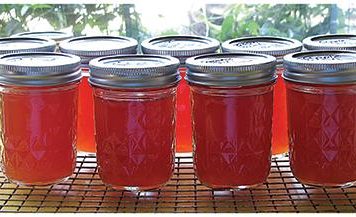
Banana Jam

3 cups water
3 cups Honey
8 bananas (mashed)
3 lemons ( juiced )
3 cloves
1 ginger ( dried)

Using a large saucepan over a high heat, add the water and honey, bring to a boil. Let boil for about 10 minutes then add the bananas, lemon rind, lemon juice, cloves, and ginger. Let the mixture simmer for about an hour until well thickened while skiming off the scum that may rise to the surface. Remove the ginger. Then pour the mixture into jam jars seal and store away and enjoy.

Ronnie & Helen Roberts,
Philippines

Thanks for the banana jam recipe. I'm sure a lot of readers will happily use it. I know I'll give it a go the next time bananas are on a killer sale at the supermarket!

—Jackie

LDS canneries

I read in one of your back columns where a lady asked about Mormon (or LDS) canneries. I am LDS, and have had association with many canneries in my time. I thought I'd share what I know.

The canneries come in two basic types: wet pack and dry pack. The wet pack canneries can things such as stew, vegetables, and some fruits. The dry packs do things like flour, sugar, dry milk and other powders. The wet packs are more scarce than the dry packs as they need expensive machinery and cookers for the process. The dry packs are numerous, but only according to region: if the cannery isn't used, it gets shut down. All of the labor (except for some management) is done by volunteers.

In the wet packs, the only things canned are what the LDS Church authorizes. In the dry packs, you can buy the stuff the Church has on hand (which is a large variety, from hard beans to hot cocoa and a plethora of flours) or bring your own stuff and use the equipment. The catch is the canneries are usually scheduled by groups (congregational units) and are usually only open for those groups; therefore you usually need to go with one of these groups of crazy Mormons and share your labor with theirs. It does make the time go by faster, though.

I recommend, if you are interested in using one of these canneries, look up the nearest LDS stake offices (Church of Jesus Christ of Latter-day Saints: Stakes), and ask for the phone number of the Stake Relief Society President; or if you have seen a local LDS Church meetinghouse, take the name of one of the wards off the front of the building and look it up and ask for the Ward Relief Society President. Either of these two women will be able to steer you to a cannery in your area, and possibly even get you signed up for an outing. Please understand that all local Church positions are volunteers, so you might have to try a couple of times to catch somebody at the building phone or at home. You don't have to be a member, you don't have to sign up for missionaries to visit your home, but I wouldn't count on being able to smoke in the cars or in the cannery area, and a trip to the local pub afterward for a drink might have you drinking alone.

I hope this is helpful. I think the website lds.org might also have some information on it. The canneries are really wonderful tools for home storage, and I, if not we, urge all those interested to search us out and use our facilities.

David Roquemore
Payson, UT

Thanks, David, for all the information on LDS canneries! I am not LDS, but I have long admired the sense of community, hard work and encouragement towards emergency preparedness of the Church. We can all take lessons, here!

—Jackie

Steam canner

I just purchased a steam canner, rather than a water bath canner, as it appeared to be more energy efficient to heat six cups of water as opposed to gallons of water. I am however, interested to know if you write any articles or offer any recipes for steam canners, rather than the water bath canners.

Thanks

Ed Marsh
Epawmarsh at hotmail.com

Sorry, Ed, I am not a fan of steam canners. Yes, it is more energy efficient to only heat six cups of water. But those six cups of water cannot be depended upon to keep the heat in a big batch of processing food up to a high enough internal temperature for SAFE canning. I know they are in all the catalogs, but if you will notice, no canning manuals recommend the use of them.

They would probably be okay to seal jams, jellies and pickles, but I'd be leery of them for use in other foods.

—Jackie

Shelf-life of pickles

I would like to know how long can I keep home canned dill pickles and still eat them?

Thanks,

Ray Yaakov
RAVYAAKOV at WI.RR.COM

You can keep home canned dill pickles for years and years and still enjoy them. As long as the seal is sound (firmly indented in the center) and the pickles have been stored in a cool (never freezing), relatively dark and dry place, they will be great. I don't make wine, but I've got twenty year old pickles that only seem to be better and better!

—Jackie


Read More Ask Jackie Online

Read Articles by Jackie Clay

Read Ask Jackie


Comments regarding this article may be addressed to editor@backwoodshome.com. Comments may appear online in "Feedback" or in the "Letters" section of Backwoods Home Magazine. Although every email is read, busy schedules generally do not permit a personal response to each one.


Read more Ask Jackie in every issue of Backwoods Home Magazine. Click Here to subscribe.


www.backwoodshome.com designed and maintained by Oliver Del Signore
© Copyright 1998 - Present by Backwoods Home Magazine