

|
|
|
|

Click here to ask Jackie a question! Jackie Clay answers questions for BHM Subscribers & Customers on any aspect of low-tech, self-reliant living.
Read the old Ask Jackie Online columns Read Ask Jackie print columns
|
Archive for the ‘Self-sufficiency’ Category
Jackie Clay
Monday, April 9th, 2012
Peeling fresh eggs
I read with interest your post on using your “surplus” of eggs by pickling them. Do you have a secret to getting your FRESH eggs to come out whole after they are boiled? Mine are always just a mess and I can’t use them for anything except egg salad..
Ramona B.
South Carolina
I know what you mean. I DO let my fresh eggs sit around for a couple of weeks before pickling or hardboiling them for that very reason. What I do with fresher eggs is to add half a cup of vinegar to the water, put the eggs in cold water, and turn on the heat. After boiling, I immediately drain the water and toss them up and down in the dry pan to crack them. Then I chill with cold water, then let them sit in cold water for several hours. By starting with the large end, where the air space usually is, I peel them after rolling a bit with the flat of my hand on a hard surface. Be sure to get the thin membrane right away; the egg’s slick under it but with fresh eggs you sometimes can’t get under it to start the egg peeling. Once you get under the membrane, the shell peels away pretty well. — Jackie
Storing eggs
No one else in my house is big on pickled things but I want to store my surplus eggs for leaner times. Can they be canned without pickling? And I saw a lady on Doomsday Preppers rubbing them down with some sort of oil (vegetable?) and saying they could be stored at room temp this way for extended periods of time. Have you ever heard of this method and if so do you have any specifics on it?
Grace Johnston
Tangier, Indiana
No, you can’t can eggs without pickling them. We use pickled eggs for deviled eggs and egg salad. To keep eggs for extended periods, just keep them in a cool area such as an unheated root cellar, basement, or back closet that is very cool. They will keep this way nearly all winter. You can block the pores of the eggs with vegetable oil or by submersing them in waterglass. They might keep a little longer, but I find them kind of nasty to handle and have not found it necessary. Our chickens lay, without a lighted coop, from March through December and I’ve kept fresh eggs over winter until they started again in the spring. — Jackie
Posted in Cooking/Recipes, Food Preservation, Self-sufficiency | 6 Comments »
Jackie Clay
Sunday, April 8th, 2012
Canning strawberries, dry summer, and harvesting rhubarb
My grocery store opened a dollar section. I found a jar of WHOLE strawberries in lite syrup. How did they can them and not have them turn to mush? BTW they were delicious.
You said the beavers were indicating a dry summer. What are they doing to show you that?
My rhubarb plant is producing. It is my first experience with it. It is a two year old plant. How do I know when it is ready to pick and use? One plant has an asparagus like thing coming up in the middle. What is that?
J in Missouri
I think what they’ve done is to pack the whole strawberries in hot jars then pour a boiling light syrup over them then process in a boiling water bath canner for 10 minutes (pints). This, however, often results in strawberries that float badly. Maybe when they are packed tightly to start with, they don’t?
Yep, the beavers are building their dam higher and a new lodge with a lower entrance (under the water line). They want to trap all the spring rain moisture while it’s there so they have something left at the end of summer. We’ll see how these furry weather forecasters do this summer. I wouldn’t feel too bad if they were wrong this time!
Your rhubarb will form nice stalks — from the size of your finger to much larger. Young plants are smaller than older ones. You can pick it at any time, but I’d wait until the stalks are at least a foot long to get a better harvest. Don’t try to eat the leaves in any form; they are poisonous but fine for compost. The asparagus-like thing may be a flower cone or it may, in fact, be an asparagus that got “planted” by nature. The flowering stem starts out as a cone, light colored and tightly bunched with leaves with short stalks. Then the stalk shoots up with branching short stalks attached. When left to flower and form seeds, the plant will stop making nice stalks for you and make seeds instead. To stop this from happening, just break off the flower heads as they form. To harvest your rhubarb, pull the stalks right out of the ground; don’t cut them off. Your plant will like you better and won’t be prone to disease. Don’t over-harvest your young plants. You should be able to harvest several pullings from a two-year-old plant that is well grown. Then let it rest until next year when you can harvest more. A four-year-old plant that is grown well will stand many pullings of big, fat stalks. — Jackie
Proper range when pressure canning
When pressure canning, what would be an acceptable range to stay within. For example, if pressure says 11 lbs would a range of 10-12 lbs. be acceptable. Or how high or low is acceptable?
Brad Barrie
Strong, Maine
Don’t go under the recommended pressure. If you can’t hit it and stay on it, opt for a slightly higher pressure for safe canning. A couple pounds higher pressure is fine. — Jackie
Posted in Cooking/Recipes, Food Preservation, Self-sufficiency | No Comments »
Jackie Clay
Saturday, April 7th, 2012
Canning beef
I, too, just got a half of beef. I wanted to start canning with the ground beef. Your canning book calls for salt with the ground beef but it is optional with stew meat. Why the difference?
Erica Kardelis
Helper, Utah
No difference; salt is optional in almost all canning recipes. In meats and vegetables it is purely a flavor enhancer. It is not necessary. — Jackie
Canning pickled eggs
Seeing your blog on canning pickled eggs sparked my interest but when I looked in my old canning books I couldn’t find a recipe. Could you please post it?
William Fisher
Grinnell, Iowa
Others have asked for it and I gave my recipe. But if you missed it, here it is again. (And it’s also found in my book Growing and Canning Your own Food.)
18 whole, peeled, hardboiled eggs
1½ quarts white vinegar
2 tsp. salt
1 Tbsp. whole allspice
1 Tbsp. mixed pickling spices
Mix vinegar and spices in large pan and bring to a boil. Pack whole, peeled, hardboiled eggs into hot, sterilized jars leaving ½ inch of headspace. Ladle boiling pickling solution over eggs, leaving ½ inch of headspace. Be sure all eggs are covered. Remove air bubbles. Process for 25 minutes in a boiling water bath canner. Never leave unsealed pickled eggs out at room temperature. You risk danger from botulism and other bacterial diseases.
I also add 2 Tbsp. vinegar from my jars of hot pepper rings to “spunk” up my eggs. This is very good. — Jackie
Posted in Food Preservation, Meat, Self-sufficiency | 1 Comment »
Jackie Clay
Friday, April 6th, 2012
Sprouting beans
What kinds of store-bought beans can I sprout?
Pete Triandos
Santa Clarita, California
You can sprout nearly every variety of dry bean. You’ll have to try and experiment and see which ones you like best. I do lentils, navies, kidneys, adzuki, and black beans. — Jackie
Salty peach cobbler
I had a friend try the peach cobbler recipe from your cookbook. She substituted butter for the shortening and it came out really salty. I told her that if she substituted butter to cut out the salt since shortening is not salted. Sound right?
Kathy Vilseck
Coldwater, Mississippi
That may have been what happened or she may have just mis-measured the salt. Or if she is using less salt in her diet, she may be sensitive to salt and need to cut the amount used in a recipe even more than directed. — Jackie
Posted in Cooking/Recipes, Self-sufficiency | 2 Comments »
Jackie Clay
Thursday, April 5th, 2012

Last year we had trouble with hatching turkey poults. Too many hens would try laying and sitting in the same nest box; eggs would get broken and the eggs would chill and no babies were hatched. So this year, we decided to make a nest box for each turkey hen. We have five hens, so on a rainy, cold day, Will started measuring and cutting 2x2s and scraps of OSB to size. A friend of ours had given us some small sheets of corrugated steel roofing she’d found at the dump, thinking we might find some use for it. She was so right! After about three hours of assembly, Will and I had put together some real cute and weather-proof turkey “hooches.” We separated our pair of Bourbon Red turkeys and will soon catch our other turkeys and put them in the goat pasture. The new nests are now down there, covered with branches like little wigwams. Now each hen will have her own nest. If two want the same one, we’ll block one out until she decides to choose another for herself. And hopefully, this year we’ll be having some cute baby turkeys.


This spring and summer is going to be busy for us. On April 21st, Will and I will be manning the Backwoods Home Magazine booth at the Iron Range Earth Fest in Mountain Iron, Minnesota. Then I’ll be flying to Colorado Springs, Colorado, for the Preparedness Expo May 18 and 19th, where I’ll join a panel discussion and also hang out at the magazine’s booth with Dave and the bunch. The very next weekend, Will and I will be hosting our first homestead seminar here at our homestead, with a second seminar being scheduled July 13-15th. I’m putting together a flyer on that seminar, so anyone who would like more information, e-mail me at Jackie@backwoodshome.com. Again, we’re limiting the attendance so everyone will have a personal experience and not be just one of the crowd. Oh, on June 15 and 16th, we’ll join Ilene Duffy and the boys at the MREA Fair in Custer, Wisconsin. If you get a chance to attend any or all of these events, we’ll be happy to meet you (and sign books, if you’d like).
Posted in Animals, Building, Self-sufficiency | 8 Comments »
Jackie Clay
Thursday, April 5th, 2012
Using flour in canned pie fillings
Is it safe to use flour for thickener in home canned fruit pie (apple) fillings? We have an allergy to corn issue, and can’t use the Clear Jel.
Jolene Teeters
Stanwood, Washington
Sorry, Jolene, but no. It isn’t considered safe to use flour as a thickener for gravies and pie fillings. You’ll have to can the apples in light syrup and then thicken when you go to use them to make your pies. — Jackie
Moving home canned goods
How did you move your canned goods? Did you put rings back on the lids? How did you keep jars from breaking?
J from Missouri
I went to the neighboring liquor store/bar and asked that they save empty boxes for me. They were more than happy to because they have to pay to get them hauled off in the trash. These are very heavy and have dividers to keep jars apart. (I’ll bet everyone who came to our house early on saw all those booze boxes and figured we were really big party people!) No, I didn’t put rings back on. I packed the jars that didn’t get packed in these boxes in newspapers to prevent them from knocking together. I only lost three jars in a 1,000 mile move. Not bad out of a huge pantry full. — Jackie
Posted in Food Preservation, Self-sufficiency | 1 Comment »
Jackie Clay
Wednesday, April 4th, 2012
Using duck eggs
My husband was gifted 2 dozen duck eggs. Is there anything that just tastes better with duck eggs over chicken eggs? We’ve already enjoyed some french toast and that turned out so great I thought I didn’t want to waste the rest.
Dawn Norcross
Orion, Illinois
Duck eggs are very good in any kind of baked goods and, as you’ve found out, just about any recipe that calls for chicken eggs. What a nice gift! — Jackie
Beaver prediction
In one of your recent articles you said that by the beavers the summer is going to be dry. How did you tell that? I would really like to know.
Ann Nelson
Franklin, West Virginia
The beavers in our pond are building their dam higher and building a new lodge with a lower entrance. This tells me that they want to trap as much water as they can early in the year (hence the higher dam) and expect the pond level to be lower later on (hence the new lodge with lower entrance). We’ll see. Right now we’re getting damp weather, but really not much total rainfall and we had a very open winter with little snow melt to soak into our already low waterways. — Jackie
Posted in Animals, Cooking/Recipes, Self-sufficiency | 1 Comment »
Jackie Clay
Tuesday, April 3rd, 2012
Pickled eggs
After you pickled your eggs did you seal them? I didn’t know you could do that, could you please share that info, how long etc.? I use a pressure cooker, but I could also do a bath if I had to.
Cheryl Haven
Ketchikan, Alaska
Yes, I processed them in a boiling water bath canner for 25 minutes. Some recipes call for only 10 minutes, but most I have call for 25 minutes, so that’s what I use. You don’t need a pressure canner for pickled eggs. — Jackie
My family really likes pickled eggs, but I have never seen any info on the loss or not of the food value of the egg itself. Have you ever run across info on the effect of vinegar on the food value? I know with regular “pickles” one has to watch the salt intake.
Linda Leach
Billings, Montana
I don’t know for certain, but I’d suspect there is no loss of food value in pickled eggs. The reason one has to watch salt in some pickles is that some have salt as an ingredient and others are soaked overnight in a salt brine to draw off excess juice and crisp up the pickles. If you want to make pickled eggs with no salt, you can certainly do that; the salt does nothing to preserve the eggs. It’s only a flavor enhancer. — Jackie
Onions from seeds and pickled egg recipe
Oh, your plants look wonderful. Do you start onions from seed? I get them going then some of them die. Is it because I put them in too cool an area? Do I need to fertilize them? To me they look a little pale since I tried them in the outdoor greenhouse. They now live back with us in the house since the weather changed. I too have a stand like you do. Best $15 I ever spent lately.
I also would like to know your recipe for the pickled eggs? I have eggs coming out of my ears right now and not a lot of people need them right now so I have to do something with them!
Cindy Hills
Wild Rose, Wisconsin
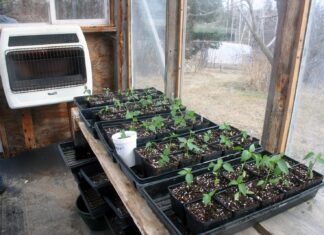
Yes, we start onions from seed. I’ve got a double batch of Copra seedlings right now. What are you using for seed starting? I used Miracle Gro several years back and had extremely poor luck; yellow plants, poor germination, etc. Now I’m using Pro-Mix which I get from our local greenhouse and it’s really worth the money! Of course, good old black garden soil is just as good if you sterilize it by heating it in your oven to kill weed seeds and bacteria. Too cool a growing area will make onion seedlings kind of stand still. Be sure they’re getting plenty of light. That’s the most common cause for pale, spindly seedlings of all kinds.
My recipe for pickling eggs (also found in my book, Growing and Canning your Own Food, is as follows:
18 whole, hardboiled, peeled eggs
1½ quarts white vinegar
2 tsp. salt
1 Tbsp. whole allspice
1 Tbsp. mixed pickling spices
Mix vinegar with spices and salt. Bring to a boil. Pack whole, peeled, hardboiled eggs into hot, sterilized jar, leaving ½ inch of headspace. Ladle boiling pickling solution over eggs, leaving ½ inch of headspace. Be sure to cover eggs. Remove air bubbles. Process for 25 minutes in a boiling water bath canner. Never let unsealed pickled eggs sit out at room temperature. You risk danger from botulism and other bacterial diseases.
This year, I’ve also added about 2 Tbsp. spiced vinegar from my hot pepper rings to give the pickled eggs a little “punch,” just using the juice from an open, refrigerated jar of pickled hot pepper rings.
I use these pickled eggs for deviled eggs and egg salad, especially during the winter when eggs are a little scarce. — Jackie
Posted in Cooking/Recipes, Gardening, Self-sufficiency | No Comments »
|
|
Have questions regarding this Blog? Please email us. Comments may appear online in "Feedback" or in the "Letters" section of Backwoods Home Magazine. We read every email you send us, but due to the sheer volume of mail we receive, we can't respond to each one.

|
|

|
|

(PDF 3.33 MB)
(PDF 213 KB)

| |