
Backwoods Home Magazine


Remembering
Sept. 11, 2001

Subscribe to Backwoods Home Magazine

Features
   Home Page
   Current Issue
   Article Index
   Author Index
   Previous Issues
   Newsletter
   Letters
   Humor
   Free Stuff
   Feedback
   Recipes
   Tell-A-Friend
   Home Energy Info
   Ask Jackie Online

BHM Blogs
   Dave Duffy
   Massad Ayoob
   Ask Jackie Clay
   Bramblestitches
Retired Blogs
   David Lee

Quick Links
   Jackie Clay
   Ask Jeff Yago
   Dave Duffy
   Massad Ayoob
   John Silveira
   Claire Wolfe

Forum / Chat
   Forum/Chat Info
   Enter Forum
   Member Chat
   Lost Password

General Store
   Ordering Info
   Subscriptions
   Anthologies
   T-Shirts
   Books
   Back Issues
   Help Yourself
   All Specials
   Classified Ad
   Trading Post Ad

Advertising
   Print Classifieds
   Trading Post
   Web Site Ads
   Magazine Ads

More Features
   Links
   Country Moments
   Radio Show
   Meet The Staff
   Contact Us/
   Address Change
   Write For BHM
   Privacy Policy

News/Politics
   Dave Duffy
   John Silveira
   Columnists


Ask Jackie headline


Want to Comment on a blog post? Look for and click on the blue No Comments or # Comments at the end of each post.

Click here to ask Jackie a question!
Jackie Clay answers questions for BHM Subscribers & Customers
on any aspect of low-tech, self-reliant living.

Read the old Ask Jackie Online columns
Read Ask Jackie print columns


Get a FREE Jackie Clay CD Anthology

Archive for the ‘Meat’ Category

Jackie Clay

I’m playing catch-up today

Wednesday, May 21st, 2008

With Mom in the hospital, doing fairly well, and my two sisters visiting her today, I stayed home to get caught up. I had a table full of dirty dishes, tomatoes that needed planting in their Wall’o Waters, two roses and a tub peach, plus some perennials that sadly needed planting. So to keep busy and keep my mind off Mom’s problem, I started in this morning doing “normal” things. It eases my worries like nothing else does.

By noon, I’d planted six tomatoes, the roses, perennials and even some glad bulbs. Then I tilled another strip of garden and planted another ten tomatoes. I’m so happy with my Wall’o Waters, as they let me plant my tomatoes and peppers a whole month early. (I could have even planted them earlier, but I kind of got behind.) Last year my son, Bill, planted their tomatoes in the Walls, where his in-laws planted their tomatoes the same day without them. In a month, his plants were literally twice the size and they were the same variety of tomatoes!

This afternoon, I wandered through my flower gardens for a break and marveled at how beautiful the daffodils and other spring flowers looked. EVERYTHING is popping up rank and gorgeous. There are peonies, lilies, columbine, penstemons, daylilies, violas, tulips and a whole lot more. Even my on-sale clematis from last year are shooting up like they mean business. This is despite the late spring snows and hail we’ve had lately, too!

I topped my day off by playing with Ladyhawk, my new Friesian filly. She’s so friendly and responsive, not to mention drop dead gorgeous. I can hardly wait to start her training.

Tomorrow, it’s off to the hospital again, but I’m grateful for my respite of a day to regroup.

Readers’ questions:

Old glass-top canning jars

I was recently fortunate enough to come into over 200 of the old style glass top canning jars (free!). Once cleaned and sterilized (and with new rubbers) are these safe to can with? I’ve been told not to trust ‘em but I figure they worked for everyone else for umpteen years and hey, the price was right. Also, since I’m new to canning I don’t currently have a pressure canner. Do you have any suggestions on brand or size? One more question - when are you going to write a book?! My wife and I look forward to your column every issue and would absolutely love to have our very own “Jackie” reference book for recipes, gardening tips and great anecdotes.

Allen Foster
Northfield, New Hampshire

Wow! You really got a find, there. But, unfortunately, they really aren’t safe to can many foods. They probably would be okay for pickles, jams, jellies and preserves; the worst that could happen is that they might (but probably won’t) get moldy if they don’t seal.

They definitely aren’t good for pressure canning; there’s no flex to the lid like there is with a modern two piece lid/ring. And you would have no way of knowing if the jar was sealed or not like you do with the two-piece lids. These jars are quite pricey at antique and flea markets. If I had that many, I’d save a few dozen for storing dry foods, then sell the rest and buy my new pressure canner and several cases of good, modern, used jars. You’ll probably still have enough left for a celebration dinner!

And, yes, I have thought seriously about doing a book. Right now, with taking care of Mom, I have less time than I need already. But someday…. — Jackie

Dried egg shells

Since the compost piles need plenty of moisture anyway, why is it important to let eggshells dry out before putting them in the compost piles? I have a tiny kitchen and love to add kitchen stuff to the compost piles but once I fill up a bowl, I want to go ahead and get it out of the kitchen.

A friend of mine has her used eggshells in the stove/oven bottom drawer drying out but my stove/oven is small.

Joanna Wilcox
Boone, North Carolina

I think the reason that some folks dry egg shells before composting them is to dehydrate any clinging egg from the shells so they don’t smell up the pile like rotten eggs. Personally, I don’t compost my egg shells; I dry them on the counter in a bowl, crush them and save them up to plant under my tomatoes in the spring (helps prevent blossom end rot because of the calcium) or feed them back to the chickens.

If you want to dry your egg shells before composting them, just put them in a bowl on the counter; they’ll dry fine without additional heat. — Jackie

Canning cornish rock chickens

First of all I would like to thank you for sharing with us all the knowledge that you do! I also think that its great that your son David is such a help. Just think of the things he knows to help him as he enters adulthood! If all our teens were prepared the way he is our world would certainly be a much different place!

Anyway, I am going to be raising our annual batch of 50 cornish cross chickens. Instead of being dependent on our freezer I would like to can many of them preferably off the bone. What is the most effecient way to can those? I usually butcher 10/day since I butcher alone mostly. Could I safely cook them down in a nesco roaster or boil them in a huge kettle to get the meat off the bone? I would also like to can the broth since it’s so hard to get broth at the store that is low in sodium.

Thank you for taking the time to share with us all. I am making many improvements to our garden this year and expanding with the way the economy is. We have a very limited income so we epend on this food. Plus my husband has serious heart disease and can’t eat many of our grocery store foods that are filled with high fructose corn syrup, msg and saturated fats. So your column is always thought provoking and inspiring !! Plus it gives us all hope that there are alternatives we can do with a little hard work! Thanks!!

Cindy Hills
Wild Rose, Wisconsin

Yes, I’m very appreciative for having David’s help. Perhaps we “let” him do too much at a young age, but he loves it and yes, it is preparing him for a variety of jobs/useful lifeskills in adulthood.

I prefer to butcher only 3 chickens a day, as it takes me a day to process the birds…only 3 cut up fit in my largest stock pot to boil down. You can also roast them; the main thing it to cook them to get the meat off the bone. I’ve found that the stock pot leaves the meat more tender and less dry, but a covered roaster does fine, too; just don’t over-cook the meat.

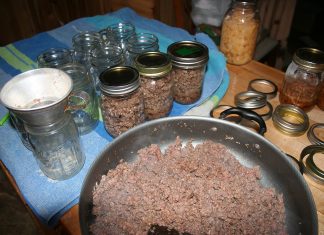
I cool the stock pot down enough to handle the meat, then dip a bone-in piece at a time out and debone it. Some of the meat, I leave whole, such as the large breast pieces and heavy thighs. But much of it, I dice up because it’s so useful that way in so many different recipes. The smaller pieces, I cut up small to use in half pints or in quarts with stock with rice/onions/carrots as a soup base.

After the meat is deboned, the broth is cooled and I skim off most of the fat that forms on the top. Then I reheat the broth and meat and pack the jars.

By doing 3 chickens a day, allowing overnight to cool the carcasses, I can process a whole lot of meat in a week’s time. Of course something always comes up, and I don’t always get 3 done EVERY day, so butchering time kind of gets spotty. But the important thing is that it gets done.

I’m raising 25 Cornish Rock chickens again this year; they’re very efficient meat producers even though they don’t seem to be “real” chickens (leg problems because of huge weight). — Jackie

Recycling trash

Jackie, I am reading ANIMAL, VEGETABLE, MIRACLE by BARBRA KINGSOLVER and I thought of you when I read the words - “I have seen women looking over jewlery ads with a misty eye and one hand resting on the heart, I only know what they are feeling because that’s how I read the seed catalogs in January.”

My question - Do you do much recycling with everyday trash? If so, what is your routine?

Joanna Wilcox
Boone, North Carolina

Well, kind of. I try not to buy stuff in plastic, wrapped or whatever. Then I try not to buy things in glass that can not be reused for canning or food storage. I can most of my vegetables and meat, so there isn’t much for tin cans, either. The ones that I do have get put into a separate shopping bag. There’s another one for aluminum cans hanging on the same nail. All edible “garbage” except for meat/grease goes to the chickens. The meat/grease goes to the dogs. Bones are burned in the kitchen range, along with newsprint and other decent burnable paper. Junk mail, old catalogs and magazines are either recycled or with the magazines, given to places that can use them.

I’ve found that the less you buy, the less you have that needs to be recycled. Only in our affluent society do you see a need for recycling! We’ve become a throw-away society and I hate it. Why can’t we bring our clean glass bottles to be filled with milk, juice or whatever? Why can’t we do the same with peanut butter, cheese and other products? Why can’t meat be wrapped in paper like it used to be? Plastic, plastic, plastic. Gee, I wonder why the cost of petroleum products is going up. Maybe it’s NOT the gas for our cars, but the plastic we are wrapped in! — Jackie

Baking soda and beans

My foster mother, a semi nutritionist, told me never to use soda in cooking baked beans because it will destroy the vitamins in the beans. Today, I checked and sure enough: Read this:
http://nutrition.about.com/od/askyournutritionist/f/bakingsodabvit.htm

She was right. Since I read about you canning beans, I have found the beans are much nicer, and handy to use. They do not require soda to soften them.

Bruce Clark
Interlaken, New York

I didn’t know that about baking soda. But it isn’t used to soften the beans, but to reduce the “bad” effects beans have on some folks. If baking soda reduces the nutrition of the beans, people might substitute using epazote (the herb) in their beans. It has the same benefit and I don’t think it would damage the nutrition. — Jackie

Canning frozen vegetables

I want to can frozen veg. What is the procedure?

Jimmy Crawford
Monticello, Georgia

To can frozen vegetables, heat them just until they are thawed and hot; don’t boil. Then just proceed as if they were hot packed fresh veggies. I’ve canned a lot of them in the past when our power failed and I was in danger of losing my food. Now I just can and dry it all! — Jackie

Jackie Clay

Hey! Spring’s back

Monday, April 14th, 2008

After a week of back to back blizzards, the sun came out and the temperature climbed to 50 degrees today. It was SO nice. And today my son Bill and his wife, Kelly came up to help Mom celebrate her 92nd birthday. Of course their son, Mason, came with them and both Greatgrandma and Grandma got to play with him and be wowed by his frequent smiles!

Mom enjoying Mason

He was afraid of the chickens, but it won’t be long before he’s ready for a pony. His daddy was riding his pony, Sprite, while still in diapers. And they had years of history together. They went to lots and lots of horse shows, to compete with not only kids Bill’s age, but also adults on expensive horses. And you know what? They won a lot! We had Sprite until she was 42; she was a member of the family. I hope we can find Mason such a good pony!

Me trying to get another smile
-
Readers’ questions:

Cracked corn for chickens

I only have a handful of chickens and have access to pleny of free field corn. I would like to make my own “cracked corn”. What kind of grinder do I need? And, do you have any suggestions on where to get one?. Thank you SO MUCH for all of your help and articles. You are a treasure trove and I bow to your feet. I also have many other questions- how is it best to ask, snail mail or like this?

Grace johnston
Tangier, Indiana

If you have field corn, GREAT!!! You don’t need to crack corn for chickens. They digest it fine whole, and really prefer it that way. There really isn’t a home grinder for cracked corn, other than using your grain mill, which is plenty labor intensive for the results given.

You can certainly ask questions either way. Via snail mail shares the answer with a lot more readers. — Jackie

Uses for pig fat/suet

What are some uses for pig fat/suet, besides lard? Is there other uses such as candles or something? Thank you, I enjoy your writings and the knowledge you give out. This means a lot to me and helps out so much.

Scott Michael
Canyon City, Oregon

You can make soap from pork fat! Candles don’t work because pork fat has a low melting temperature and the candles won’t handle hot temperatures before melting down. (You could make fat oil lamps in a pinch, but I don’t think you’d like the results, otherwise; it tends to smoke and not put out great light.) Soap is a much better alternative. — Jackie

Canning bacon

How does one can bacon?

Kimberly Baxter Packwood
Ames, Iowa

You can home can bacon, but you’ll need “real” bacon, not store bacon, because store bacon is too fat and not “solid” enough to hold up for canning. I canned my own bacon by first smoking it, then cutting it into chunks that would fit into a wide mouth pint or quart jar. You don’t can it sliced. I heat the bacon in a roasting pan, in the oven at 200 degrees until it’s hot all the way through. Then I pack it into hot jars to within 1/2″ of the top. Bacon, as with all meat, is processed for 75 minutes for pints and 90 minutes at quarts, at 10 pounds pressure.(Check your canning manual if you live at an altitude above 1,000 feet and must adjust your pressure to suit your altitude.) Bacon is canned without adding liquid.

Important note: As far as I know, there isn’t an approved method of canning bacon, but this has worked well for me. Consider it an “experimental” method. — Jackie

Canned bacon

This is a response to the question asked by Pete Gibson in the May/June issue regarding canned bacon. It used to be manufactured by Celebrity Foods Canned Bacon but has not been available for approximately 10 years. According to the company’s web site it will soon be available again produced in Ohio under direct license from MRE wholesalers.com. Thought this might be of interest to the readers of BHM. Their web site shows them opening a can that was 20 years old and the product still good. Great idea for storing in case of an emergency.

Bill Lahnen
Lakewood, New York

Thanks for the info, Bill. There’s been a lot of interest in canned bacon, and for good reason; it’s a great product. I’ll be waiting to see it once again on the market! — Jackie

Freecycle groups, dehydrating

I hope you have plowed yourself out. We are getting snow this weekend in PA, but not like you. Thank goodness!! Recently, I joined a “free to join” group -”freecycle”, which, by the way, you probably would love. It’s an organization where people give others what they no longer need to help keep things out of landfills. The main stipulation for being able to join and participate is that every thing is “free”, absolutely no money exchanged. Today I received a slightly used dehydrator. If it’s been used, I would be really surprised, it’s still in the original box and spanking clean.

I’ve noticed that in several of your answers to questions, you mention your preference for dehydrating. Could you please tell me what you dehydrate and give me some tips for success. Onions are on sale for a really good price this week. I use a lot of onions and wanted to know if you have been successful drying them and how you do it. Also, potatoes. After they are dried … can’t they be used for frying, mashed or only in casseroles? What’s the storage method?

If you are interested in more information about “freecycle”, go to www.freecycle.org then browse the many groups by specific states. There are groups all over the US and possibly in your area, which might help you get things you need for your homestead and also possibly help someone else. Today was the first time I requested one of the offers and have gratefully benefited. Thanks for any advise you have time to offer. Since your advice helps me all the time, I hope I have given you something to help you too.

Rosemarie Wesolek
Mahaffey, Pennsylvania

I’m sure many readers will pick up on your tip about freecycle. I do know about them, but just don’t have the time to go so far out of town; there’s none within 35 miles of us and most of the better stuff
is in Duluth, 80 some miles south. Mom kind of ties me down as to my “going”. I dehydrate a whole lot of foods, as well as canning them. I dehydrate peas, carrots, onions, fruits of all kinds, asparagus, tomatoes, corn, squash, jerky and a whole lot more. Onions are dead easy; I just slice them into whole rounds, then lay them on the dehydrator trays, in a single layer. When they are dry, I either put them in jars that way or whiz them through the blender to make chunks or powder. These, I put on cookie sheets in the oven, with only the pilot light on and stir until they are really dry; they tend to clump without this extra drying.

To do potatoes, I slice them into salt water to keep them from blackening. Then I drain them and drop them into boiling water for a minute. Then I drain them and lay them out onto the dehydrator trays. The boiling keeps them fromdarkening during dehydrating. No, you can’t make French fries out of them, but you can rehydrate them and then make fried potatoes out of them. Or you can make potatoes augratin, scalloped potatoes or the like. Dehydrated foods are very good and take up little room on the shelf. I lovethat! — Jackie

Gooseberries not producing

I ordered & planted some Gooseberrys plants May-2005.They were 2 yr.old plants called (Hinnonmaki ) the red kind.Well they have never produced anything but they grew. Last fall I moved them & replanted to another place as I thought that might help. Why don’t they produce any fruit? What am i doing wrong? Thanks for the great info you give..

Sharon Beck
Sikeston, Missouri

Have patience. Most trees and shrubs, including gooseberries need a little time to sink their roots down and get over the shock of transplanting. This can take a year or more; often several years.
Moving them just delayed things. If they’re getting sunlight, a little compost and kept weed free, you will get fruit. — Jackie


Have questions regarding this Blog? Just email us and we'll try to help. Comments may appear online in "Feedback" or in the "Letters" section of Backwoods Home Magazine. We read every email you send us, but due to the sheer volume of mail we receive, we can't always respond to each one.


www.backwoodshome.com designed and maintained by Oliver Del Signore
© Copyright 1998 - Present by Backwoods Home Magazine