

 Remembering Sept. 11, 2001
|
|
 |
Or call us at 1-800-835-2418 |
|
|
|
|

Click here to ask Jackie a question! Jackie Clay answers questions for BHM Subscribers & Customers on any aspect of low-tech, self-reliant living.
Read the old Ask Jackie Online columns Read Ask Jackie print columns
|
Archive for the ‘Building’ Category
Jackie Clay
Tuesday, September 20th, 2011
I got to “play” with our Hud-Son bandsaw mill this afternoon. We had picked the last of our sweet corn after it had gotten frosted. Because sweet corn will convert sugars to starch in a few days after a freeze, I needed to get that canned up pronto. So I husked it all, then went out to join Will in the drizzle, as he was setting up to saw 2×6 rafters, 16 feet long, for our new calf stable. Under his watchful eye, I got to saw the rafters, getting pointers all the while on how to best run our new saw. I can’t get over how fast those nice boards are sawn!

Then, while I went in to finish up the corn, Will finished up the last rafters and hauled them down to the yard to measure and cut to length. He went down to the building site and, with a chain and come-along, he drew the upright posts into perfect alignment vertically. Plumb, level, and square makes the roof come out perfectly!
I’ve got nine pints of corn, mixed with carrots, on the table right now, cooling down and Will’s down, nailing the rafters in place. With winter coming on like a freight train, we have to work in the rain and heat just to get everything done we need to do.

Take a look at our “wedding calf,” Lace’s bull calf that was born on our wedding day. He’s just a little more than three months old and take a look at the size on that baby! Wow! He’s going to make a real nice herd bull for someone next year. As he’s purebred Milking Shorthorn, from an A.I bull, we kept him intact. I’ve been handling him daily and teaching him manners as well. We love him, but do not want him to develop into a pushy, dangerous bull. — Jackie
Posted in Animals, Building, Food Preservation, Gardening, Self-sufficiency | 2 Comments »
Jackie Clay
Monday, September 19th, 2011
Not only did we have a frost, but it was also a deep freeze, with temps down to the very low twenties! We knew it was coming and picked nearly everything in the garden, including our peppers in the hoop house. Without heat, we knew it would freeze too, and as we’ve got a lot of peppers and I’ve used them for more than a month in canning, we decided to let it go. We knew there were a lot of peppers in there — and big ones — but we were still amazed to see the three big baskets of huge peppers! One was more than 8 inches long and 5 inches wide! That one was a Sweet Goliath. All of our peppers have been huge: Giant Marconi, Revolution, and Park’s Early Thickset, to name a few.

We also harvested more than half of our potatoes and our reds and russets were also huge. They were planted late and I thought I’d get medium potatoes, at best, as the plants didn’t blossom! But I was wrong. I started forking over hills of huge potatoes, larger than my two fists together! And plenty of them, too. We were really happy about that.
Of course, we also picked all of our squash, corn, and tomatoes, bringing in buckets, baskets, and boxes full of produce. Now I’ve just got to can, can, can and dehydrate the rest. What a pleasure, even though I get pretty darned tired a lot of nights. It sure is worth it when we sit down to meal after meal of all homegrown food and a big glass of cold milk from our wonderful cow and a nibble of cheese on crackers to go with it.

We’re already planning for next spring when we hope to be able to start the porch on the north side of our house. Our entryway already comes off of that so we’re going to extend the roof all across the house and make an open porch and a place to sit in the shade in the summer.

Because frost takes its sweet time getting out of the ground in the spring, Will dug the holes 4 feet deep for the pillars upon which the porch will sit. Now he’s got the treated, used power poles in the holes and is going to level them and cut them off to length. So when spring does come, maybe we can start framing in that project — if cash permits, that is. Like everything, we pay as we go and sometimes it’s a while between the accumulation of cash. — Jackie
Posted in Building, Food Preservation, Gardening, Self-sufficiency | 6 Comments »
Jackie Clay
Monday, September 12th, 2011
As if one new barn wasn’t enough, now we’re working on two barns. After Will came home with five new bottle calves, and we got such a good deal on several more, we suddenly were bottle-feeding nine calves! That is fine, but winter’s coming and the goats would not be too happy sharing their cottage with eleven partly-grown calves this winter. Talk about crowded! So Will has been shuttling work between the new barn and a 12×20-foot “stable,” adjacent to the horse training ring. First, he took Old Yeller down and leveled off the site so water will not stand in the stable or the area around it. Then he dug holes for the six poles and two days ago I helped him set those poles. Because it was 90 degrees plus…and dry as a bone, the dust was a foot thick down there. It was not a pleasant afternoon, but the posts got set and plumbed. Today, he is placing the flat-sided tamarack support beams for the rafters, notching them in to the upright posts. Luckily, we have some large tamarack logs so we won’t have to buy rafters. We’ll be sawing them with our Hud-Son bandsaw mill. I’m looking forward to that, as I really enjoy sawing boards with it!


Meanwhile, I’ve been canning up a storm following our severe frost last week. Now they’re calling for a bad freeze (down to the low twenties!) on Wed. night, so the tomatoes and even peppers in the hoop house have to come in to the house. So we’ll be picking up a storm very soon. Today I’m canning up blackberry jam from some blackberry puree our friend, Carl, sent (frozen) from Washington. So far I’ve done three batches, with enough puree for one more batch. Boy, is it good! Thank you Carl!

I just had to show you this photo of one of our Giant Marconi sweet peppers. We’ve always grown Giant Marconis because they are very productive and quite early. But this one is huge and fire engine red. We are so impressed with the results of our hoop house. — Jackie
Posted in Animals, Building, Food Preservation, Gardening, Self-sufficiency | 3 Comments »
Jackie Clay
Saturday, September 3rd, 2011

Out of the neighbor’s scrap pile, Will re-purposed an old satellite dish stand to be used for our new solar panels that our carpenter friend, Tom, gave us for our wedding present. He’s spent hours for two days, figuring out angles and measuring things, but tonight, after dark, he’s out there, pouring concrete in the form, in a hole in the ground. This will be the sturdy base to which the steel rack will be bolted. We DO have wind up here…and one day, we’ll use that wind for a wind generator to provide electricity for our house and get even further away from using gas for the generator to charge our battery bank.

Meanwhile, I’ve been canning up a storm. The last batch was chili. I’ll do a repeat tomorrow, after we go pick up two more calves from a friend who has a dairy about thirty miles south of us. The garden is simply abundant with produce that I’m trying hard to use to its best advantage. Stay tuned; I’ll give you more pictures of the solar panels when they’re mounted. — Jackie
Posted in Building, Self-sufficiency | No Comments »
Jackie Clay
Friday, August 26th, 2011
Bell peppers
I am so jealous of your beautiful green bell peppers! What kind are they? And where did you get the seed?
Audrey Dee Bennett
Belvidere, Tennessee
They are King of the North, and I saved seed from way back in New Mexico — the last place I was able to get mature peppers! They are an open pollinated variety, available from many seed houses. — Jackie
Building a log home
You are truly a life changing event for me! I have been increasing my farming experience, working at self reliant gardening,milk goats, poultry, pigs, beekeeping and have become seriously more self-reliant through years of practice, on my 1 acre homestead, where I also supported myself and 3 children with a Christian daycare. I’ve been a single mom to 3 children for most of these years…Now I am trying to buy forest land and build my own dream home. You also did so much alone while parenting! Do you have any advice on how to build, as a single person, a log home — or is it simply too much? I honestly think I am tough enough, smart enough, and self reliant enough. Can one person actually build a little log home, alone? Not to mention…all the other farming, too? Please answer! All advice is appreciated, and I will keep you completely informed how we’re all doing.
Laura
Stanwood, Washington
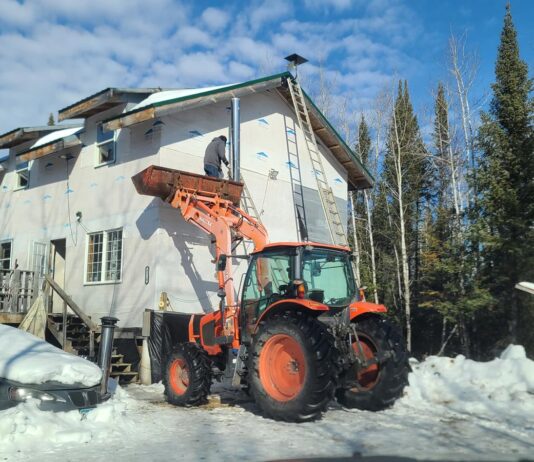
Yes, you can. But it would be a great idea if you picked up a good, inexpensive tractor with a loader. This is what my son, Bill, used when he built his big log home. He used it to lift the heavy logs up into place safely. When he had his house up, he sold the tractor for what he’d paid for it. Or if you are going to do farming, keep the tractor to use around the homestead. It saves your back a whole lot! Do be aware that building with logs is hard, heavy work. Read Dorothy Ainsworth’s articles on how she built not only a large log home (twice!), but other buildings out of log on her homestead, as a single, working woman. You might want to consider what kind of living arrangements you need while you are building. My son built a two car, stick-built garage. He lived in one side, in an apartment, while building his house; it took nearly 5 years before he and his wife moved into the new house. We hauled in an old mobile home to live in while we built. The trick is to know you will be building for awhile, and to pace yourself, living reasonably comfortably while you build. The rest of the homestead stuff is a piece of cake for a single mom!
Remember to check building codes where you plan on building; it greatly impacts your choices. In some areas, you must have a building inspector for each step. Some areas do not let you live in a garage while building, some require you finish within a certain length of time, etc. Check before you begin to build. Please let us know how you are coming! — Jackie
Growing potatoes with tomatoes
This is my first year for growing potatoes. I put them in a tub with holes in the bottom. Then I planted tomatoes on the sides and let them hang over the edge. I had run out of room to plant the tomatoes. All of a sudden the potatoes plants died. I know I have potatoes in there but should I leave them until the tomatoes are done or work them out gentle so they don’t rot?
Jana Bisgaard
Thornton, Colorado
I think I’d try to work the potatoes out, as by watering the tomatoes you might rot the potatoes, underneath. Let us know how they did. — Jackie
Growing onions
I have been trying to grow onions for a while now and they never seem to grow or get bigger than a bulb in size. I have been told that even though they are supposed to be the big white and yellow and purple ones that they don’t get big? That one stumps me. What do you think I am doing wrong? Is it the seed I am trying to use or? Shallots grow fine.
Robert Duke
Poplarville, Mississippi
If your shallots are doing fine, it shows that you don’t lack for water, soil fertility, or weeding. It may be the variety of seed you are using. Be sure to use short-day varieties. If you are using long-day requirement varieties, such as Walla Walla, they won’t do much in Mississippi. You might also have better luck growing onions from sets if plants aren’t working for you. If the plants are set out when quite little, sometimes they just seem to sit there when hot weather comes. — Jackie
Water hydrant
Thank you for taking time out of your hectic life to answer questions, I know from reading your blog you are one busy person. Well here goes, we have an outdoor one armed water hydrant like the one that you have posted on your blog and we have a dilly of a time getting it started when the hydrant has not been in use. It is connected to a buried water line that was t’d off of the main line that is going into our basement and is fed from spring on the back of our property. Inside works great but outside is not working. Any suggestions? Our hydrant is a frost free also I believe.
Michelle
Fresno, Ohio
If the handle raises the rod, I’d guess that maybe you have got sediment built up in the valve that drains/opens the water line. You could probably back-flush the hydrant by attaching a hose with an added female end onto the hydrant faucet, raising the handle, then running water from the house to the hydrant. Or maybe attaching a hose to pipe fitting, then building a fitting to receive an air valve and flushing it with an air compressor. To keep it running, try opening it a couple times a month, whether or not you need it. — Jackie
Posted in Building, Gardening, Self-sufficiency | 5 Comments »
Jackie Clay
Monday, August 22nd, 2011
Quarantining chickens
We’re home from our first showing at the county fair. My children brought 6 chickens to show for 4-H. I see you quarantine your chickens for 3 weeks after fair. What do you look for before putting them back in your flock?
Jeanette Mellesmo
Embarrass, Minnesota
I just make sure that they appear healthy: no snuffly noses, no diarrhea, etc. It’s usually no big deal, but we just like to be extra safe following stress and being around other birds — Jackie
PVC hoop house
How do you bend your PVC pipe to make your hoop houses? This is something I really want to do. I’ve looked at Hoop Benders but they seem to be for conduit pipe, not PVC pipe.
Alice Clapper
New Castle, Pennsylvania
PVC is very flexible and it bends very easily by hand, with no strain or pain. No hoop bender is necessary. — Jackie
Building codes
We deal with building codes here. Do you have county building codes where you are or do they leave you alone.
Amanda Modin
Bend, Oregon
Fortunately, we don’t have building codes way out in the woods. I’m sure some other areas, not so far from us DO have building codes/inspections. But so far, for us, we have to have a land use permit for any construction, septic or addition, but no inspections (other than the septic). — Jackie
Posted in Animals, Building, Gardening, Self-sufficiency | 1 Comment »
Jackie Clay
Tuesday, August 16th, 2011
Our neighbor, Jerry Yourceck, called Will two days ago and asked if he’d go with him to the livestock sale barn to help haul cattle. (Jerry is in his eighties and I think he likes Will to go along in case they have a flat tire…which they did!) They loaded some cattle and took off for the 150-mile trip. One flat tire later, they arrived kind of late at the sale barn. While Jerry checked the cattle he’d hauled in, Will went in, got a bidding number, and sat down at the ring. We had wanted to buy another bottle calf or two, but the dairy we usually had bought calves from didn’t have any bull calves this summer — only heifers. I thought maybe he’d come home with a calf. He called an hour later; he’d bought five. FIVE! Holy smoke. Where would we put them? I scrambled around while they drove home and moved our older calves and a few goats. Yep, I guess we could fit them in.

I like the calves in smaller bunches or in single pens so I can keep track of their poop. Scours is the number one killer of baby calves — especially calves from the sale barn.
Will had gotten great deals on those calves. Too good to pass up, I’ll admit. So now we’re bottle-feeding five babies. I do love those calves! One is a real small little Holstein and is too cute. I’m feeding him real cow milk from Lace, so he’ll catch up with his sort-of siblings. Those guys have to have powdered milk replacer because I want some milk too!
I just made a soft white cheese and used it to replace the cream cheese in Will’s cheesecake. (Jackie Clay’s Pantry Cookbook, page 182) It turned out perfect. No more paying $1.49 (on sale!) for cream cheese. One more step toward self-reliance! I’m making butter today. Mmm.

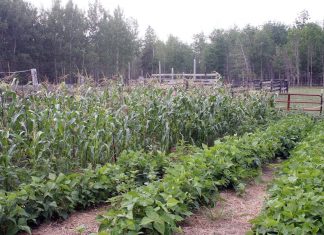
Oh, by the way, the garden’s doing excellent! I’ll never be without a hoop house for peppers (and melons next year!). I’ve never even seen such big peppers! NEVER. And they’re grown right here, not in Mexico. I’m talking about huge peppers and lots of them. Wow! The corn’s making nice ears, the cabbage is setting big heads, and I’ll be canning the second batch of green beans this afternoon. The potatoes were in a little late and are just thinking about blooming. But that’s fine, as we should have another 6 weeks or more of growing season. The carrots and onions suffered from the weeds, so we’ll see how they do. We’ll have enough, but not a huge crop, this year. But that’s the way things go.

Will’s been working steadily on the new barn, flat-siding the floor joists for the hayloft and peeling each one. As they were winter-cut, the bark is tough to peel, but he’s getting it done. The barn won’t be done by winter, but it’s going to be well started. (Due to vehicle breakdowns, which were expensive, we don’t have the cash for the dimension lumber for the trusses and rafters yet.) But we know it’ll get done and it’ll be a great addition to the homestead. We’re in no hurry and want to do it right. — Jackie
Posted in Animals, Building, Cooking/Recipes, Food Preservation, Gardening, Meat, Self-sufficiency | 4 Comments »
Jackie Clay
Thursday, August 11th, 2011
Making tomato sauces
About a year ago I asked a question on how to keep tomato sauce from separating after cooking down and canning. Since then I’ve tried a couple experiments that have greatly improved my sauce that I thought I’d share with you.
To boil the sauce down I took your idea of the roasting pan and used a table top electric version. It holds three times more than most any other pot and will go for hours without burning the sauce. I just have to check the water in the bottom of the roaster every few hours to keep it from going dry. Second is the use of an immersion blender. When the sauce is pretty close to the consistency you want you use the immersion blender and blend it half to death to break up the tomato “meat” clumps. Blend till super smooth and finish the thickening process.
Lastly, to cut the sharp acid tartness of it without sugar is to use lemon juice. Fresh is better than bottled “lemon” juice. I haven’t worked out a tried and true ratio yet, but it mellows the sauce and doesn’t leave a lemony taste behind. Sugar can still be added to add sweetness though.
Dion Fotinakes
Orangeville, Illinois
Thanks for your tips, Dion! I’m sure readers will appreciate it as I do! Tomato season is upon us! — Jackie
Hoop house
You have mentioned your hoop house several times and I was wondering if you purchased a kit and if so, from what company? Do you have the house covered on the ends, also? What materials did you use for the covering and also for the bent hoops? I am hoping to use one next year and could use some advice.
Deborah Motylinski
Brecksville, Ohio
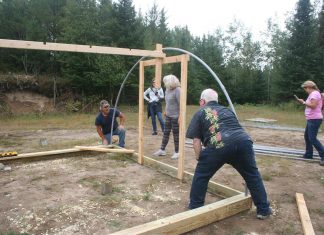
Keep watch for the Sept/Oct 2011 issue, which should be in your mailbox soon. I wrote an article not only on our hoop house, but other temporary greenhouses I have and use. No it was not a kit. Our stuff is pretty much home built, on the cheap! We used a piece of 6 mil plastic we had leftover from another project and 3/4″ PVC pipe (1″ would be stronger in the wind). In the article, you’ll see construction (which took an afternoon and was easy) and other hoop house/temporary greenhouse ideas. — Jackie
Posted in Building, Food Preservation, Gardening, Self-sufficiency | No Comments »
|
|
Have questions regarding this Blog? Please email us. Comments may appear online in "Feedback" or in the "Letters" section of Backwoods Home Magazine. We read every email you send us, but due to the sheer volume of mail we receive, we can't respond to each one.

|
|

|
|

(PDF 3.33 MB)
(PDF 213 KB)

| |